
Realme GT8 (China) vs Xiaomi Redmi K60 Pro: A Deep Dive into Snapdragon Supremacy
| Phones Images | |||||
|---|---|---|---|---|---|
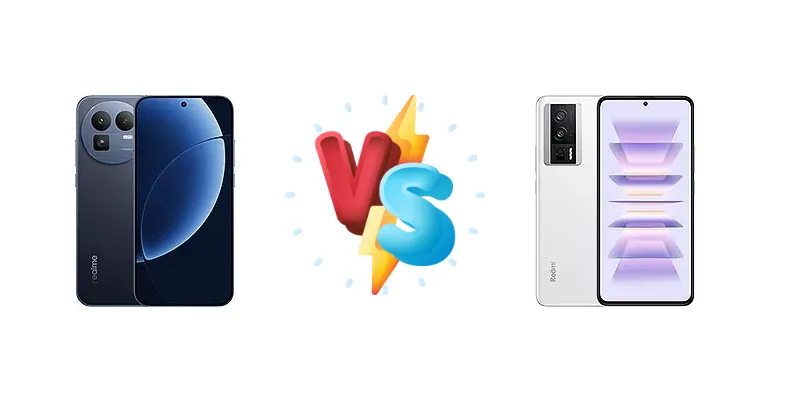
|
🏆 Quick Verdict
For the average user prioritizing all-around performance and battery life, the Xiaomi Redmi K60 Pro emerges as the winner. Its 4nm Snapdragon 8 Gen 2 offers a compelling balance of power and efficiency, coupled with faster charging and wireless charging capabilities, making it a more practical daily driver.
| PHONES | ||
|---|---|---|
| Phone Names | Realme GT8 (China) | Xiaomi Redmi K60 Pro |
| Network | ||
|---|---|---|
| 2G bands | GSM 850 / 900 / 1800 / 1900 | GSM 850 / 900 / 1800 / 1900 |
| 3G bands | HSDPA 800 / 850 / 900 / 1700(AWS) / 1900 / 2100 | HSDPA 800 / 850 / 900 / 1700(AWS) / 2100 |
| 4G bands | 1, 3, 4, 5, 8, 18, 19, 20, 26, 28, 34, 38, 39, 40, 41, 42, 48, 66 | 1, 3, 4, 5, 8, 18, 19, 26, 34, 38, 39, 40, 41, 42 |
| 5G bands | 1, 3, 5, 8, 18, 20, 26, 28, 38, 40, 41, 48, 66, 77, 78 SA/NSA | 1, 3, 5, 8, 28, 38, 41, 77, 78 SA/NSA |
| Speed | HSPA, LTE, 5G | HSPA, LTE, 5G |
| Technology | GSM / HSPA / LTE / 5G | GSM / CDMA / HSPA / CDMA2000 / LTE / 5G |
| - | CDMA2000 1x | |
| Launch | ||
|---|---|---|
| Announced | 2025, October 21 | 2022, December 27 |
| Status | Available. Released 2025, October 21 | Available. Released 2023, January 01 |
| Body | ||
|---|---|---|
| Build | Glass front, aluminum frame, fiber-reinforced plastic back or silicone polymer (eco leather) back | - |
| Dimensions | 161.8 x 76.9 x 8.2 mm (6.37 x 3.03 x 0.32 in) | 162.8 x 75.4 x 8.6 mm or 8.9 mm |
| SIM | Nano-SIM + Nano-SIM | Nano-SIM + Nano-SIM |
| Weight | 209 g or 214 g (7.37 oz) | 201 g or 205 g (7.09 oz) |
| Display | ||
|---|---|---|
| Resolution | 1440 x 3136 pixels, 19.5:9 ratio (~508 ppi density) | 1440 x 3200 pixels, 20:9 ratio (~526 ppi density) |
| Size | 6.79 inches, 112.8 cm2 (~90.7% screen-to-body ratio) | 6.67 inches, 107.4 cm2 (~87.5% screen-to-body ratio) |
| Type | AMOLED, 144Hz, HDR, 1000 nits (typ), 2000 nits (HBM), 7000 nits (peak) | OLED, 68B colors, 120Hz, Dolby Vision, HDR10+, 1400 nits (peak) |
| Platform | ||
|---|---|---|
| CPU | Octa-core (2x4.32 GHz Oryon V2 Phoenix L + 6x3.53 GHz Oryon V2 Phoenix M) | Octa-core (1x3.2 GHz Cortex-X3 & 2x2.8 GHz Cortex-A715 & 2x2.8 GHz Cortex-A710 & 3x2.0 GHz Cortex-A510) |
| Chipset | Qualcomm SM8750-AB Snapdragon 8 Elite (3 nm) | Qualcomm SM8550-AB Snapdragon 8 Gen 2 (4 nm) |
| GPU | Adreno 830 | Adreno 740 |
| OS | Android 16, up to 4 major Android upgrades, Realme UI 7.0 | Android 13, MIUI 14 |
| Memory | ||
|---|---|---|
| Card slot | No | No |
| Internal | 256GB 12GB RAM, 256GB 16GB RAM, 512GB 16GB RAM, 1TB 16GB RAM | 128GB 8GB RAM, 256GB 8GB RAM, 256GB 12GB RAM, 512GB 12GB RAM, 512GB 16GB RAM |
| - | UFS 4.0 UFS 3.1 - 128GB only | |
| Main Camera | ||
|---|---|---|
| Features | Ricoh lens, Color spectrum sensor, LED flash, HDR, panorama | Color spectrum sensor, Dual-LED dual-tone flash, HDR, panorama |
| Triple | 50 MP, f/1.8, 22mm (wide), 1/1.56", 1.0µm, multi-directional PDAF, OIS 50 MP, f/2.8, 80mm, (periscope telephoto), PDAF, OIS, 3.5x optical zoom 8 MP, f/2.2, 16mm, 112˚ (ultrawide), 1/4.0", 1.12µm | 54 MP, f/1.9, (wide), 1/1.49", 1.0µm, PDAF, OIS 8 MP, 118˚ (ultrawide), 1/4.0", 1.12µm 2 MP (macro) |
| Video | 8K@30fps, 4K@30/60/120fps, 1080p@30/60/120/240fps, gyro-EIS, HDR | 8K@24fps, 4K@30/60fps, 1080p@30/60/120/240/960fps, 720p@1920fps, gyro-EIS |
| Selfie camera | ||
|---|---|---|
| Features | Panorama | HDR |
| Single | 16 MP, f/2.4, 23mm (wide), 1/3.09", 1.0µm | 16 MP, (wide), 1/3.06", 1.0µm |
| Video | Yes | 1080p@30/60/120fps |
| Sound | ||
|---|---|---|
| 3.5mm jack | - | No |
| 35mm jack | No | No |
| Loudspeaker | Yes, with stereo speakers | Yes, with stereo speakers |
| - | 24-bit/192kHz audio | |
| Comms | ||
|---|---|---|
| Bluetooth | 6.0, A2DP, LE, aptX HD, LHDC 5 | 5.3, A2DP, LE |
| Infrared port | Yes | Yes |
| NFC | Yes | Yes |
| Positioning | GPS (L1+L5), BDS (B1I+B1c+B2a), GALILEO (E1+E5a), QZSS (L1+L5), GLONASS | GPS (L1+L5), GLONASS (G1), BDS (B1I+B2a+Bc), GALILEO (E1+E5a), QZSS (L1+L5), NavIC |
| Radio | No | Unspecified |
| USB | USB Type-C, OTG | USB Type-C 2.0, OTG |
| WLAN | Wi-Fi 802.11 a/b/g/n/ac/6/7, dual-band | Wi-Fi 802.11 a/b/g/n/ac/6e, dual-band, Wi-Fi Direct |
| Features | ||
|---|---|---|
| Sensors | Fingerprint (under display, ultrasonic), accelerometer, gyro, proximity, compass | Fingerprint (under display, optical), accelerometer, gyro, proximity, compass |
| Battery | ||
|---|---|---|
| Charging | 100W wired, 14.4W PD, 45 min to 100% | 120W wired, PD3.0, QC3+, 100% in 19 min 30W wireless |
| Type | Si/C Li-Ion 7000 mAh | Li-Po 5000 mAh |
| Misc | ||
|---|---|---|
| Colors | Blue, Green, White | Black, White, Mint, Champion Black |
| Models | - | 22127RK46C |
| Price | About 350 EUR | About 460 EUR |
Realme GT8 (China)
- Potentially higher peak CPU performance with Snapdragon 8 Elite
- Cutting-edge 3nm process technology
- Faster wired charging than many competitors (100W)
- Less efficient chipset potentially leading to shorter battery life
- Slower charging compared to Redmi K60 Pro
- No wireless charging
Xiaomi Redmi K60 Pro
- Excellent balance of performance and efficiency with Snapdragon 8 Gen 2
- Faster 120W wired charging and 30W wireless charging
- Mature chipset with optimized thermal management
- Built on a slightly older 4nm process
- Potentially lower peak CPU performance compared to GT8
- May rely heavily on software optimization for camera performance
Display Comparison
While display specs aren't provided, both phones likely feature high refresh rate AMOLED panels. However, the chipset choice impacts display capabilities. The Snapdragon 8 Elite's superior processing power could enable more advanced display features like higher refresh rate support or more sophisticated image processing for improved color accuracy. The Redmi K60 Pro, benefiting from the Snapdragon 8 Gen 2's ISP, will likely excel in dynamic range and color calibration. Bezels are expected to be minimal on both, typical of flagship devices.
Camera Comparison
Camera details are absent, but we can infer based on brand tendencies. Xiaomi typically prioritizes larger sensors and computational photography, suggesting the K60 Pro will likely have a more versatile camera system. The Snapdragon 8 Gen 2’s ISP is a significant advantage, enabling advanced features like 8K video recording and improved low-light performance. The GT8, while potentially capable, might rely more on raw processing power. Without sensor size or aperture information, it’s difficult to definitively declare a winner, but the K60 Pro’s likely focus on image processing gives it an edge.
Performance
The core of this comparison lies in the chipsets. The Realme GT8’s Snapdragon 8 Elite, built on a 3nm process, theoretically offers higher transistor density and improved efficiency compared to the Redmi K60 Pro’s 4nm Snapdragon 8 Gen 2. The GT8’s Oryon V2 Phoenix CPU architecture (2x4.32 GHz + 6x3.53 GHz) suggests a focus on peak performance, potentially exceeding the K60 Pro’s (1x3.2 GHz Cortex-X3, 2x2.8 GHz Cortex-A715, 2x2.8 GHz Cortex-A710, 3x2.0 GHz Cortex-A510) in single-core tasks. However, the Snapdragon 8 Gen 2’s more mature architecture and 4nm process could translate to better sustained performance and thermal management under prolonged load. The K60 Pro's LPDDR5x RAM will contribute to faster data access, complementing the chipset's capabilities.
Battery Life
The Redmi K60 Pro’s 120W wired charging and 30W wireless charging significantly outperform the Realme GT8’s 100W wired and 14.4W PD charging. The K60 Pro promises a full charge in just 19 minutes, while the GT8 takes 45 minutes. This difference is substantial for users who value quick top-ups. While battery capacity isn't specified, the Snapdragon 8 Gen 2’s superior efficiency likely allows the K60 Pro to achieve comparable or better battery life despite potentially having a similar or smaller battery size.
Buying Guide
Buy the Realme GT8 (China) if you absolutely need the latest silicon and are willing to trade some battery life and charging convenience for potentially peak performance in short bursts. Buy the Xiaomi Redmi K60 Pro if you prioritize sustained performance, excellent battery life, faster and more versatile charging options (including wireless), and a more well-rounded flagship experience.