
Realme GT8 (China) vs Xiaomi 13T: A Deep Dive into Performance, Battery, and Display
| Phones Images | |||||
|---|---|---|---|---|---|
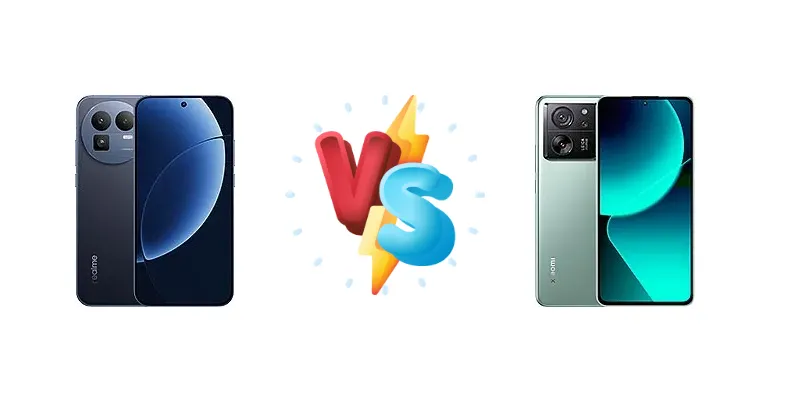
|
🏆 Quick Verdict
For users prioritizing raw processing power and gaming performance, the Realme GT8 (China) is the clear winner thanks to its Snapdragon 8 Elite. However, the Xiaomi 13T delivers a more balanced package with significantly longer battery life and a brighter display, making it the better choice for everyday users.
| PHONES | ||
|---|---|---|
| Phone Names | Realme GT8 (China) | Xiaomi 13T |
| Network | ||
|---|---|---|
| 2G bands | GSM 850 / 900 / 1800 / 1900 | GSM 850 / 900 / 1800 / 1900 |
| 3G bands | HSDPA 800 / 850 / 900 / 1700(AWS) / 1900 / 2100 | HSDPA 800 / 850 / 900 / 1700(AWS) / 1900 / 2100 |
| 4G bands | 1, 3, 4, 5, 8, 18, 19, 20, 26, 28, 34, 38, 39, 40, 41, 42, 48, 66 | 1, 2, 3, 4, 5, 7, 8, 12, 13, 17, 18, 19, 20, 26, 28, 32, 38, 40, 41, 66 |
| 5G bands | 1, 3, 5, 8, 18, 20, 26, 28, 38, 40, 41, 48, 66, 77, 78 SA/NSA | 1, 3, 5, 7, 8, 20, 28, 38, 40, 41, 66, 77, 78 SA/NSA |
| Speed | HSPA, LTE, 5G | HSPA, LTE, 5G |
| Technology | GSM / HSPA / LTE / 5G | GSM / HSPA / LTE / 5G |
| Launch | ||
|---|---|---|
| Announced | 2025, October 21 | 2023, September 26 |
| Status | Available. Released 2025, October 21 | Available. Released 2023, September 26 |
| Body | ||
|---|---|---|
| Build | Glass front, aluminum frame, fiber-reinforced plastic back or silicone polymer (eco leather) back | Glass front (Gorilla Glass 5), glass back or silicone polymer back, plastic frame |
| Dimensions | 161.8 x 76.9 x 8.2 mm (6.37 x 3.03 x 0.32 in) | 162.2 x 75.7 x 8.5 mm (6.39 x 2.98 x 0.33 in) |
| SIM | Nano-SIM + Nano-SIM | · Nano-SIM + eSIM· Nano-SIM + Nano-SIM |
| Weight | 209 g or 214 g (7.37 oz) | 193 g or 197 g (6.81 oz) |
| Display | ||
|---|---|---|
| Protection | - | Corning Gorilla Glass 5 |
| Resolution | 1440 x 3136 pixels, 19.5:9 ratio (~508 ppi density) | 1220 x 2712 pixels, 20:9 ratio (~446 ppi density) |
| Size | 6.79 inches, 112.8 cm2 (~90.7% screen-to-body ratio) | 6.67 inches, 107.4 cm2 (~87.5% screen-to-body ratio) |
| Type | AMOLED, 144Hz, HDR, 1000 nits (typ), 2000 nits (HBM), 7000 nits (peak) | AMOLED, 68B colors, 144Hz, Dolby Vision, HDR10+, 1200 nits (HBM), 2600 nits (peak) |
| Platform | ||
|---|---|---|
| CPU | Octa-core (2x4.32 GHz Oryon V2 Phoenix L + 6x3.53 GHz Oryon V2 Phoenix M) | Octa-core (1x3.1 GHz Cortex-A78 & 3x3.0 GHz Cortex-A78 & 4x2.0 GHz Cortex-A55) |
| Chipset | Qualcomm SM8750-AB Snapdragon 8 Elite (3 nm) | Mediatek Dimensity 8200 Ultra (4 nm) |
| GPU | Adreno 830 | Mali-G610 MC6 |
| OS | Android 16, up to 4 major Android upgrades, Realme UI 7.0 | Android 13, up to 4 major Android upgrades, HyperOS |
| Memory | ||
|---|---|---|
| Card slot | No | No |
| Internal | 256GB 12GB RAM, 256GB 16GB RAM, 512GB 16GB RAM, 1TB 16GB RAM | 256GB 8GB RAM, 256GB 12GB RAM |
| Main Camera | ||
|---|---|---|
| Features | Ricoh lens, Color spectrum sensor, LED flash, HDR, panorama | Leica lens, color spectrum sensor, LED flash, HDR, panorama |
| Triple | 50 MP, f/1.8, 22mm (wide), 1/1.56", 1.0µm, multi-directional PDAF, OIS 50 MP, f/2.8, 80mm, (periscope telephoto), PDAF, OIS, 3.5x optical zoom 8 MP, f/2.2, 16mm, 112˚ (ultrawide), 1/4.0", 1.12µm | 50 MP, f/1.9, 24mm (wide), 1/1.28", 1.22µm, PDAF, OIS 50 MP, f/1.9, 50mm (telephoto), 1/2.88", 0.61µm, PDAF, 2x optical zoom 12 MP, f/2.2, 15mm (ultrawide), 1/3.06", 1.12µm |
| Video | 8K@30fps, 4K@30/60/120fps, 1080p@30/60/120/240fps, gyro-EIS, HDR | 4K@30fps (HDR10+), 1080p@30/60/120fps, gyro-EIS |
| Selfie camera | ||
|---|---|---|
| Features | Panorama | HDR |
| Single | 16 MP, f/2.4, 23mm (wide), 1/3.09", 1.0µm | 20 MP, f/2.2, (wide), 0.8µm |
| Video | Yes | 1080p@30fps, HDR10+ |
| Sound | ||
|---|---|---|
| 35mm jack | No | No |
| Loudspeaker | Yes, with stereo speakers | Yes, with stereo speakers |
| Comms | ||
|---|---|---|
| Bluetooth | 6.0, A2DP, LE, aptX HD, LHDC 5 | 5.4, A2DP, LE |
| Infrared port | Yes | Yes |
| NFC | Yes | Yes (market/region dependent) |
| Positioning | GPS (L1+L5), BDS (B1I+B1c+B2a), GALILEO (E1+E5a), QZSS (L1+L5), GLONASS | GPS (L1+L5), GLONASS (G1), GALILEO (E1+E5a), QZSS (L1+L5), NavIC (L5), BDS |
| Radio | No | No |
| USB | USB Type-C, OTG | USB Type-C 2.0, OTG |
| WLAN | Wi-Fi 802.11 a/b/g/n/ac/6/7, dual-band | Wi-Fi 802.11 a/b/g/n/ac/6, dual-band |
| Features | ||
|---|---|---|
| Sensors | Fingerprint (under display, ultrasonic), accelerometer, gyro, proximity, compass | Fingerprint (under display, optical), accelerometer, gyro, proximity, compass |
| Battery | ||
|---|---|---|
| Charging | 100W wired, 14.4W PD, 45 min to 100% | 67W wired, PD3.0, QC4, 100% in 42 min |
| Type | Si/C Li-Ion 7000 mAh | Li-Po 5000 mAh |
| Misc | ||
|---|---|---|
| Colors | Blue, Green, White | Alpine Blue, Meadow Green, Black |
| Models | - | 2306EPN60G |
| Price | About 350 EUR | $ 255.96 / £ 326.27 / € 204.18 |
| SAR EU | - | 0.99 W/kg (head) 0.99 W/kg (body) |
Realme GT8 (China)
- Unmatched processing power with Snapdragon 8 Elite
- Faster charging speeds (100W)
- Potentially better thermal management due to 3nm process
- Battery life likely to be shorter than Xiaomi 13T
- Camera specifications unknown
- Limited availability (China only)
Xiaomi 13T
- Excellent battery life (12:23h active use)
- Brighter display (1264 nits)
- Competitive charging speed (67W)
- Less powerful chipset compared to Snapdragon 8 Elite
- May experience throttling under sustained heavy load
- Camera details are vague
Display Comparison
The Xiaomi 13T boasts a significantly brighter display, reaching a measured 1264 nits, which translates to superior visibility in direct sunlight. While the Realme GT8’s display specifications are not provided, the 13T’s brightness advantage is substantial. The 13T also likely benefits from modern panel technology, though details like LTPO are missing. Bezels are expected to be comparable, given both phones target a similar price bracket. Color accuracy is unknown for both, but Xiaomi typically delivers well-calibrated displays.
Camera Comparison
Camera details are limited for both devices. The Xiaomi 13T is described as having 'Photo / Video' capabilities, suggesting a versatile camera system. Without sensor size or aperture information, it’s difficult to make a direct comparison. The Realme GT8’s camera specs are entirely absent, making it impossible to assess its photographic capabilities. We can assume both phones will include a standard suite of lenses, but the quality of image processing and low-light performance will be key differentiators. Ignoring typical 2MP macro lenses, the main sensor and its accompanying optics will be the deciding factor.
Performance
The core difference lies in the chipsets. The Realme GT8’s Snapdragon 8 Elite (3nm) utilizes Oryon V2 Phoenix cores, promising a substantial performance leap over the Xiaomi 13T’s Mediatek Dimensity 8200 Ultra (4nm). The Snapdragon’s 2x4.32 GHz Oryon V2 Phoenix L cores will deliver significantly higher single-core performance, crucial for responsive UI and app loading. The Dimensity 8200 Ultra, while still powerful, relies on older Cortex-A78 cores. The 3nm process of the Snapdragon 8 Elite also offers superior thermal efficiency, potentially leading to less throttling during sustained workloads. The GT8 is expected to excel in GPU-intensive tasks, though RAM speed (LPDDR5x is likely on both) will play a secondary role.
Battery Life
The Xiaomi 13T shines in battery performance, achieving an active use score of 12:23h and an endurance rating of 101h. This indicates excellent power efficiency. The Realme GT8’s battery capacity is unknown, but its more powerful chipset is likely to consume more energy. The 13T’s 67W wired charging, with a full charge in 42 minutes, is competitive, but the GT8’s 100W charging offers a faster 45-minute 0-100% charge. However, the 13T’s superior battery life may negate the need for ultra-fast charging for many users.
Buying Guide
Buy the Realme GT8 (China) if you absolutely need the fastest possible Android performance for demanding games and applications, and are willing to compromise on battery life. Buy the Xiaomi 13T if you prioritize all-day battery life, a vibrant display for media consumption, and a more consistently smooth experience across a wider range of tasks, even if it means sacrificing some peak performance.