
Realme GT8 (China) vs Xiaomi 13 Pro: A Deep Dive into Flagship Android Power
| Phones Images | |||||
|---|---|---|---|---|---|
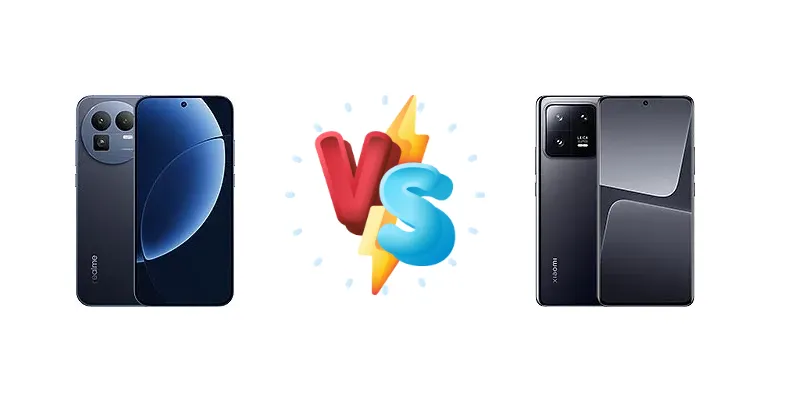
|
🏆 Quick Verdict
For the average user prioritizing all-around excellence, the Xiaomi 13 Pro emerges as the winner. Its refined software, excellent camera system, and robust battery life (10:55h active use) provide a more complete package. However, the Realme GT8’s Snapdragon 8 Elite offers a glimpse into future performance, appealing to power users and gamers.
| PHONES | ||
|---|---|---|
| Phone Names | Realme GT8 (China) | Xiaomi 13 Pro |
| Network | ||
|---|---|---|
| 2G bands | GSM 850 / 900 / 1800 / 1900 | GSM 850 / 900 / 1800 / 1900 |
| 3G bands | HSDPA 800 / 850 / 900 / 1700(AWS) / 1900 / 2100 | HSDPA 800 / 850 / 900 / 1700(AWS) / 1900 / 2100 |
| 4G bands | 1, 3, 4, 5, 8, 18, 19, 20, 26, 28, 34, 38, 39, 40, 41, 42, 48, 66 | 1, 2, 3, 4, 5, 7, 8, 12, 13, 17, 18, 19, 20, 25, 26, 28, 32, 38, 39, 40, 41, 42, 48, 66 - International |
| 5G bands | 1, 3, 5, 8, 18, 20, 26, 28, 38, 40, 41, 48, 66, 77, 78 SA/NSA | 1, 3, 5, 7, 8, 20, 28, 38, 40, 41, 66, 71, 75, 77, 78 SA/NSA - International |
| Speed | HSPA, LTE, 5G | HSPA, LTE, 5G |
| Technology | GSM / HSPA / LTE / 5G | GSM / CDMA / HSPA / CDMA2000 / LTE / 5G |
| - | 1, 3, 5, 8, 28, 38, 40, 41, 77, 78, 79 SA/NSA - China | |
| Launch | ||
|---|---|---|
| Announced | 2025, October 21 | 2022, December 11 |
| Status | Available. Released 2025, October 21 | Available. Released 2022, December 14 |
| Body | ||
|---|---|---|
| Build | Glass front, aluminum frame, fiber-reinforced plastic back or silicone polymer (eco leather) back | Glass front (Gorilla Glass Victus), ceramic back or silicone polymer back, aluminum frame |
| Dimensions | 161.8 x 76.9 x 8.2 mm (6.37 x 3.03 x 0.32 in) | 162.9 x 74.6 x 8.4 mm or 8.7 mm |
| SIM | Nano-SIM + Nano-SIM | · Nano-SIM + eSIM· Nano-SIM + Nano-SIM |
| Weight | 209 g or 214 g (7.37 oz) | 210 g or 229 g (7.41 oz) |
| - | IP68 dust/water resistant (up to 1.5m for 30 min) | |
| Display | ||
|---|---|---|
| Protection | - | Corning Gorilla Glass Victus |
| Resolution | 1440 x 3136 pixels, 19.5:9 ratio (~508 ppi density) | 1440 x 3200 pixels, 20:9 ratio (~522 ppi density) |
| Size | 6.79 inches, 112.8 cm2 (~90.7% screen-to-body ratio) | 6.73 inches, 108.9 cm2 (~89.6% screen-to-body ratio) |
| Type | AMOLED, 144Hz, HDR, 1000 nits (typ), 2000 nits (HBM), 7000 nits (peak) | LTPO AMOLED, 1B colors, 120Hz, Dolby Vision, HDR10+, 1200 nits (HBM), 1900 nits (peak) |
| Platform | ||
|---|---|---|
| CPU | Octa-core (2x4.32 GHz Oryon V2 Phoenix L + 6x3.53 GHz Oryon V2 Phoenix M) | Octa-core (1x3.2 GHz Cortex-X3 & 2x2.8 GHz Cortex-A715 & 2x2.8 GHz Cortex-A710 & 3x2.0 GHz Cortex-A510) |
| Chipset | Qualcomm SM8750-AB Snapdragon 8 Elite (3 nm) | Qualcomm SM8550-AB Snapdragon 8 Gen 2 (4 nm) |
| GPU | Adreno 830 | Adreno 740 |
| OS | Android 16, up to 4 major Android upgrades, Realme UI 7.0 | Android 13, upgradable to Android 14, HyperOS |
| Memory | ||
|---|---|---|
| Card slot | No | No |
| Internal | 256GB 12GB RAM, 256GB 16GB RAM, 512GB 16GB RAM, 1TB 16GB RAM | 128GB 8GB RAM, 256GB 8GB RAM, 256GB 12GB RAM, 512GB 12GB RAM |
| - | UFS 3.1 - 128GB UFS 4.0 - 256/512GB | |
| Main Camera | ||
|---|---|---|
| Features | Ricoh lens, Color spectrum sensor, LED flash, HDR, panorama | Laser AF, color spectrum sensor, Leica lens, Dual-LED dual-tone flash, HDR, panorama |
| Triple | 50 MP, f/1.8, 22mm (wide), 1/1.56", 1.0µm, multi-directional PDAF, OIS 50 MP, f/2.8, 80mm, (periscope telephoto), PDAF, OIS, 3.5x optical zoom 8 MP, f/2.2, 16mm, 112˚ (ultrawide), 1/4.0", 1.12µm | 50.3 MP, f/1.9, 23mm (wide), 1.0"-type, 1.6µm, dual pixel PDAF, OIS 50 MP, f/2.0, 75mm (telephoto), PDAF (10cm - ∞), 3.2x optical zoom 50 MP, f/2.2, 14mm, 115˚ (ultrawide), AF |
| Video | 8K@30fps, 4K@30/60/120fps, 1080p@30/60/120/240fps, gyro-EIS, HDR | 8K@24fps (HDR), 4K@24/30/60fps (HDR10+, 10-bit Dolby Vision HDR, 10-bit LOG), 1080p@30/120/240/960fps, 1080p@1920fps, gyro-EIS |
| Selfie camera | ||
|---|---|---|
| Features | Panorama | HDR, panorama |
| Single | 16 MP, f/2.4, 23mm (wide), 1/3.09", 1.0µm | 32 MP, f/2.0, 22mm (wide), 1/3.14", 0.7µm |
| Video | Yes | 1080p@30fps |
| Sound | ||
|---|---|---|
| 3.5mm jack | - | No |
| 35mm jack | No | No |
| Loudspeaker | Yes, with stereo speakers | Yes, with stereo speakers |
| - | 24-bit/192kHz audio | |
| Comms | ||
|---|---|---|
| Bluetooth | 6.0, A2DP, LE, aptX HD, LHDC 5 | 5.3, A2DP, aptX HD, aptX Adaptive |
| Infrared port | Yes | Yes |
| NFC | Yes | Yes |
| Positioning | GPS (L1+L5), BDS (B1I+B1c+B2a), GALILEO (E1+E5a), QZSS (L1+L5), GLONASS | GPS (L1+L5), GLONASS (G1), BDS (B1I+B1c+B2a), GALILEO (E1+E5a), QZSS (L1+L5), NavIC (L5) |
| Radio | No | No |
| USB | USB Type-C, OTG | USB Type-C 2.0, OTG |
| WLAN | Wi-Fi 802.11 a/b/g/n/ac/6/7, dual-band | Wi-Fi 802.11 a/b/g/n/ac/6e, dual-band, Wi-Fi Direct |
| Features | ||
|---|---|---|
| Sensors | Fingerprint (under display, ultrasonic), accelerometer, gyro, proximity, compass | Fingerprint (under display, optical), accelerometer, proximity, gyro, compass, barometer |
| Battery | ||
|---|---|---|
| Charging | 100W wired, 14.4W PD, 45 min to 100% | 120W wired, PD3.0, QC4, 100% in 19 min 50W wireless, 100% in 36 min 10W reverse wireless |
| Type | Si/C Li-Ion 7000 mAh | Li-Po 4820 mAh |
| Misc | ||
|---|---|---|
| Colors | Blue, Green, White | Ceramic White, Ceramic Black, Ceramic Flora Green, Mountain Blue |
| Models | - | 2210132G, 2210132C |
| Price | About 350 EUR | About 750 EUR |
| Tests | ||
|---|---|---|
| Battery life | - | Endurance rating 115h |
| Camera | - | Photo / Video |
| Display | - | Contrast ratio: Infinite (nominal) |
| Loudspeaker | - | -25.6 LUFS (Very good) |
| Performance | - | AnTuTu: 1281666 (v9) GeekBench: 5087 (v5.1), 5323 (v6) GFXBench: 64fps (ES 3.1 onscreen) |
Realme GT8 (China)
- Potentially higher CPU performance due to Snapdragon 8 Elite and Oryon cores.
- Cutting-edge 3nm process for improved efficiency (theoretical).
- Fast 100W wired charging.
- China-exclusive device with potential software and warranty limitations.
- Limited information on camera specifications.
- Slower PD charging compared to Xiaomi 13 Pro.
Xiaomi 13 Pro
- Excellent battery life (10:55h active use).
- Versatile charging options (120W wired, 50W wireless, 10W reverse).
- Globally available with reliable support.
- Snapdragon 8 Gen 2 is a generation behind the 8 Elite.
- May exhibit thermal throttling under sustained heavy load.
- Relatively higher price point.
Display Comparison
The Xiaomi 13 Pro boasts a display capable of reaching 1253 nits of peak brightness, ensuring excellent visibility even in direct sunlight. While the Realme GT8’s display specifications are not provided, Xiaomi’s panel offers an infinite (nominal) contrast ratio, delivering deep blacks and vibrant colors. The absence of PWM frequency data for the GT8 makes it difficult to assess potential flicker-related eye strain compared to the Xiaomi 13 Pro, which likely employs a higher frequency for smoother dimming.
Camera Comparison
Both devices are described as having capable photo/video systems, but detailed sensor information is lacking for the Realme GT8. The Xiaomi 13 Pro likely features a larger main sensor and more sophisticated image processing algorithms, typical of Xiaomi’s flagship offerings. Without specifics on the GT8’s camera hardware, it’s difficult to assess its low-light performance or dynamic range capabilities relative to the Xiaomi 13 Pro. The absence of details on the GT8’s camera suggests Xiaomi holds a clear advantage in this category.
Performance
The core difference lies in the chipsets. The Realme GT8’s Snapdragon 8 Elite (3nm) utilizes Oryon V2 Phoenix cores – a custom design – clocked up to 4.32 GHz, suggesting a focus on raw CPU performance. The Xiaomi 13 Pro’s Snapdragon 8 Gen 2 (4nm) employs a more conventional ARM architecture with a Cortex-X3 prime core at 3.2 GHz. The 3nm process of the 8 Elite *should* offer superior power efficiency, but the Gen 2’s mature architecture and optimized software integration could mitigate this advantage. The GT8’s potential for higher sustained performance will depend heavily on its thermal solution, an area where Xiaomi typically excels.
Battery Life
The Xiaomi 13 Pro demonstrates impressive battery life, achieving an active use score of 10:55h and an endurance rating of 115h. Its charging capabilities are equally noteworthy: 120W wired (19 min to 100%), 50W wireless (36 min), and 10W reverse wireless. The Realme GT8 offers 100W wired charging (45 min to 100%) and slower 14.4W PD charging. While the GT8’s wired charging is fast, the Xiaomi 13 Pro’s broader charging options and superior battery endurance provide greater flexibility and longevity.
Buying Guide
Buy the Realme GT8 (China) if you absolutely need the bleeding edge of mobile processing power and are comfortable with the limitations of a China-exclusive device, potentially including software and warranty concerns. Buy the Xiaomi 13 Pro if you prioritize a polished user experience, a versatile camera system, and reliable global support, even if it means sacrificing the absolute latest chipset.