
Realme GT8 (China) vs. vivo iQOO 11S: A Deep Dive into Snapdragon Power and Charging Innovation
| Phones Images | |||||
|---|---|---|---|---|---|
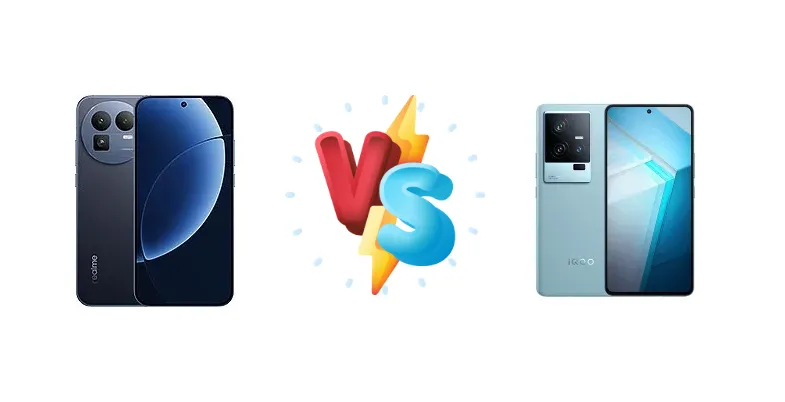
|
🏆 Quick Verdict
For the average user prioritizing raw speed and future-proofing, the vivo iQOO 11S emerges as the winner. Its Snapdragon 8 Gen 2 offers a well-rounded experience with excellent thermal management and widespread software optimization. While the GT8’s 3nm Snapdragon 8 Elite is intriguing, its limited availability and potential software quirks give the iQOO 11S the edge.
| PHONES | ||
|---|---|---|
| Phone Names | Realme GT8 (China) | vivo iQOO 11S |
| Network | ||
|---|---|---|
| 2G bands | GSM 850 / 900 / 1800 / 1900 | GSM 850 / 900 / 1800 / 1900 |
| 3G bands | HSDPA 800 / 850 / 900 / 1700(AWS) / 1900 / 2100 | HSDPA 800 / 850 / 900 / 1700(AWS) / 1900 / 2100 |
| 4G bands | 1, 3, 4, 5, 8, 18, 19, 20, 26, 28, 34, 38, 39, 40, 41, 42, 48, 66 | 1, 2, 3, 4, 5, 7, 8, 12, 17, 18, 19, 20, 26, 28, 34, 38, 39, 40, 41 |
| 5G bands | 1, 3, 5, 8, 18, 20, 26, 28, 38, 40, 41, 48, 66, 77, 78 SA/NSA | 1, 3, 5, 8, 28, 40, 41, 77, 78 SA/NSA |
| Speed | HSPA, LTE, 5G | HSPA, LTE, 5G |
| Technology | GSM / HSPA / LTE / 5G | GSM / CDMA / HSPA / CDMA2000 / LTE / 5G |
| Launch | ||
|---|---|---|
| Announced | 2025, October 21 | 2023, July 04 |
| Status | Available. Released 2025, October 21 | Available. Released 2023, July 10 |
| Body | ||
|---|---|---|
| Build | Glass front, aluminum frame, fiber-reinforced plastic back or silicone polymer (eco leather) back | - |
| Dimensions | 161.8 x 76.9 x 8.2 mm (6.37 x 3.03 x 0.32 in) | 164.9 x 77.1 x 8.4 mm or 8.7 mm |
| SIM | Nano-SIM + Nano-SIM | Nano-SIM + Nano-SIM |
| Weight | 209 g or 214 g (7.37 oz) | 207 g or 210 g (7.30 oz) |
| Display | ||
|---|---|---|
| Protection | - | Corning Gorilla Glass Victus |
| Resolution | 1440 x 3136 pixels, 19.5:9 ratio (~508 ppi density) | 1440 x 3200 pixels, 20:9 ratio (~518 ppi density) |
| Size | 6.79 inches, 112.8 cm2 (~90.7% screen-to-body ratio) | 6.78 inches, 111.0 cm2 (~87.3% screen-to-body ratio) |
| Type | AMOLED, 144Hz, HDR, 1000 nits (typ), 2000 nits (HBM), 7000 nits (peak) | LTPO4 AMOLED, 1B colors, 144Hz, HDR10+, 1800 nits (peak) |
| Platform | ||
|---|---|---|
| CPU | Octa-core (2x4.32 GHz Oryon V2 Phoenix L + 6x3.53 GHz Oryon V2 Phoenix M) | Octa-core (1x3.2 GHz Cortex-X3 & 2x2.8 GHz Cortex-A715 & 2x2.8 GHz Cortex-A710 & 3x2.0 GHz Cortex-A510) |
| Chipset | Qualcomm SM8750-AB Snapdragon 8 Elite (3 nm) | Qualcomm SM8550-AB Snapdragon 8 Gen 2 (4 nm) |
| GPU | Adreno 830 | Adreno 740 |
| OS | Android 16, up to 4 major Android upgrades, Realme UI 7.0 | Android 13, OriginOS 3 (China) |
| Memory | ||
|---|---|---|
| Card slot | No | No |
| Internal | 256GB 12GB RAM, 256GB 16GB RAM, 512GB 16GB RAM, 1TB 16GB RAM | 256GB 12GB RAM, 256GB 16GB RAM, 512GB 16GB RAM, 1TB 16GB RAM |
| Main Camera | ||
|---|---|---|
| Features | Ricoh lens, Color spectrum sensor, LED flash, HDR, panorama | Dual-LED flash, HDR, panorama |
| Triple | 50 MP, f/1.8, 22mm (wide), 1/1.56", 1.0µm, multi-directional PDAF, OIS 50 MP, f/2.8, 80mm, (periscope telephoto), PDAF, OIS, 3.5x optical zoom 8 MP, f/2.2, 16mm, 112˚ (ultrawide), 1/4.0", 1.12µm | 50 MP, f/1.9, 23mm (wide), 1/1.49", 1.0µm, PDAF, OIS 13 MP, f/2.5, 47mm (telephoto), PDAF, 2x optical zoom 8 MP, f/2.2, 16mm (ultrawide) |
| Video | 8K@30fps, 4K@30/60/120fps, 1080p@30/60/120/240fps, gyro-EIS, HDR | 8K@30fps, 4K@30/60fps, 1080p@30/60/120/240fps, gyro-EIS |
| Selfie camera | ||
|---|---|---|
| Features | Panorama | HDR |
| Single | 16 MP, f/2.4, 23mm (wide), 1/3.09", 1.0µm | 16 MP, f/2.5, (wide) |
| Video | Yes | 1080p@30fps, gyro-EIS |
| Sound | ||
|---|---|---|
| 35mm jack | No | No |
| Loudspeaker | Yes, with stereo speakers | Yes, with stereo speakers |
| Comms | ||
|---|---|---|
| Bluetooth | 6.0, A2DP, LE, aptX HD, LHDC 5 | 5.3, A2DP, LE, aptX HD, aptX Adaptive, aptX Lossless |
| Infrared port | Yes | Yes |
| NFC | Yes | Yes |
| Positioning | GPS (L1+L5), BDS (B1I+B1c+B2a), GALILEO (E1+E5a), QZSS (L1+L5), GLONASS | GPS, GLONASS, GALILEO, BDS, NavIC |
| Radio | No | No |
| USB | USB Type-C, OTG | USB Type-C 2.0, OTG |
| WLAN | Wi-Fi 802.11 a/b/g/n/ac/6/7, dual-band | Wi-Fi 802.11 a/b/g/n/ac/6, dual-band, Wi-Fi Direct |
| Features | ||
|---|---|---|
| Sensors | Fingerprint (under display, ultrasonic), accelerometer, gyro, proximity, compass | Fingerprint (under display, optical), accelerometer, gyro, proximity, compass |
| Battery | ||
|---|---|---|
| Charging | 100W wired, 14.4W PD, 45 min to 100% | 200W wired, PD3.0, UFCS |
| Type | Si/C Li-Ion 7000 mAh | 4700 mAh |
| Misc | ||
|---|---|---|
| Colors | Blue, Green, White | Black, Sky Blue, Legendary White (BMW M branding) |
| Models | - | V2304A |
| Price | About 350 EUR | About 500 EUR |
Realme GT8 (China)
- Potentially higher peak CPU performance with Snapdragon 8 Elite.
- Cutting-edge 3nm process technology.
- Faster wired charging than many competitors (100W).
- Limited availability (China exclusive).
- Potential software optimization issues with a new chipset.
- Thermal management could be a concern with the high-performance chip.
vivo iQOO 11S
- Mature Snapdragon 8 Gen 2 platform with excellent optimization.
- Industry-leading 200W wired charging.
- Wider availability and support.
- 4nm process is less efficient than the GT8's 3nm.
- May not achieve the absolute highest CPU scores compared to the GT8.
- Image processing style may not appeal to all users.
Display Comparison
While display specs aren't provided, both phones likely feature high refresh rate AMOLED panels. However, the iQOO 11S benefits from vivo’s history of display calibration and potentially LTPO technology for adaptive refresh rates, improving battery life. The Realme GT8, being a China-exclusive, may prioritize different color profiles catering to regional preferences. Bezels are expected to be minimal on both, but the iQOO 11S’s focus on multimedia consumption suggests a potentially brighter panel.
Camera Comparison
Camera details are absent, but iQOO phones typically prioritize image processing and computational photography. The iQOO 11S likely features a larger main sensor and robust OIS, focusing on delivering consistently high-quality images in various conditions. Realme often emphasizes vibrant, social media-ready images. Without sensor size or aperture information, it’s difficult to definitively declare a winner, but iQOO’s track record suggests a more versatile camera system. The absence of details suggests neither phone will heavily emphasize a telephoto lens.
Performance
The core battleground is the chipset. The Realme GT8’s Snapdragon 8 Elite (3nm) utilizes Oryon V2 Phoenix cores, promising significant IPC gains over traditional Arm designs. However, the Snapdragon 8 Gen 2 (4nm) in the iQOO 11S is a mature platform with extensive optimization. The 4nm process offers excellent thermal efficiency, mitigating throttling during sustained loads. The iQOO 11S’s LPDDR5x RAM complements the Gen 2, ensuring smooth multitasking. While the GT8’s Oryon cores *could* theoretically outperform the Gen 2’s Cortex-X3, real-world performance will depend heavily on software implementation and thermal management. The Snapdragon 8 Gen 2’s Adreno 740 GPU is a known quantity, delivering exceptional gaming performance.
Battery Life
The iQOO 11S’s 200W wired charging is a game-changer, promising a full charge in under 12 minutes. The Realme GT8’s 100W charging is still fast, taking around 45 minutes, but falls significantly behind. The iQOO 11S also supports PD3.0 and UFCS, offering broader compatibility. While battery capacity isn’t specified, the iQOO 11S’s more efficient Snapdragon 8 Gen 2 and potentially adaptive refresh rate display will likely translate to longer real-world battery life, despite the aggressive charging speeds.
Buying Guide
Buy the Realme GT8 (China) if you need the absolute latest in mobile silicon and are comfortable with potential software inconsistencies inherent in early adoption. Its Snapdragon 8 Elite promises peak performance, but requires a willingness to troubleshoot. Buy the vivo iQOO 11S if you prefer a refined, reliable experience with proven performance, incredibly fast 200W charging, and a broader ecosystem of support.