
Realme GT8 (China) vs OnePlus 11R: A Head-to-Head Performance and Value Showdown
| Phones Images | |||||
|---|---|---|---|---|---|
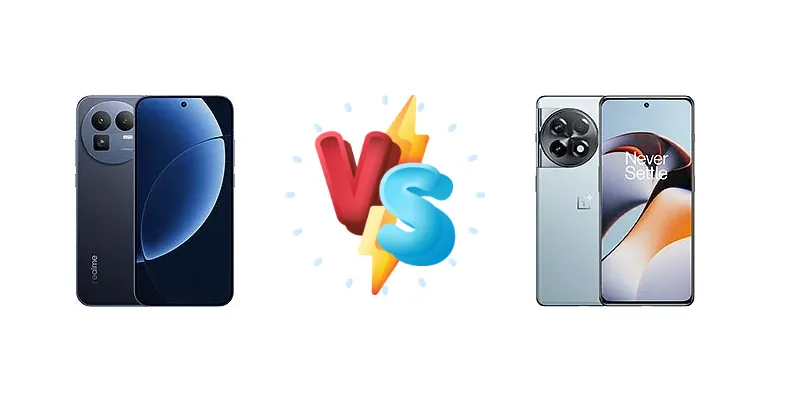
|
🏆 Quick Verdict
For users prioritizing absolute, untamed performance and willing to potentially manage thermal output, the Realme GT8 (China) is the winner. However, the OnePlus 11R offers a more balanced experience with excellent performance, efficient power management, and a proven track record, making it the better choice for most users.
| PHONES | ||
|---|---|---|
| Phone Names | Realme GT8 (China) | OnePlus 11R |
| Network | ||
|---|---|---|
| 2G bands | GSM 850 / 900 / 1800 / 1900 | GSM 850 / 900 / 1800 / 1900 |
| 3G bands | HSDPA 800 / 850 / 900 / 1700(AWS) / 1900 / 2100 | HSDPA 850 / 900 / 1700(AWS) / 2100 |
| 4G bands | 1, 3, 4, 5, 8, 18, 19, 20, 26, 28, 34, 38, 39, 40, 41, 42, 48, 66 | 1, 3, 4, 5, 8, 28, 34, 38, 39, 40, 41 |
| 5G bands | 1, 3, 5, 8, 18, 20, 26, 28, 38, 40, 41, 48, 66, 77, 78 SA/NSA | 1, 3, 5, 8, 28, 40, 41, 77, 78 SA/NSA |
| Speed | HSPA, LTE, 5G | HSPA, LTE (3CA), 5G |
| Technology | GSM / HSPA / LTE / 5G | GSM / CDMA / HSPA / LTE / 5G |
| - | CDMA 800 | |
| Launch | ||
|---|---|---|
| Announced | 2025, October 21 | 2023, February 07 |
| Status | Available. Released 2025, October 21 | Available. Released 2023, February 21 |
| Body | ||
|---|---|---|
| Build | Glass front, aluminum frame, fiber-reinforced plastic back or silicone polymer (eco leather) back | Glass front, glass back (Gorilla Glass 5), plastic frame |
| Dimensions | 161.8 x 76.9 x 8.2 mm (6.37 x 3.03 x 0.32 in) | 163.4 x 74.3 x 8.7 mm (6.43 x 2.93 x 0.34 in) |
| SIM | Nano-SIM + Nano-SIM | Nano-SIM + Nano-SIM |
| Weight | 209 g or 214 g (7.37 oz) | 204 g (7.20 oz) |
| Display | ||
|---|---|---|
| Resolution | 1440 x 3136 pixels, 19.5:9 ratio (~508 ppi density) | 1240 x 2772 pixels, 20:9 ratio (~451 ppi density) |
| Size | 6.79 inches, 112.8 cm2 (~90.7% screen-to-body ratio) | 6.74 inches, 109.2 cm2 (~90.0% screen-to-body ratio) |
| Type | AMOLED, 144Hz, HDR, 1000 nits (typ), 2000 nits (HBM), 7000 nits (peak) | Fluid AMOLED, 1B colors, 120Hz, HDR10+, 1450 nits (peak) |
| Platform | ||
|---|---|---|
| CPU | Octa-core (2x4.32 GHz Oryon V2 Phoenix L + 6x3.53 GHz Oryon V2 Phoenix M) | Octa-core (1x3.0 GHz Cortex-X2 & 3x2.5 GHz Cortex-A710 & 4x1.80 GHz Cortex-A510) |
| Chipset | Qualcomm SM8750-AB Snapdragon 8 Elite (3 nm) | Qualcomm SM8475 Snapdragon 8+ Gen 1 (4 nm) |
| GPU | Adreno 830 | Adreno 730 |
| OS | Android 16, up to 4 major Android upgrades, Realme UI 7.0 | Android 13, upgradable to Android 15, OxygenOS 15 |
| Memory | ||
|---|---|---|
| Card slot | No | No |
| Internal | 256GB 12GB RAM, 256GB 16GB RAM, 512GB 16GB RAM, 1TB 16GB RAM | 128GB 8GB RAM, 256GB 16GB RAM, 512GB 18GB RAM |
| - | UFS 3.1 | |
| Main Camera | ||
|---|---|---|
| Features | Ricoh lens, Color spectrum sensor, LED flash, HDR, panorama | Color spectrum sensor, LED flash, HDR, panorama |
| Single | - | 16 MP, f/2.4, 24mm (wide), 1/3.09", 1.0µm |
| Triple | 50 MP, f/1.8, 22mm (wide), 1/1.56", 1.0µm, multi-directional PDAF, OIS 50 MP, f/2.8, 80mm, (periscope telephoto), PDAF, OIS, 3.5x optical zoom 8 MP, f/2.2, 16mm, 112˚ (ultrawide), 1/4.0", 1.12µm | 50 MP, f/1.8, 24mm (wide), 1/1.56", 1.0µm, multi-directional PDAF, OIS 8 MP, f/2.2, 120˚ (ultrawide), 1/4.0", 1.12µm 2 MP (macro) |
| Video | 8K@30fps, 4K@30/60/120fps, 1080p@30/60/120/240fps, gyro-EIS, HDR | 4K@30/60fps, 1080p@30/60/240fps, gyro-EIS |
| Selfie camera | ||
|---|---|---|
| Features | Panorama | HDR |
| Single | 16 MP, f/2.4, 23mm (wide), 1/3.09", 1.0µm | 16 MP, f/2.4, 24mm (wide), 1/3.09", 1.0µm |
| Video | Yes | 1080p@30fps |
| Sound | ||
|---|---|---|
| 3.5mm jack | - | No |
| 35mm jack | No | No |
| Loudspeaker | Yes, with stereo speakers | Yes, with stereo speakers |
| - | 24-bit/192kHz audio | |
| Comms | ||
|---|---|---|
| Bluetooth | 6.0, A2DP, LE, aptX HD, LHDC 5 | 5.3, A2DP, LE, aptX HD |
| Infrared port | Yes | Yes |
| NFC | Yes | Yes |
| Positioning | GPS (L1+L5), BDS (B1I+B1c+B2a), GALILEO (E1+E5a), QZSS (L1+L5), GLONASS | GPS (L1+L5), GLONASS (G1), BDS (B1I+B1c+B2a), GALILEO (E1+E5a), QZSS (L1+L5) |
| Radio | No | No |
| USB | USB Type-C, OTG | USB Type-C 2.0 |
| WLAN | Wi-Fi 802.11 a/b/g/n/ac/6/7, dual-band | Wi-Fi 802.11 a/b/g/n/ac/6, dual-band |
| Features | ||
|---|---|---|
| Sensors | Fingerprint (under display, ultrasonic), accelerometer, gyro, proximity, compass | Fingerprint (under display, optical), accelerometer, gyro, proximity, compass |
| Battery | ||
|---|---|---|
| Charging | 100W wired, 14.4W PD, 45 min to 100% | 100W wired |
| Type | Si/C Li-Ion 7000 mAh | Li-Po 5000 mAh |
| Misc | ||
|---|---|---|
| Colors | Blue, Green, White | Galactic Silver, Sonic Black, Solar Red |
| Models | - | CPH2487 |
| Price | About 350 EUR | About 600 EUR |
| SAR | - | 1.16 W/kg (head) 0.61 W/kg (body) |
Realme GT8 (China)
- Potentially unmatched CPU performance with Snapdragon 8 Elite
- 3nm process for improved efficiency (theoretical)
- Faster charging (claimed 45 minutes to 100%)
- Potential for thermal throttling under sustained load
- China-exclusive availability limits access
- Unknown battery capacity impacts real-world endurance
OnePlus 11R
- Proven Snapdragon 8+ Gen 1 performance and efficiency
- Wider availability and established brand reputation
- Excellent thermal management and sustained performance
- Less powerful CPU compared to Snapdragon 8 Elite
- Relies on a slightly older chipset architecture
- May not offer the same peak performance in demanding tasks
Display Comparison
While both devices likely feature high refresh rate AMOLED displays (data not provided), the core difference lies in the underlying chipsets impacting display responsiveness. The Snapdragon 8 Elite’s advanced ISP could translate to more accurate color reproduction. However, without specific display specs like peak brightness or PWM dimming rates, it’s difficult to definitively declare a winner. The 11R’s established platform suggests a well-tuned display experience, but the GT8 has the potential for superior visual fidelity.
Camera Comparison
Without detailed camera specifications, a direct comparison is challenging. However, the chipset plays a crucial role. The Snapdragon 8 Elite’s advanced ISP should offer superior image processing capabilities, potentially leading to better dynamic range and low-light performance. The OnePlus 11R benefits from Qualcomm’s well-established camera algorithms, but the GT8 has the potential to deliver a more refined and detailed image. We anticipate both phones will offer capable camera systems, but the GT8 has a theoretical edge.
Performance
The Realme GT8’s Snapdragon 8 Elite, built on a 3nm process, is the clear leader on paper. Its octa-core configuration with 2x4.32 GHz Oryon V2 Phoenix L cores and 6x3.53 GHz Oryon V2 Phoenix M cores promises significantly higher CPU performance compared to the OnePlus 11R’s Snapdragon 8+ Gen 1 (1x3.0 GHz Cortex-X2, 3x2.5 GHz Cortex-A710, 4x1.80 GHz Cortex-A510). The 3nm node should also offer improved thermal efficiency, though the higher clock speeds could offset some of those gains. The 8+ Gen 1 is a proven performer, but the GT8’s architecture represents a generational leap in CPU power. The GT8 will likely excel in multi-threaded workloads and demanding games.
Battery Life
Both devices feature 100W wired charging, promising a full charge in approximately 30-45 minutes. The Realme GT8 claims 45 minutes to 100%, while the OnePlus 11R’s charging speed is identical. Without knowing the battery capacity of the GT8, it’s difficult to assess real-world battery life. The Snapdragon 8+ Gen 1 in the 11R is known for its efficiency, potentially offering longer battery life despite a potentially smaller battery capacity. The faster charging speeds on both mitigate concerns about battery endurance.
Buying Guide
Buy the Realme GT8 (China) if you absolutely need the fastest possible processing power for demanding tasks like video editing or emulation, and are comfortable with potential thermal throttling under sustained load. Buy the OnePlus 11R if you prioritize a smooth, consistent gaming experience, all-day battery life, and a more refined software experience without sacrificing significant performance.