
Realme GT8 (China) vs Honor Magic Vs3: A Head-to-Head Performance and Feature Breakdown
| Phones Images | |||||
|---|---|---|---|---|---|
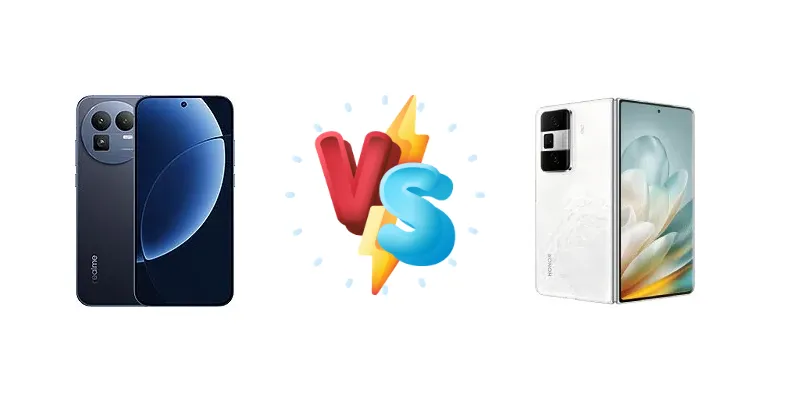
|
🏆 Quick Verdict
For users prioritizing peak performance and rapid wired charging, the Realme GT8 (China) is the clear winner. However, the Honor Magic Vs3 offers a more refined, all-around experience with the convenience of wireless charging and potentially better sustained performance due to the Snapdragon 8 Gen 2's thermal efficiency.
| PHONES | ||
|---|---|---|
| Phone Names | Realme GT8 (China) | Honor Magic Vs3 |
| Network | ||
|---|---|---|
| 2G bands | GSM 850 / 900 / 1800 / 1900 | GSM 850 / 900 / 1800 / 1900 |
| 3G bands | HSDPA 800 / 850 / 900 / 1700(AWS) / 1900 / 2100 | HSDPA 800 / 850 / 900 / 1700(AWS) / 1900 / 2100 |
| 4G bands | 1, 3, 4, 5, 8, 18, 19, 20, 26, 28, 34, 38, 39, 40, 41, 42, 48, 66 | 1, 2, 3, 4, 5, 7, 8, 12, 17, 18, 19, 20, 26, 28, 34, 38, 39, 40, 41, 66 |
| 5G bands | 1, 3, 5, 8, 18, 20, 26, 28, 38, 40, 41, 48, 66, 77, 78 SA/NSA | 1, 3, 5, 8, 28, 38, 41, 77, 78 SA/NSA |
| Speed | HSPA, LTE, 5G | HSPA, LTE, 5G |
| Technology | GSM / HSPA / LTE / 5G | GSM / CDMA / HSPA / CDMA2000 / LTE / 5G |
| Launch | ||
|---|---|---|
| Announced | 2025, October 21 | 2024, July 12 |
| Status | Available. Released 2025, October 21 | Available. Released 2024, July 19 |
| Body | ||
|---|---|---|
| Build | Glass front, aluminum frame, fiber-reinforced plastic back or silicone polymer (eco leather) back | - |
| Dimensions | 161.8 x 76.9 x 8.2 mm (6.37 x 3.03 x 0.32 in) | Unfolded: 156.8 x 145.2 x 4.65 mm or 4.8 mmFolded: 156.8 x 74.0 x 9.8 mm or 10.1 mm |
| SIM | Nano-SIM + Nano-SIM | · Nano-SIM + eSIM· Nano-SIM + Nano-SIM |
| Weight | 209 g or 214 g (7.37 oz) | 229 g or 231 g (8.08 oz) |
| Display | ||
|---|---|---|
| Protection | - | King Kong Rhinoceros |
| Resolution | 1440 x 3136 pixels, 19.5:9 ratio (~508 ppi density) | 2156 x 2344 pixels (~402 ppi density) |
| Size | 6.79 inches, 112.8 cm2 (~90.7% screen-to-body ratio) | 7.92 inches, 201.6 cm2 (~88.6% screen-to-body ratio) |
| Type | AMOLED, 144Hz, HDR, 1000 nits (typ), 2000 nits (HBM), 7000 nits (peak) | Foldable LTPO AMOLED, 1B colors, Dolby Vision, 120Hz |
| Platform | ||
|---|---|---|
| CPU | Octa-core (2x4.32 GHz Oryon V2 Phoenix L + 6x3.53 GHz Oryon V2 Phoenix M) | Octa-core (1x3.2 GHz Cortex-X3 & 2x2.8 GHz Cortex-A715 & 2x2.8 GHz Cortex-A710 & 3x2.0 GHz Cortex-A510) |
| Chipset | Qualcomm SM8750-AB Snapdragon 8 Elite (3 nm) | Qualcomm SM8550-AB Snapdragon 8 Gen 2 (4 nm) |
| GPU | Adreno 830 | Adreno 740 |
| OS | Android 16, up to 4 major Android upgrades, Realme UI 7.0 | Android 14, MagicOS 8.0.1 |
| Memory | ||
|---|---|---|
| Card slot | No | No |
| Internal | 256GB 12GB RAM, 256GB 16GB RAM, 512GB 16GB RAM, 1TB 16GB RAM | 256GB 12GB RAM, 512GB 12GB RAM, 1TB 16GB RAM |
| Main Camera | ||
|---|---|---|
| Features | Ricoh lens, Color spectrum sensor, LED flash, HDR, panorama | Laser AF, LED flash, HDR, panorama |
| Triple | 50 MP, f/1.8, 22mm (wide), 1/1.56", 1.0µm, multi-directional PDAF, OIS 50 MP, f/2.8, 80mm, (periscope telephoto), PDAF, OIS, 3.5x optical zoom 8 MP, f/2.2, 16mm, 112˚ (ultrawide), 1/4.0", 1.12µm | 50 MP, f/1.9, (wide), 1/1.56", PDAF, OIS 8 MP, f/3.4, (periscope telephoto), PDAF, OIS, 5x optical zoom 40 MP, f/2.2, 112˚, (ultrawide), AF |
| Video | 8K@30fps, 4K@30/60/120fps, 1080p@30/60/120/240fps, gyro-EIS, HDR | 4K@30/60fps (10-bit), 1080p@30/60fps, gyro-EIS, OIS |
| Selfie camera | ||
|---|---|---|
| Features | Panorama | HDR |
| Single | 16 MP, f/2.4, 23mm (wide), 1/3.09", 1.0µm | 16 MP, f/2.2, 90˚, (wide) Cover camera: 16 MP, f/2.2, 90˚, (wide) |
| Video | Yes | 4K@30fps, 1080p@30fps, gyro-EIS |
| Sound | ||
|---|---|---|
| 35mm jack | No | No |
| Loudspeaker | Yes, with stereo speakers | Yes, with stereo speakers |
| Comms | ||
|---|---|---|
| Bluetooth | 6.0, A2DP, LE, aptX HD, LHDC 5 | 5.3, A2DP, LE, aptX HD, LDAC |
| Infrared port | Yes | Yes |
| NFC | Yes | Yes |
| Positioning | GPS (L1+L5), BDS (B1I+B1c+B2a), GALILEO (E1+E5a), QZSS (L1+L5), GLONASS | GPS (L1+L5), GLONASS (L1), BDS (B1I+B1c+B2a), GALILEO (E1+E5a) |
| Radio | No | No |
| USB | USB Type-C, OTG | USB Type-C 3.1, OTG, Display Port 1.2 |
| WLAN | Wi-Fi 802.11 a/b/g/n/ac/6/7, dual-band | Wi-Fi 802.11 a/b/g/n/ac/6e/7, dual-band, Wi-Fi Direct |
| Features | ||
|---|---|---|
| Sensors | Fingerprint (under display, ultrasonic), accelerometer, gyro, proximity, compass | Fingerprint (side-mounted), accelerometer, gyro, proximity, compass, barometer |
| Battery | ||
|---|---|---|
| Charging | 100W wired, 14.4W PD, 45 min to 100% | 66W wired 50W wireless 5W reverse wired |
| Type | Si/C Li-Ion 7000 mAh | Li-Po 5000 mAh |
| Misc | ||
|---|---|---|
| Colors | Blue, Green, White | Velvet Black, Snow, Tundra Green |
| Models | - | FLC-AN00 |
| Price | About 350 EUR | About 980 EUR |
Realme GT8 (China)
- Unmatched CPU performance with Snapdragon 8 Elite
- Extremely fast 100W wired charging
- Potentially higher memory bandwidth with LPDDR5x
- Potential for thermal throttling under sustained load
- Lacks wireless charging
Honor Magic Vs3
- Balanced performance and efficiency with Snapdragon 8 Gen 2
- Convenient 50W wireless charging
- Potentially better sustained performance due to thermal efficiency
- Lower peak CPU performance compared to Snapdragon 8 Elite
- Slower wired charging than Realme GT8
Display Comparison
While display specs are missing for both devices, the Honor Magic Vs3, being a 'Vs' series phone, likely features a foldable display. This inherently differentiates it. The Realme GT8, being a standard flagship, will likely have a high-refresh-rate AMOLED panel. The Snapdragon 8 Elite's ISP will likely support higher resolution video output, potentially benefiting display quality. Without specific nit brightness or color gamut data, it's difficult to definitively declare a winner, but the Magic Vs3's foldable form factor is a unique advantage.
Camera Comparison
Camera specifications are absent, but given the brands' typical strategies, the Honor Magic Vs3 is likely to emphasize computational photography and image processing. The Snapdragon 8 Gen 2's ISP is highly capable in this regard. The Realme GT8, while possessing a powerful processor for image processing, may lean towards a more direct, less-processed image style. Without sensor size or aperture information, it's impossible to assess low-light performance. The absence of details on OIS is also a significant gap in the data.
Performance
The Realme GT8's Snapdragon 8 Elite, built on a 3nm process, boasts a significant architectural advantage with its Oryon V2 Phoenix cores clocked up to 4.32 GHz. This promises superior single-core and multi-core performance compared to the Honor Magic Vs3's Snapdragon 8 Gen 2 (4nm). However, the 4nm node of the Gen 2 offers better thermal efficiency. The GT8's raw power may lead to more aggressive throttling under sustained load, potentially diminishing real-world gaming advantages. The Gen 2's Cortex-X3 core, while clocked lower at 3.2 GHz, is a proven performer. The GT8's LPDDR5x RAM configuration will further enhance memory bandwidth, but the Gen 2's optimized architecture may mitigate the difference.
Battery Life
The Realme GT8's 100W wired charging is a substantial advantage, promising a full charge in just 45 minutes. The Honor Magic Vs3 offers a more versatile charging solution with 66W wired, 50W wireless, and 5W reverse wired. While the GT8's charging speed is faster, the Magic Vs3's wireless charging adds convenience. Battery capacity is unknown for both devices, but the Snapdragon 8 Gen 2's efficiency may translate to longer real-world battery life despite potentially having a smaller battery than the GT8.
Buying Guide
Buy the Realme GT8 (China) if you absolutely need the fastest possible CPU performance for demanding tasks like video editing or emulation, and if you primarily charge your phone via a wired connection. Buy the Honor Magic Vs3 if you value a more balanced experience with excellent performance, the convenience of 50W wireless charging, and potentially better long-term thermal management during extended gaming sessions.