
Realme GT7 Pro Racing vs. vivo iQOO 12 Pro: A Head-to-Head Performance Showdown
| Phones Images | |||||
|---|---|---|---|---|---|
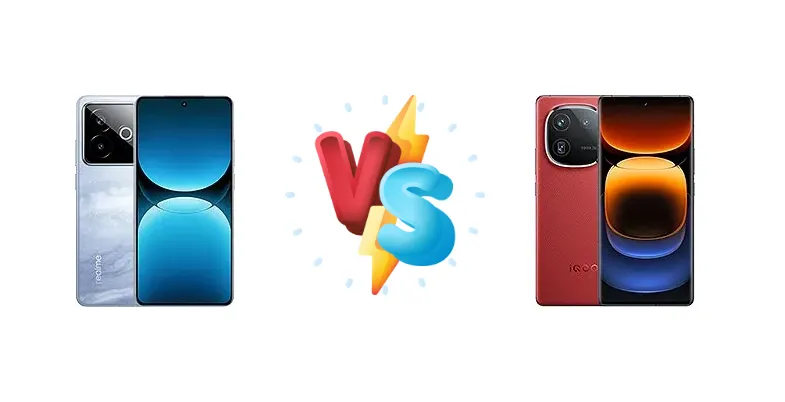
|
🏆 Quick Verdict
For the power user demanding the absolute fastest CPU performance, the Realme GT7 Pro Racing takes the lead thanks to its Snapdragon 8 Elite and Oryon cores. However, the iQOO 12 Pro offers a more well-rounded package with wireless charging and a potentially more refined software experience, making it the better choice for the average flagship buyer.
| PHONES | ||
|---|---|---|
| Phone Names | Realme GT7 Pro Racing | vivo iQOO 12 Pro |
| Network | ||
|---|---|---|
| 2G bands | GSM 850 / 900 / 1800 / 1900 | GSM 850 / 900 / 1800 / 1900 |
| 3G bands | HSDPA 800 / 850 / 900 / 1700(AWS) / 1900 / 2100 | HSDPA 800 / 850 / 900 / 1700(AWS) / 1900 / 2100 |
| 4G bands | 1, 3, 4, 5, 8, 18, 19, 20, 26, 28, 34, 38, 39, 40, 41, 66 - China | 1, 2, 3, 4, 5, 7, 8, 12, 17, 18, 19, 20, 25, 26, 28, 34, 38, 39, 40, 41, 42, 66 |
| 5G bands | 1, 3, 5, 8, 20, 28, 38, 40, 41, 66, 77, 78 SA/NSA - China | 1, 2, 3, 5, 7, 8, 12, 20, 25, 26, 28, 66, 38, 40, 41, 77, 78 SA/NSA |
| Speed | HSPA, LTE, 5G | HSPA, LTE, 5G |
| Technology | GSM / HSPA / LTE / 5G | GSM / CDMA / HSPA / CDMA2000 / LTE / 5G |
| Launch | ||
|---|---|---|
| Announced | 2025, February 13 | 2023, November 07 |
| Status | Available. Released 2025, February 13 | Available. Released 2023, November 14 |
| Body | ||
|---|---|---|
| Build | Glass front, aluminum frame, glass back | - |
| Dimensions | 162.5 x 76.9 x 8.6 mm (6.40 x 3.03 x 0.34 in) | 164.6 x 75.4 x 8.6 mm or 8.8 mm |
| SIM | Nano-SIM + Nano-SIM | Nano-SIM + Nano-SIM |
| Weight | 218 g (7.69 oz) | 205 g or 210 g (7.23 oz) |
| Display | ||
|---|---|---|
| Resolution | 1264 x 2780 pixels (~450 ppi density) | 1440 x 3200 pixels, 20:9 ratio (~518 ppi density) |
| Size | 6.78 inches, 111.7 cm2 (~89.4% screen-to-body ratio) | 6.78 inches, 111.0 cm2 (~89.4% screen-to-body ratio) |
| Type | LTPO AMOLED, 1B colors, 120Hz, HDR10+, Dolby Vision, 1500 nits (HBM), 6000 nits (peak) | LTPO AMOLED, 1B colors, 144Hz, HDR10+, 1600 nits (HBM), 3000 nits (peak) |
| Platform | ||
|---|---|---|
| CPU | Octa-core (2x4.32 GHz Oryon V2 Phoenix L + 6x3.53 GHz Oryon V2 Phoenix M) | Octa-core (1x3.3 GHz Cortex-X4 & 3x3.2 GHz Cortex-A720 & 2x3.0 GHz Cortex-A720 & 2x2.3 GHz Cortex-A520) |
| Chipset | Qualcomm SM8750-AB Snapdragon 8 Elite (3 nm) | Qualcomm SM8650-AB Snapdragon 8 Gen 3 (4 nm) |
| GPU | Adreno 830 | Adreno 750 |
| OS | Android 15, Realme UI 6.0 | Android 14, up to 2 major Android upgrades, Funtouch 14 (International), OriginOS 4 (China) |
| Memory | ||
|---|---|---|
| Card slot | No | No |
| Internal | 256GB 12GB RAM, 256GB 16GB RAM, 512GB 12GB RAM, 512GB 16GB RAM | 256GB 16GB RAM, 512GB 16GB RAM, 1TB 16GB RAM |
| Main Camera | ||
|---|---|---|
| Dual | 50 MP, f/1.8, 24mm (wide), 1/1.56", 1.0µm, multi-directional PDAF, OIS 8 MP, f/2.2, 16mm, 112˚ (ultrawide), 1/4.0", 1.12µm | - |
| Features | Color spectrum sensor, Dual-LED flash, HDR, panorama | Color spectrum sensor, Dual-LED flash, HDR, panorama |
| Triple | - | 50 MP, f/1.7, 23mm (wide), 1/1.3", 1.2µm, ulti-directional PDAF, OIS 64 MP, f/2.6, 70mm (periscope telephoto), 1/2.0", PDAF, OIS, 3x optical zoom 50 MP, f/2.0, 15mm, 119˚ (ultrawide), AF |
| Video | 4K@30/60fps, 1080p@30/60/120fps, gyro-EIS | 8K@30fps, 4K@24/30/60fps, 1080p@30/60/120/240fps, gyro-EIS |
| Selfie camera | ||
|---|---|---|
| Features | Panorama | HDR |
| Single | 16 MP, f/2.5, 25mm (wide), 1/3.09", 1.0µm | 16 MP, f/2.5, (wide) |
| Video | 1080p@30/60fps | 1080p@30fps, gyro-EIS |
| Sound | ||
|---|---|---|
| 35mm jack | No | No |
| Loudspeaker | Yes, with stereo speakers | Yes, with stereo speakers |
| Comms | ||
|---|---|---|
| Bluetooth | 5.4, A2DP, LE | 5.4, A2DP, LE, aptX HD, aptX Adaptive, aptX Lossless |
| Infrared port | Yes | Yes |
| NFC | Yes, 360˚ | Yes |
| Positioning | GPS (L1+L5), BDS (B1I+B1c+B2a), GALILEO (E1+E5a), QZSS (L1+L5), GLONASS | GPS (L1+L5), GLONASS (G1), BDS (B1I+B1c+B2a), GALILEO (E1+E5a), QZSS (L1+L5) |
| Radio | No | No |
| USB | USB Type-C | USB Type-C 2.0, OTG |
| WLAN | Wi-Fi 802.11 a/b/g/n/ac/6/7, dual-band | Wi-Fi 802.11 a/b/g/n/ac/6/7, tri-band, Wi-Fi Direct |
| Features | ||
|---|---|---|
| Sensors | Fingerprint (under display, optical), accelerometer, gyro, proximity, compass | Fingerprint (under display, ultrasonic), accelerometer, gyro, proximity, compass |
| Battery | ||
|---|---|---|
| Charging | 120W wired, 13 min to 50%, 38 min to 100% Bypass charging | 120W wired 50W wireless 10W reverse wireless |
| Type | Si/C Li-Ion 6500 mAh | 5100 mAh |
| Misc | ||
|---|---|---|
| Colors | Titanium, Blue | Black, Red, White (BMW M branding) |
| Models | - | V2329A |
| Price | About 400 EUR | About 650 EUR |
Realme GT7 Pro Racing
- Potentially highest CPU performance with Snapdragon 8 Elite and Oryon cores
- 3nm process for improved thermal efficiency
- Extremely fast 120W wired charging
- Bypass charging for battery health
- Lacks wireless charging
- Software optimization may be less mature compared to iQOO
vivo iQOO 12 Pro
- 50W wireless charging and 10W reverse wireless charging
- Snapdragon 8 Gen 3 offers excellent all-around performance
- Potentially more refined software experience
- Established brand reputation for gaming features
- Snapdragon 8 Gen 3 is less powerful than Snapdragon 8 Elite
- 4nm process may result in slightly higher temperatures under sustained load
Display Comparison
While both devices are expected to feature high-refresh-rate AMOLED displays, specific details like peak brightness and color accuracy are currently unavailable. However, given the flagship positioning, both will likely exceed 1000 nits peak brightness. The absence of LTPO information suggests both may not dynamically adjust refresh rates as aggressively as some competitors, potentially impacting battery life during static content viewing. Bezels are expected to be minimal on both, reflecting current design trends.
Camera Comparison
Without detailed camera specifications, a direct comparison is difficult. However, both brands typically employ high-resolution main sensors. The iQOO series often focuses on computational photography and vibrant image processing, while Realme tends towards a more natural look. The absence of information regarding OIS and lens apertures makes it impossible to assess low-light performance or video stabilization capabilities. We can assume both will offer a versatile camera system, but the image processing philosophies will likely differ.
Performance
The core differentiator lies in the chipsets. The Realme GT7 Pro Racing’s Snapdragon 8 Elite (3nm) with its Oryon V2 Phoenix cores (2x4.32 GHz + 6x3.53 GHz) is designed for sustained peak performance. This architecture, unlike the Snapdragon 8 Gen 3’s (4nm) Cortex-X4/A720 configuration (1x3.3 GHz + 3x3.2 GHz + 2x3.0 GHz + 2x2.3 GHz), prioritizes single-core and multi-core speed. The 3nm process of the 8 Elite should also yield better thermal efficiency, potentially leading to less throttling under sustained load. The iQOO 12 Pro benefits from the Snapdragon 8 Gen 3’s established optimizations and wider software support. Both devices will likely feature LPDDR5x RAM, but the speed and configuration could vary, impacting overall system responsiveness.
Battery Life
Both devices feature 120W wired charging, promising rapid replenishment. The Realme GT7 Pro Racing claims 50% charge in 13 minutes and 100% in 38 minutes, while the iQOO 12 Pro offers a similar wired charging speed. The iQOO 12 Pro distinguishes itself with 50W wireless charging and 10W reverse wireless charging, features absent in the GT7 Pro Racing. While battery capacity is unknown, the iQOO 12 Pro’s wireless charging capabilities provide added convenience, potentially offsetting a slightly smaller battery size.
Buying Guide
Buy the Realme GT7 Pro Racing if you need uncompromising CPU performance for demanding tasks like video editing, emulation, or competitive mobile gaming, and are willing to sacrifice wireless charging convenience. Buy the vivo iQOO 12 Pro if you prefer a more balanced flagship experience with the convenience of 50W wireless charging, a potentially more polished software experience, and don't necessarily require the absolute peak CPU performance offered by the Snapdragon 8 Elite.