
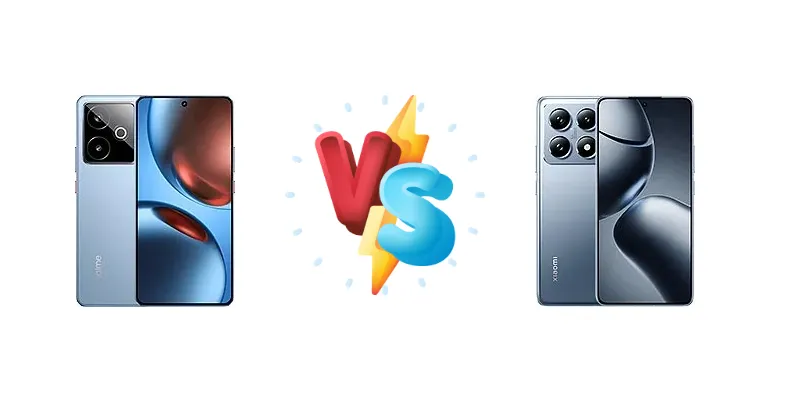
Realme GT7 vs Xiaomi 14T Pro: A Deep Dive into Mediatek's Flagship Chipsets
| Phones Images | |||||
|---|---|---|---|---|---|
|
🏆 Quick Verdict
For the average user prioritizing all-around performance and faster charging, the Xiaomi 14T Pro emerges as the winner. Its 120W charging and proven 12:32h active use battery life offer a more convenient experience, while the Dimensity 9300+ provides excellent performance. The GT7's Dimensity 9400+ holds theoretical advantages, but real-world benefits are less clear without further testing.
| PHONES | ||
|---|---|---|
| Phone Names | Realme GT7 (China) | Xiaomi 14T Pro |
| Network | ||
|---|---|---|
| 2G bands | GSM 850 / 900 / 1800 / 1900 | GSM 850 / 900 / 1800 / 1900 |
| 3G bands | HSDPA 800 / 850 / 900 / 1700(AWS) / 1900 / 2100 | HSDPA 800 / 850 / 900 / 1700(AWS) / 1900 / 2100 |
| 4G bands | 1, 3, 4, 5, 8, 18, 19, 20, 26, 28, 34, 38, 39, 40, 41, 42, 48, 66 | 1, 2, 3, 4, 5, 7, 8, 12, 13, 17, 18, 19, 20, 25, 26, 28, 32, 38, 39, 40, 41, 42, 48, 66 |
| 5G bands | 1, 3, 5, 8, 20, 28, 38, 40, 41, 48, 66, 77, 78 SA/NSA | 1, 2, 3, 5, 7, 8, 12, 20, 25, 26, 28, 38, 40, 41, 48, 66, 75, 77, 78 SA/NSA |
| Speed | HSPA, LTE, 5G | HSPA, LTE, 5G |
| Technology | GSM / HSPA / LTE / 5G | GSM / HSPA / LTE / 5G |
| Launch | ||
|---|---|---|
| Announced | 2025, April 23 | 2024, September 26 |
| Status | Available. Released 2025, April 23 | Available. Released 2024, September 26 |
| Body | ||
|---|---|---|
| Build | - | Glass front (Gorilla Glass 5), aluminum frame, glass back (Panda X) |
| Dimensions | 162.4 x 76 x 8.3 mm (6.39 x 2.99 x 0.33 in) | 160.4 x 75.1 x 8.4 mm (6.31 x 2.96 x 0.33 in) |
| SIM | Nano-SIM + Nano-SIM | · Nano-SIM + eSIM· eSIM + eSIM· Nano-SIM + Nano-SIM |
| Weight | 203 g (7.16 oz) | 209 g (7.37 oz) |
| Display | ||
|---|---|---|
| Protection | - | Corning Gorilla Glass 5 |
| Resolution | 1280 x 2800 pixels, 19.5:9 ratio (~453 ppi density) | 1220 x 2712 pixels, 20:9 ratio (~446 ppi density) |
| Size | 6.8 inches, 112.8 cm2 (~91.4% screen-to-body ratio) | 6.67 inches, 107.4 cm2 (~89.1% screen-to-body ratio) |
| Type | AMOLED, 1B colors, 144Hz, HDR, 1800 nits (HBM), 6500 nits (peak) | AMOLED, 68B colors, 144Hz, 3840Hz PWM, Dolby Vision, HDR10+, 1600 nits (HBM), 4000 nits (peak) |
| Platform | ||
|---|---|---|
| CPU | Octa-core (1x3.73 GHz Cortex-X925 & 3x3.3 GHz Cortex-X4 & 4x2.4 GHz Cortex-A720) | Octa-core (1x3.4 GHz Cortex-X4 & 3x2.85 GHz Cortex-X4 & 4x2.0 GHz Cortex-A720) |
| Chipset | Mediatek Dimensity 9400+ (3 nm) | Mediatek Dimensity 9300+ (4 nm) |
| GPU | Immortalis-G925 MC12 | Immortalis-G720 MC12 |
| OS | Android 15, Realme UI 6.0 | Android 14, HyperOS |
| Memory | ||
|---|---|---|
| Card slot | No | No |
| Internal | 256GB 12GB RAM, 512GB 12GB RAM, 512GB 16GB RAM, 1TB 16GB RAM | 256GB 12GB RAM, 512GB 12GB RAM, 512GB 16GB RAM, 1TB 12GB RAM |
| Main Camera | ||
|---|---|---|
| Dual | 50 MP, f/1.8, 24mm (wide), 1/1.56", 1.0µm, multi-directional PDAF, OIS 8 MP, f/2.2, 16mm, 112˚ (ultrawide), 1/4.0", 1.12µm | - |
| Features | Color spectrum sensor, LED flash, HDR, panorama | Leica lens, Ultra HDR, LED flash, HDR, panorama |
| Triple | - | 50 MP, f/1.6, 23mm (wide), 1/1.31", 1.2µm, PDAF, OIS 50 MP, f/2.0, 60mm (telephoto), 1/2.88", 0.61µm, PDAF, 2.6x optical zoom 12 MP, f/2.2, 15mm (ultrawide), 1/3.06", 1.12µm |
| Video | 4K@30/60fps, 1080p@30/60/120fps, gyro-EIS | 8K@24/30fps, 4K@24/30/60fps, 1080p@30/60/120/240/960fps, gyro-EIS, 10-bit Rec. 2020, HDR10+ |
| Selfie camera | ||
|---|---|---|
| Features | Panorama | HDR |
| Single | 16 MP, f/2.4, 23mm (wide), 1/3.0", 1.0µm | 32 MP, f/2.0, 25mm (wide), 1/3.44", 0.64µm |
| Video | 1080p@30/60fps, gyro-EIS | 4K@30fps, 1080p@30/60fps, HDR10+ |
| Sound | ||
|---|---|---|
| 35mm jack | No | No |
| Loudspeaker | Yes, with stereo speakers | Yes, with stereo speakers |
| Comms | ||
|---|---|---|
| Bluetooth | 5.4, A2DP, LE | 5.4, A2DP, LE, LHDC |
| Infrared port | Yes | Yes |
| NFC | Yes | Yes (market/region dependent) |
| Positioning | GPS (L1+L5), BDS (B1I+B1c+B2a+B2b), GALILEO (E1+E5a+E5b), QZSS (L1+L5), NavIC (L5), GLONASS | GPS (L1+L5), BDS (B1I+B1C+B2a+B2b), GALILEO (E1+E5a+E5b), QZSS (L1+L5), NavIC (L5), GLONASS |
| Radio | No | No |
| USB | USB Type-C | USB Type-C 2.0, OTG |
| WLAN | Wi-Fi 802.11 a/b/g/n/ac/6/7, dual-band | Wi-Fi 802.11 a/b/g/n/ac/6e/7, dual-band, Wi-Fi Direct |
| Features | ||
|---|---|---|
| Sensors | Fingerprint (under display, ultrasonic), accelerometer, proximity, gyro, compass | Fingerprint (under display, optical), accelerometer, gyro, proximity, compass |
| Battery | ||
|---|---|---|
| Charging | 100W wired Bypass charging | 120W wired, PD3.0, QC4, 100% in 19 min 50W wireless, 100% in 45 min |
| Type | Si/C Li-Ion 7200 mAh | Li-Po 5000 mAh |
| Misc | ||
|---|---|---|
| Colors | Black, Blue, White | Titan Gray, Titan Blue, Titan Black |
| Models | - | 2407FPN8EG |
| Price | About 310 EUR | $ 550.00 / £ 498.00 / € 539.99 |
| SAR EU | - | 0.99 W/kg (head) 1.00 W/kg (body) |
Realme GT7 (China)
- Potentially higher CPU performance with Dimensity 9400+ and Cortex-X925 core
- 3nm process may offer improved power efficiency
- 100W fast charging
- China-specific model, potential software and availability issues
- Battery life and display specs currently unknown
- Limited information available for a comprehensive comparison
Xiaomi 14T Pro
- Faster 120W wired and 50W wireless charging
- Brighter display (1228 nits)
- Proven 12:32h active use battery life
- 4nm process may be less efficient than 3nm
- Slightly lower CPU clock speeds compared to GT7
- Potential for software bloat (typical of Xiaomi)
Display Comparison
The Xiaomi 14T Pro boasts a significantly brighter display, reaching a measured peak of 1228 nits, crucial for outdoor visibility. While the Realme GT7’s display specs are currently unknown, the 14T Pro’s brightness advantage is substantial. The 14T Pro’s panel likely utilizes LTPO technology for adaptive refresh rates, contributing to battery efficiency, a feature not confirmed for the GT7. Bezels and color accuracy will require hands-on testing, but the Xiaomi 14T Pro sets a high bar for display quality.
Camera Comparison
Without detailed camera specifications for the Realme GT7, a direct comparison is limited. However, the Xiaomi 14T Pro is expected to feature a high-resolution main sensor with OIS, prioritizing image quality and stabilization. The focus should be on the primary sensor's size and aperture, as these significantly impact low-light performance. The inclusion of a 2MP macro camera on either device is largely inconsequential; image quality from such sensors is typically poor. Image processing algorithms will also play a crucial role, differentiating the final image output.
Performance
The core difference lies in the chipsets: the Realme GT7 features the Mediatek Dimensity 9400+, built on a 3nm process, while the Xiaomi 14T Pro uses the Dimensity 9300+, fabricated on a 4nm node. The 9400+’s CPU configuration includes a single high-performance Cortex-X925 core clocked at 3.73 GHz, alongside three Cortex-X4 cores at 3.3 GHz, and four Cortex-A720 cores at 2.4 GHz. The 14T Pro’s CPU has a single Cortex-X4 core at 3.4 GHz, three more Cortex-X4 cores at 2.85 GHz, and four Cortex-A720 cores at 2.0 GHz. The 3nm process of the 9400+ *should* offer better power efficiency, but the 9300+'s architecture and clock speeds are competitive. The 9400+'s X925 core is a newer architecture, potentially offering a performance uplift in single-threaded tasks. Both phones utilize LPDDR5x RAM, but the speed and configuration will impact real-world performance.
Battery Life
The Xiaomi 14T Pro’s 12:32h active use battery score is a significant advantage, demonstrating excellent real-world endurance. While the Realme GT7’s battery capacity is unknown, the Xiaomi 14T Pro’s 120W wired charging (0-100% in 19 minutes) and 50W wireless charging (0-100% in 45 minutes) offer superior convenience. The GT7’s 100W wired charging is fast, but the 14T Pro’s charging ecosystem is more versatile with PD3.0 and QC4 support. The 3nm process of the Dimensity 9400+ *could* offset a smaller battery capacity in the GT7, but the 14T Pro’s proven battery life is a strong selling point.
Buying Guide
Buy the Realme GT7 (China) if you prioritize raw CPU power and are comfortable with importing a China-specific model. The Dimensity 9400+’s Cortex-X925 core offers a potential edge in demanding tasks. Buy the Xiaomi 14T Pro if you value a more polished, readily available experience with faster charging, a brighter display, and a longer-lasting battery as demonstrated by its 12:32h active use score.