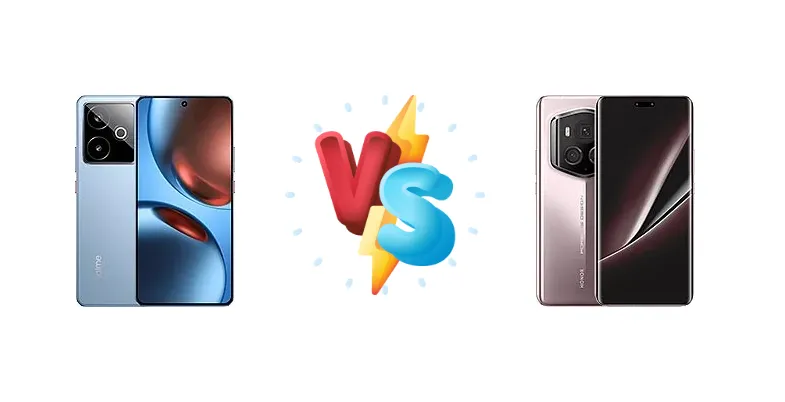
The Realme GT7, powered by the cutting-edge MediaTek Dimensity 9400+, aims to deliver uncompromising performance. Conversely, the Honor Magic6 RSR Porsche Design, featuring the Qualcomm Snapdragon 8 Gen 3, prioritizes a holistic flagship experience with a focus on battery life and premium design. This comparison dissects their strengths and weaknesses to determine which device reigns supreme.
🏆 Quick Verdict
For users prioritizing raw processing power and speed, the Realme GT7 (China) is the clear winner, thanks to the Dimensity 9400+. However, the Honor Magic6 RSR Porsche Design offers a more balanced package with superior battery endurance and a brighter display, making it the better choice for everyday users.
| Network |
|---|
| 2G bands | GSM 850 / 900 / 1800 / 1900 | GSM 850 / 900 / 1800 / 1900 |
| 3G bands | HSDPA 800 / 850 / 900 / 1700(AWS) / 1900 / 2100 | HSDPA 800 / 850 / 900 / 1700(AWS) / 1900 / 2100 |
| 4G bands | 1, 3, 4, 5, 8, 18, 19, 20, 26, 28, 34, 38, 39, 40, 41, 42, 48, 66 | LTE |
| 5G bands | 1, 3, 5, 8, 20, 28, 38, 40, 41, 48, 66, 77, 78 SA/NSA | SA/NSA |
| Speed | HSPA, LTE, 5G | HSPA, LTE, 5G |
| Technology | GSM / HSPA / LTE / 5G | GSM / CDMA / HSPA / CDMA2000 / LTE / 5G |
| Launch |
|---|
| Announced | 2025, April 23 | 2024, March 18 |
| Status | Available. Released 2025, April 23 | Available. Released 2024, March 22 |
| Body |
|---|
| Build | - | Glass front (NanoCrystal Shield), glass back (NanoCrystal Shield), titanium frame |
| Dimensions | 162.4 x 76 x 8.3 mm (6.39 x 2.99 x 0.33 in) | 162.5 x 75.8 x 8.9 mm (6.40 x 2.98 x 0.35 in) |
| SIM | Nano-SIM + Nano-SIM | · Nano-SIM + eSIM· Nano-SIM + Nano-SIM |
| Weight | 203 g (7.16 oz) | 237 g (8.36 oz) |
| Display |
|---|
| Protection | - | NanoCrystal Shield |
| Resolution | 1280 x 2800 pixels, 19.5:9 ratio (~453 ppi density) | 1280 x 2800 pixels, 19.5:9 ratio (~453 ppi density) |
| Size | 6.8 inches, 112.8 cm2 (~91.4% screen-to-body ratio) | 6.8 inches, 112.8 cm2 (~91.6% screen-to-body ratio) |
| Type | AMOLED, 1B colors, 144Hz, HDR, 1800 nits (HBM), 6500 nits (peak) | LTPO OLED, 1B colors, 120Hz, Dolby Vision, HDR, 1800 nits (HBM), 5000 nits (peak) |
| Platform |
|---|
| CPU | Octa-core (1x3.73 GHz Cortex-X925 & 3x3.3 GHz Cortex-X4 & 4x2.4 GHz Cortex-A720) | Octa-core (1x3.3 GHz Cortex-X4 & 3x3.2 GHz Cortex-A720 & 2x3.0 GHz Cortex-A720 & 2x2.3 GHz Cortex-A520) |
| Chipset | Mediatek Dimensity 9400+ (3 nm) | Qualcomm SM8650-AB Snapdragon 8 Gen 3 (4 nm) |
| GPU | Immortalis-G925 MC12 | Adreno 750 |
| OS | Android 15, Realme UI 6.0 | Android 14, MagicOS 8 |
| Memory |
|---|
| Card slot | No | No |
| Internal | 256GB 12GB RAM, 512GB 12GB RAM, 512GB 16GB RAM, 1TB 16GB RAM | 1TB 24GB RAM |
| Main Camera |
|---|
| Dual | 50 MP, f/1.8, 24mm (wide), 1/1.56", 1.0µm, multi-directional PDAF, OIS
8 MP, f/2.2, 16mm, 112˚ (ultrawide), 1/4.0", 1.12µm | - |
| Features | Color spectrum sensor, LED flash, HDR, panorama | Color spectrum sensor, LED flash, HDR, panorama |
| Triple | - | 50 MP, f/1.4-2.0, 23mm (wide), 1/1.3", LiDAR AF, PDAF, OIS
180 MP, f/2.6, (periscope telephoto), 1/1.49", 0.56µm, PDAF, OIS, 2.5x optical zoom
50 MP, f/2.0, 13mm, 122˚ (ultrawide), 1/2.88", AF |
| Video | 4K@30/60fps, 1080p@30/60/120fps, gyro-EIS | 4K@24/30/60fps, 1080p@30/60/120/240fps, gyro-EIS, OIS, HDR, 10-bit video |
| Selfie camera |
|---|
| Features | Panorama | - |
| Single | 16 MP, f/2.4, 23mm (wide), 1/3.0", 1.0µm | 50 MP, f/2.0, 22mm (wide), 1/2.93", AF
TOF 3D, (depth/biometrics sensor) |
| Video | 1080p@30/60fps, gyro-EIS | 4K@30fps, 1080p@30/60fps, gyro-EIS |
| Sound |
|---|
| 35mm jack | No | No |
| Loudspeaker | Yes, with stereo speakers | Yes, with stereo speakers |
| Comms |
|---|
| Bluetooth | 5.4, A2DP, LE | 5.3, A2DP, LE, aptX HD |
| Infrared port | Yes | Yes |
| NFC | Yes | Yes |
| Positioning | GPS (L1+L5), BDS (B1I+B1c+B2a+B2b), GALILEO (E1+E5a+E5b), QZSS (L1+L5), NavIC (L5), GLONASS | GPS (L1+L5), GLONASS, BDS (B1I+B1c+B2a), GALILEO (E1+E5a) |
| Radio | No | No |
| USB | USB Type-C | USB Type-C 3.2, DisplayPort 1.2, OTG |
| WLAN | Wi-Fi 802.11 a/b/g/n/ac/6/7, dual-band | Wi-Fi 802.11 a/b/g/n/ac/6/7, dual-band, Wi-Fi Direct |
| Features |
|---|
| Sensors | Fingerprint (under display, ultrasonic), accelerometer, proximity, gyro, compass | Fingerprint (under display, optical), Face ID, accelerometer, gyro, proximity, compass |
| Battery |
|---|
| Charging | 100W wired
Bypass charging | 80W wired
66W wireless
Reverse wireless
5W reverse wired |
| Type | Si/C Li-Ion 7200 mAh | Si/C Li-Ion 5600 mAh |
| Misc |
|---|
| Colors | Black, Blue, White | Agate Grey, Frozen Berry |
| Models | - | BVL-N59, BVL-AN20 |
| Price | About 310 EUR | About 3020 EUR |
Realme GT7 (China)
- Potentially superior CPU performance with Dimensity 9400+
- Faster 100W wired charging
- Bypass charging for cooler gaming
- Battery life likely inferior to the Honor
- Camera specs currently unknown
Honor Magic6 RSR Porsche Design
- Excellent battery life (14:14h active use)
- Brighter display (1731 nits)
- Wireless and reverse wireless charging
- Slower wired charging (80W)
- Snapdragon 8 Gen 3 may be slightly less powerful than Dimensity 9400+ in CPU tasks
Display Comparison
The Honor Magic6 RSR boasts a significantly brighter display, reaching a measured 1731 nits, ensuring excellent visibility even in direct sunlight. While the Realme GT7’s display specs are currently unknown, the brightness advantage of the Honor is substantial. The Magic6 RSR likely employs an LTPO panel for adaptive refresh rates, contributing to battery efficiency, a feature we expect to see in flagship devices. The Porsche Design aesthetic also adds a layer of visual appeal, though subjective.
Camera Comparison
Without detailed camera specifications for the Realme GT7, a direct comparison is limited. However, the Honor Magic6 RSR is expected to feature a high-quality camera system, leveraging Qualcomm’s image signal processor. The focus should be on the main sensor’s size and aperture, as well as the effectiveness of optical image stabilization (OIS). We can assume the Honor will prioritize image processing for realistic colors and detail, while Realme often leans towards more vibrant, social media-friendly results. The absence of details on the Realme’s camera system makes it difficult to assess its capabilities.
Performance
The core difference lies in the chipsets. The Realme GT7’s Dimensity 9400+ (3nm) features a unique CPU configuration with a Cortex-X925 prime core clocked at 3.73 GHz, promising exceptional single-core performance. The Honor Magic6 RSR’s Snapdragon 8 Gen 3 (4nm) utilizes a Cortex-X4 prime core at 3.3 GHz. While the Snapdragon 8 Gen 3 is a proven performer, the Dimensity 9400+’s newer architecture and higher clock speed suggest a potential edge in CPU-bound tasks. The 3nm process of the Dimensity 9400+ should also offer improved thermal efficiency, potentially mitigating throttling during sustained loads. Both devices utilize Octa-core CPUs, but the Realme’s configuration appears geared towards maximizing peak performance.
Battery Life
The Honor Magic6 RSR demonstrates a clear advantage in battery life, achieving an active use score of 14 hours and 14 minutes. This is likely due to the efficient Snapdragon 8 Gen 3 chipset and potentially a larger battery capacity (spec not provided). The Realme GT7 offers 100W wired charging, significantly faster than the Honor’s 80W wired charging. However, the Honor compensates with 66W wireless charging and even 5W reverse wired charging, offering greater versatility. The Realme’s bypass charging feature is also a plus, allowing for direct power delivery when plugged in, minimizing heat generation during gaming.
Buying Guide
Buy the Realme GT7 (China) if you need the absolute fastest Android performance for demanding tasks like video editing, high-end gaming, and multitasking. Its 100W charging is also a significant advantage. Buy the Honor Magic6 RSR Porsche Design if you prefer a refined, all-day battery life, a stunningly bright display, and the prestige of the Porsche Design branding. It’s the better option for users who value a premium experience over peak benchmark scores.
Frequently Asked Questions
❓ Will the Dimensity 9400+ in the Realme GT7 overheat during prolonged gaming sessions?
The Dimensity 9400+'s 3nm process and the Realme GT7's bypass charging feature (which allows direct power delivery) are designed to mitigate thermal throttling. However, sustained peak performance will inevitably generate heat. Real-world testing will be crucial to determine the extent of any throttling.
❓ Does the Honor Magic6 RSR Porsche Design support high refresh rate gaming?
While not explicitly stated, flagship devices like the Honor Magic6 RSR typically support high refresh rate gaming. The Snapdragon 8 Gen 3 is capable of driving high refresh rate displays, and the Honor’s display is likely optimized for smooth gaming experiences. Specific game compatibility and frame rate settings will vary.
❓ How does the 66W wireless charging on the Honor Magic6 RSR compare to the 100W wired charging on the Realme GT7?
While 100W wired charging is significantly faster for a full charge, 66W wireless charging offers convenience. A full wireless charge will take longer, but it eliminates the need for cables. The Honor also offers 5W reverse wireless charging, a feature absent on the Realme, allowing it to charge accessories.