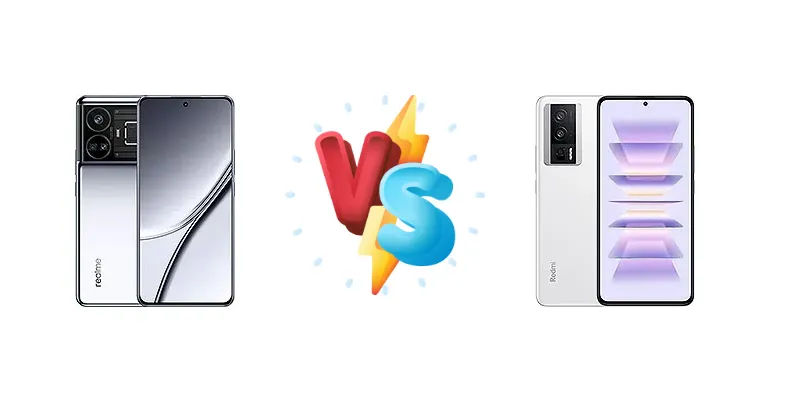
The Realme GT5 and Xiaomi Redmi K60 Pro represent the cutting edge of value-focused flagships. Both devices center around Qualcomm’s Snapdragon 8 Gen 2, promising top-tier performance. However, they diverge significantly in charging technology and feature sets, creating a compelling choice for users prioritizing speed versus convenience.
🏆 Quick Verdict
For users who absolutely demand the fastest possible wired charging, the Realme GT5’s 150W solution is the clear winner. However, the Xiaomi Redmi K60 Pro counters with the added convenience of 30W wireless charging, making it a more versatile option for everyday use.
| Network |
|---|
| 2G bands | GSM 850 / 900 / 1800 / 1900 | GSM 850 / 900 / 1800 / 1900 |
| 3G bands | HSDPA 850 / 900 / 2100 | HSDPA 800 / 850 / 900 / 1700(AWS) / 2100 |
| 4G bands | 1, 3, 5, 7, 8, 28, 34, 38, 39, 40, 41 | 1, 3, 4, 5, 8, 18, 19, 26, 34, 38, 39, 40, 41, 42 |
| 5G bands | 1, 3, 5, 8, 28, 41, 77, 78 SA/NSA | 1, 3, 5, 8, 28, 38, 41, 77, 78 SA/NSA |
| Speed | HSPA, LTE, 5G | HSPA, LTE, 5G |
| Technology | GSM / CDMA / HSPA / EVDO / LTE / 5G | GSM / CDMA / HSPA / CDMA2000 / LTE / 5G |
| | - | CDMA2000 1x |
| Launch |
|---|
| Announced | 2023, August 28 | 2022, December 27 |
| Status | Available. Released 2023, September 04 | Available. Released 2023, January 01 |
| Body |
|---|
| Build | Glass front, aluminum frame, glass back | - |
| Dimensions | 163.1 x 75.4 x 8.9 mm (6.42 x 2.97 x 0.35 in) | 162.8 x 75.4 x 8.6 mm or 8.9 mm |
| SIM | Nano-SIM + Nano-SIM | Nano-SIM + Nano-SIM |
| Weight | 205 g (7.23 oz) | 201 g or 205 g (7.09 oz) |
| Display |
|---|
| Resolution | 1240 x 2772 pixels, 20:9 ratio (~451 ppi density) | 1440 x 3200 pixels, 20:9 ratio (~526 ppi density) |
| Size | 6.74 inches, 109.2 cm2 (~88.8% screen-to-body ratio) | 6.67 inches, 107.4 cm2 (~87.5% screen-to-body ratio) |
| Type | AMOLED, 1B colors, 144Hz, HDR10+, 1400 nits (peak) | OLED, 68B colors, 120Hz, Dolby Vision, HDR10+, 1400 nits (peak) |
| Platform |
|---|
| CPU | Octa-core (1x3.2 GHz Cortex-X3 & 2x2.8 GHz Cortex-A715 & 2x2.8 GHz Cortex-A710 & 3x2.0 GHz Cortex-A510) | Octa-core (1x3.2 GHz Cortex-X3 & 2x2.8 GHz Cortex-A715 & 2x2.8 GHz Cortex-A710 & 3x2.0 GHz Cortex-A510) |
| Chipset | Qualcomm SM8550-AB Snapdragon 8 Gen 2 (4 nm) | Qualcomm SM8550-AB Snapdragon 8 Gen 2 (4 nm) |
| GPU | Adreno 740 | Adreno 740 |
| OS | Android 13, Realme UI 4.0 | Android 13, MIUI 14 |
| Memory |
|---|
| Card slot | No | No |
| Internal | 256GB 12GB RAM, 512GB 16GB RAM | 128GB 8GB RAM, 256GB 8GB RAM, 256GB 12GB RAM, 512GB 12GB RAM, 512GB 16GB RAM |
| | - | UFS 4.0
UFS 3.1 - 128GB only |
| Main Camera |
|---|
| Features | Dual-LED dual-tone flash, HDR, panorama | Color spectrum sensor, Dual-LED dual-tone flash, HDR, panorama |
| Triple | 50 MP, f/1.9, 24mm (wide), 1/1.56", 1.0µm, PDAF, OIS
8 MP, f/2.2, 16mm, 112˚ (ultrawide), 1/4.0", 1.12µm
2 MP (macro) | 54 MP, f/1.9, (wide), 1/1.49", 1.0µm, PDAF, OIS
8 MP, 118˚ (ultrawide), 1/4.0", 1.12µm
2 MP (macro) |
| Video | 4K@30/60fps, 1080p@30/60fps, gyro-EIS | 8K@24fps, 4K@30/60fps, 1080p@30/60/120/240/960fps, 720p@1920fps, gyro-EIS |
| Selfie camera |
|---|
| Features | HDR, panorama | HDR |
| Single | 16 MP, f/2.5, 25mm (wide), 1/3.09", 1.0µm | 16 MP, (wide), 1/3.06", 1.0µm |
| Video | 1080p@30fps, gyro-EIS | 1080p@30/60/120fps |
| Sound |
|---|
| 3.5mm jack | - | No |
| 35mm jack | No | No |
| Loudspeaker | Yes, with stereo speakers | Yes, with stereo speakers |
| | - | 24-bit/192kHz audio |
| Comms |
|---|
| Bluetooth | 5.3, A2DP, LE, aptX HD | 5.3, A2DP, LE |
| Infrared port | Yes | Yes |
| NFC | Yes | Yes |
| Positioning | GPS (L1+L2+L5), GLONASS, BDS, GALILEO, QZSS | GPS (L1+L5), GLONASS (G1), BDS (B1I+B2a+Bc), GALILEO (E1+E5a), QZSS (L1+L5), NavIC |
| Radio | No | Unspecified |
| USB | USB Type-C 2.0 | USB Type-C 2.0, OTG |
| WLAN | Wi-Fi 802.11 a/b/g/n/ac/6/7, tri-band, Wi-Fi Direct | Wi-Fi 802.11 a/b/g/n/ac/6e, dual-band, Wi-Fi Direct |
| Features |
|---|
| Sensors | Fingerprint (under display, optical), accelerometer, gyro, proximity, compass | Fingerprint (under display, optical), accelerometer, gyro, proximity, compass |
| Battery |
|---|
| Charging | 150W wired, PD, 50% in 7 min | 120W wired, PD3.0, QC3+, 100% in 19 min
30W wireless |
| Type | 5240 mAh | Li-Po 5000 mAh |
| Misc |
|---|
| Colors | Flowing Silver, Starry Oasis | Black, White, Mint, Champion Black |
| Models | RMX3820 | 22127RK46C |
| Price | About 380 EUR | About 460 EUR |
Realme GT5
- Industry-leading 150W wired charging for incredibly fast top-ups.
- Snapdragon 8 Gen 2 delivers flagship-level performance.
- Likely competitive pricing for the performance offered.
- Lacks wireless charging capability.
- Battery capacity may be smaller to accommodate 150W charging.
Xiaomi Redmi K60 Pro
- 30W wireless charging adds convenience.
- Snapdragon 8 Gen 2 provides excellent performance.
- PD3.0 and QC3+ support offer broad charger compatibility.
- Wired charging is slower than the Realme GT5.
- May be slightly more expensive than the Realme GT5.
Display Comparison
While both devices are expected to feature high-quality displays, specific details like peak brightness and panel type are missing. However, given the flagship positioning, both likely employ AMOLED panels with high refresh rates. The absence of LTPO information suggests neither prioritizes variable refresh rate for maximum power efficiency, though both will likely offer smooth visuals. Bezels are expected to be minimal on both, reflecting current design trends.
Camera Comparison
Detailed camera specifications are unavailable. However, given the market segment, both devices likely feature a multi-camera system with a primary sensor exceeding 50MP. The absence of information regarding OIS (Optical Image Stabilization) is notable; its presence would significantly improve image quality, particularly in low-light conditions. Image processing styles will likely differ, with Xiaomi historically favoring more saturated colors and Realme leaning towards a more natural look. The inclusion of a 2MP macro camera on either device is likely a marketing feature with limited practical utility.
Performance
Both the Realme GT5 and Xiaomi Redmi K60 Pro are powered by the Qualcomm SM8550-AB Snapdragon 8 Gen 2 (4 nm) chipset, featuring the same Octa-core CPU configuration (1x3.2 GHz Cortex-X3, 2x2.8 GHz Cortex-A715, 2x2.8 GHz Cortex-A710, and 3x2.0 GHz Cortex-A510). This ensures virtually identical CPU performance. The 4nm process node contributes to excellent thermal efficiency, minimizing throttling during sustained workloads like gaming. Performance differences will likely stem from RAM configuration (LPDDR5x is expected on both) and the effectiveness of each manufacturer’s cooling solution, which is currently unknown.
Battery Life
The Realme GT5’s 150W wired charging is its standout feature, capable of reaching 50% charge in just 7 minutes. This is significantly faster than the Xiaomi Redmi K60 Pro’s 120W wired charging, which takes 19 minutes to reach 100%. However, the Redmi K60 Pro compensates with 30W wireless charging, a feature absent on the GT5. While the battery capacity of both devices is unknown, the charging speed differential suggests the GT5 may have a slightly smaller battery, relying on its ultra-fast charging to mitigate range anxiety.
Buying Guide
Buy the Realme GT5 if you are a power user who frequently depletes their battery and needs the absolute fastest recharge times, prioritizing speed above all else. Buy the Xiaomi Redmi K60 Pro if you value the convenience of wireless charging alongside fast wired charging, and appreciate a more balanced feature set for daily use.
Frequently Asked Questions
❓ How does the 150W charging on the Realme GT5 affect battery health over the long term?
While 150W charging is incredibly fast, Qualcomm and Realme have implemented technologies to mitigate potential battery degradation. These include optimized charging algorithms and temperature control mechanisms. However, consistently using ultra-fast charging *may* contribute to slightly faster battery wear compared to slower charging methods, though the impact is likely minimal for most users.
❓ Does the Xiaomi Redmi K60 Pro support reverse wireless charging to top up accessories?
While the Redmi K60 Pro supports 30W wireless charging *for itself*, Xiaomi does not explicitly advertise reverse wireless charging functionality. It's unlikely to be available, as it's not a standard feature on their K-series devices.
❓ Will either phone get significantly hot during extended gaming sessions?
Both phones utilize the Snapdragon 8 Gen 2, which is thermally efficient. However, sustained gaming will inevitably generate heat. The effectiveness of each manufacturer’s cooling system (vapor chamber, graphite sheets, etc.) will determine how well the phone manages that heat. Without detailed thermal testing, it’s difficult to predict which phone will perform better under heavy load.