
Realme GT5 vs Xiaomi 13T Pro: Which Android Flagship Reigns Supreme?
| Phones Images | |||||
|---|---|---|---|---|---|
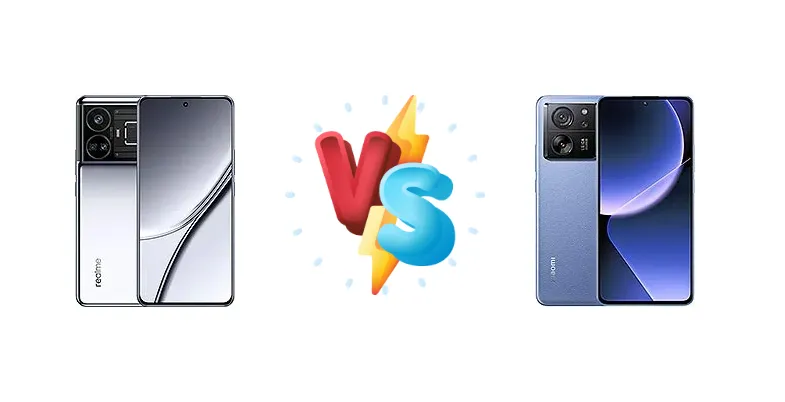
|
🏆 Quick Verdict
For users prioritizing raw performance and the absolute fastest charging speeds, the Realme GT5 is the clear winner. However, the Xiaomi 13T Pro offers a more refined, all-around experience with excellent battery endurance and a brighter display, making it ideal for everyday users.
| PHONES | ||
|---|---|---|
| Phone Names | Realme GT5 | Xiaomi 13T Pro |
| Network | ||
|---|---|---|
| 2G bands | GSM 850 / 900 / 1800 / 1900 | GSM 850 / 900 / 1800 / 1900 |
| 3G bands | HSDPA 850 / 900 / 2100 | HSDPA 800 / 850 / 900 / 1700(AWS) / 1900 / 2100 |
| 4G bands | 1, 3, 5, 7, 8, 28, 34, 38, 39, 40, 41 | 1, 2, 3, 4, 5, 7, 8, 12, 13, 17, 18, 19, 20, 25, 26, 28, 32, 38, 39, 40, 41, 42, 48, 66 |
| 5G bands | 1, 3, 5, 8, 28, 41, 77, 78 SA/NSA | 1, 3, 5, 7, 8, 20, 28, 38, 40, 41, 66, 75, 77, 78 SA/NSA |
| Speed | HSPA, LTE, 5G | HSPA, LTE, 5G |
| Technology | GSM / CDMA / HSPA / EVDO / LTE / 5G | GSM / HSPA / LTE / 5G |
| Launch | ||
|---|---|---|
| Announced | 2023, August 28 | 2023, September 26 |
| Status | Available. Released 2023, September 04 | Available. Released 2023, September 26 |
| Body | ||
|---|---|---|
| Build | Glass front, aluminum frame, glass back | Glass front (Gorilla Glass 5), glass back or silicone polymer back, plastic frame |
| Dimensions | 163.1 x 75.4 x 8.9 mm (6.42 x 2.97 x 0.35 in) | 162.2 x 75.7 x 8.5 mm (6.39 x 2.98 x 0.33 in) |
| SIM | Nano-SIM + Nano-SIM | · Nano-SIM + eSIM· Nano-SIM + Nano-SIM |
| Weight | 205 g (7.23 oz) | 200 g or 206 g (7.05 oz) |
| Display | ||
|---|---|---|
| Protection | - | Corning Gorilla Glass 5 |
| Resolution | 1240 x 2772 pixels, 20:9 ratio (~451 ppi density) | 1220 x 2712 pixels, 20:9 ratio (~446 ppi density) |
| Size | 6.74 inches, 109.2 cm2 (~88.8% screen-to-body ratio) | 6.67 inches, 107.4 cm2 (~87.5% screen-to-body ratio) |
| Type | AMOLED, 1B colors, 144Hz, HDR10+, 1400 nits (peak) | AMOLED, 68B colors, 144Hz, Dolby Vision, HDR10+, 1200 nits (HBM), 2600 nits (peak) |
| Platform | ||
|---|---|---|
| CPU | Octa-core (1x3.2 GHz Cortex-X3 & 2x2.8 GHz Cortex-A715 & 2x2.8 GHz Cortex-A710 & 3x2.0 GHz Cortex-A510) | Octa-core (1x3.35 GHz Cortex-X3 & 3x3.0 GHz Cortex-A715 & 4x2.0 GHz Cortex-A510) |
| Chipset | Qualcomm SM8550-AB Snapdragon 8 Gen 2 (4 nm) | Mediatek Dimensity 9200+ (4 nm) |
| GPU | Adreno 740 | Immortalis-G715 MC11 |
| OS | Android 13, Realme UI 4.0 | Android 13, up to 4 major Android upgrades, HyperOS |
| Memory | ||
|---|---|---|
| Card slot | No | No |
| Internal | 256GB 12GB RAM, 512GB 16GB RAM | 256GB 12GB RAM, 512GB 12GB RAM, 1TB 16GB RAM |
| Main Camera | ||
|---|---|---|
| Features | Dual-LED dual-tone flash, HDR, panorama | Leica lens, color spectrum sensor, LED flash, HDR, panorama |
| Triple | 50 MP, f/1.9, 24mm (wide), 1/1.56", 1.0µm, PDAF, OIS 8 MP, f/2.2, 16mm, 112˚ (ultrawide), 1/4.0", 1.12µm 2 MP (macro) | 50 MP, f/1.9, 24mm (wide), 1/1.28", 1.22µm, PDAF, OIS 50 MP, f/1.9, 50mm (telephoto), 1/2.88", 0.61µm, PDAF, 2x optical zoom 12 MP, f/2.2, 15mm (ultrawide), 1/3.06", 1.12µm |
| Video | 4K@30/60fps, 1080p@30/60fps, gyro-EIS | 8K@24fps, 4K@24/30/60fps, 4K/1080p@30fps HDR10+, 1080p@30/60/120/240fps; 10-bit LOG, gyro-EIS |
| Selfie camera | ||
|---|---|---|
| Features | HDR, panorama | HDR |
| Single | 16 MP, f/2.5, 25mm (wide), 1/3.09", 1.0µm | 20 MP, f/2.2, (wide), 0.8µm |
| Video | 1080p@30fps, gyro-EIS | 1080p@30fps, HDR10+ |
| Sound | ||
|---|---|---|
| 35mm jack | No | No |
| Loudspeaker | Yes, with stereo speakers | Yes, with stereo speakers |
| Comms | ||
|---|---|---|
| Bluetooth | 5.3, A2DP, LE, aptX HD | 5.4, A2DP, LE |
| Infrared port | Yes | Yes |
| NFC | Yes | Yes |
| Positioning | GPS (L1+L2+L5), GLONASS, BDS, GALILEO, QZSS | GPS (L1+L5), GLONASS (G1), GALILEO (E1+E5a), NavIC (L5), BDS |
| Radio | No | No |
| USB | USB Type-C 2.0 | USB Type-C 2.0, OTG |
| WLAN | Wi-Fi 802.11 a/b/g/n/ac/6/7, tri-band, Wi-Fi Direct | Wi-Fi 802.11 a/b/g/n/ac/6e/7, dual/tri-band (market/region dependent), Wi-Fi Direct |
| Features | ||
|---|---|---|
| Sensors | Fingerprint (under display, optical), accelerometer, gyro, proximity, compass | Fingerprint (under display, optical), accelerometer, gyro, proximity, compass |
| Battery | ||
|---|---|---|
| Charging | 150W wired, PD, 50% in 7 min | 120W wired, PD3.0, QC4, 100% in 19 min |
| Type | 5240 mAh | Li-Po 5000 mAh |
| Misc | ||
|---|---|---|
| Colors | Flowing Silver, Starry Oasis | Alpine Blue, Meadow Green, Black |
| Models | RMX3820 | 23078PND5G |
| Price | About 380 EUR | $ 370.00 / £ 482.55 / € 301.99 |
| SAR EU | - | 1.00 W/kg (head) 0.99 W/kg (body) |
Realme GT5
- Blazing-fast 150W charging
- Superior GPU performance with Snapdragon 8 Gen 2
- Potentially better thermal management for sustained gaming
- Battery life potentially compromised by faster charging focus
- Display brightness likely lower than Xiaomi 13T Pro
Xiaomi 13T Pro
- Excellent battery life (11:50h active use)
- Brighter display (1094 nits)
- Balanced feature set for everyday use
- Slower charging speed (120W)
- Dimensity 9200+ GPU may not match Snapdragon 8 Gen 2
Display Comparison
The Xiaomi 13T Pro boasts a significantly brighter display, reaching a measured peak of 1094 nits. This translates to superior visibility outdoors. While the Realme GT5’s display specs aren’t provided, the 13T Pro’s brightness advantage is substantial. The 13T Pro’s panel likely benefits from advanced display technologies to achieve this brightness, potentially impacting power consumption. The lack of detailed display information for the GT5 makes a direct comparison of color accuracy and refresh rate difficult, but the 13T Pro’s brightness is a clear advantage for outdoor use.
Camera Comparison
Detailed camera specifications are limited, but the focus should be on the main sensors. Without knowing the sensor sizes or apertures, it’s difficult to make a definitive judgment. However, the Xiaomi 13T Pro’s inclusion of 'Photo / Video' suggests a more comprehensive camera experience, potentially with advanced video recording capabilities. The Realme GT5’s camera system is likely geared towards speed and efficiency, leveraging the Snapdragon’s ISP. The presence of a 2MP macro camera on either device is largely irrelevant, offering minimal practical benefit to most users.
Performance
Both devices utilize a 4nm process, but the chipsets differ significantly. The Realme GT5’s Snapdragon 8 Gen 2 features a 1x3.2 GHz Cortex-X3 prime core, alongside 2x2.8 GHz Cortex-A715 and 2x2.8 GHz Cortex-A710 cores, and 3x2.0 GHz Cortex-A510 efficiency cores. The Xiaomi 13T Pro’s Dimensity 9200+ counters with a 1x3.35 GHz Cortex-X3, 3x3.0 GHz Cortex-A715, and 4x2.0 GHz Cortex-A510 cores. The Dimensity 9200+ has a higher clock speed on its prime core and more A715 cores, potentially offering a slight edge in multi-threaded tasks. However, the Snapdragon 8 Gen 2 is renowned for its superior GPU performance and optimized thermal management, crucial for sustained gaming. The GT5 is likely to maintain higher frame rates for longer periods under heavy load.
Battery Life
The Xiaomi 13T Pro shines in battery endurance, achieving an active use score of 11:50h and an endurance rating of 102h. This indicates excellent real-world battery life. The Realme GT5’s battery capacity is unknown, but its 150W wired charging is significantly faster than the 13T Pro’s 120W charging, reaching 50% charge in just 7 minutes. The 13T Pro takes 19 minutes to reach 100%. While the GT5 may have a smaller battery, its ultra-fast charging mitigates this, allowing for quick top-ups throughout the day. The 13T Pro prioritizes longevity, while the GT5 prioritizes speed.
Buying Guide
Buy the Realme GT5 if you need uncompromising gaming performance, the quickest possible charging (reaching 50% in just 7 minutes), and aren't overly concerned with subtle display refinements. Buy the Xiaomi 13T Pro if you prefer a longer-lasting battery, a brighter and more visible display in direct sunlight, and a more balanced feature set for daily use.