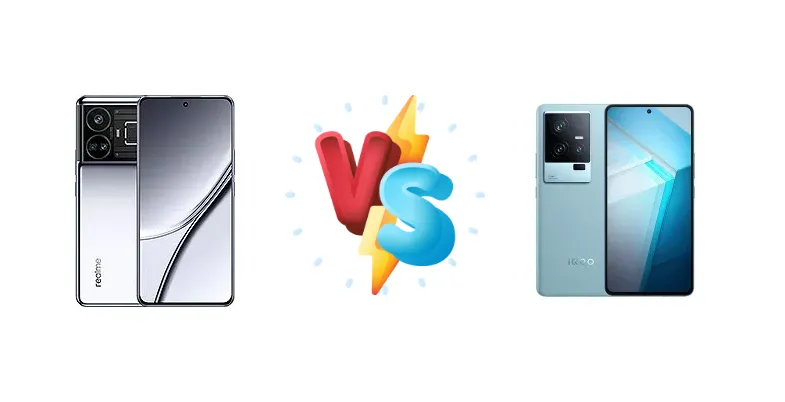
Both the Realme GT5 and vivo iQOO 11S represent aggressive value in the flagship space, powered by Qualcomm’s Snapdragon 8 Gen 2. However, they diverge significantly in charging technology – 150W versus a blistering 200W – and subtle design choices. This comparison dissects these differences to determine which phone delivers the best experience for demanding users.
🏆 Quick Verdict
For most users, the vivo iQOO 11S emerges as the superior choice. While both phones share the same powerful chipset, the iQOO 11S’s 200W charging significantly reduces downtime, and its UFCS/PD3.0 compatibility offers broader charger support. The GT5 remains a strong contender, especially if price is a primary concern.
| Network |
|---|
| 2G bands | GSM 850 / 900 / 1800 / 1900 | GSM 850 / 900 / 1800 / 1900 |
| 3G bands | HSDPA 850 / 900 / 2100 | HSDPA 800 / 850 / 900 / 1700(AWS) / 1900 / 2100 |
| 4G bands | 1, 3, 5, 7, 8, 28, 34, 38, 39, 40, 41 | 1, 2, 3, 4, 5, 7, 8, 12, 17, 18, 19, 20, 26, 28, 34, 38, 39, 40, 41 |
| 5G bands | 1, 3, 5, 8, 28, 41, 77, 78 SA/NSA | 1, 3, 5, 8, 28, 40, 41, 77, 78 SA/NSA |
| Speed | HSPA, LTE, 5G | HSPA, LTE, 5G |
| Technology | GSM / CDMA / HSPA / EVDO / LTE / 5G | GSM / CDMA / HSPA / CDMA2000 / LTE / 5G |
| Launch |
|---|
| Announced | 2023, August 28 | 2023, July 04 |
| Status | Available. Released 2023, September 04 | Available. Released 2023, July 10 |
| Body |
|---|
| Build | Glass front, aluminum frame, glass back | - |
| Dimensions | 163.1 x 75.4 x 8.9 mm (6.42 x 2.97 x 0.35 in) | 164.9 x 77.1 x 8.4 mm or 8.7 mm |
| SIM | Nano-SIM + Nano-SIM | Nano-SIM + Nano-SIM |
| Weight | 205 g (7.23 oz) | 207 g or 210 g (7.30 oz) |
| Display |
|---|
| Protection | - | Corning Gorilla Glass Victus |
| Resolution | 1240 x 2772 pixels, 20:9 ratio (~451 ppi density) | 1440 x 3200 pixels, 20:9 ratio (~518 ppi density) |
| Size | 6.74 inches, 109.2 cm2 (~88.8% screen-to-body ratio) | 6.78 inches, 111.0 cm2 (~87.3% screen-to-body ratio) |
| Type | AMOLED, 1B colors, 144Hz, HDR10+, 1400 nits (peak) | LTPO4 AMOLED, 1B colors, 144Hz, HDR10+, 1800 nits (peak) |
| Platform |
|---|
| CPU | Octa-core (1x3.2 GHz Cortex-X3 & 2x2.8 GHz Cortex-A715 & 2x2.8 GHz Cortex-A710 & 3x2.0 GHz Cortex-A510) | Octa-core (1x3.2 GHz Cortex-X3 & 2x2.8 GHz Cortex-A715 & 2x2.8 GHz Cortex-A710 & 3x2.0 GHz Cortex-A510) |
| Chipset | Qualcomm SM8550-AB Snapdragon 8 Gen 2 (4 nm) | Qualcomm SM8550-AB Snapdragon 8 Gen 2 (4 nm) |
| GPU | Adreno 740 | Adreno 740 |
| OS | Android 13, Realme UI 4.0 | Android 13, OriginOS 3 (China) |
| Memory |
|---|
| Card slot | No | No |
| Internal | 256GB 12GB RAM, 512GB 16GB RAM | 256GB 12GB RAM, 256GB 16GB RAM, 512GB 16GB RAM, 1TB 16GB RAM |
| Main Camera |
|---|
| Features | Dual-LED dual-tone flash, HDR, panorama | Dual-LED flash, HDR, panorama |
| Triple | 50 MP, f/1.9, 24mm (wide), 1/1.56", 1.0µm, PDAF, OIS
8 MP, f/2.2, 16mm, 112˚ (ultrawide), 1/4.0", 1.12µm
2 MP (macro) | 50 MP, f/1.9, 23mm (wide), 1/1.49", 1.0µm, PDAF, OIS
13 MP, f/2.5, 47mm (telephoto), PDAF, 2x optical zoom
8 MP, f/2.2, 16mm (ultrawide) |
| Video | 4K@30/60fps, 1080p@30/60fps, gyro-EIS | 8K@30fps, 4K@30/60fps, 1080p@30/60/120/240fps, gyro-EIS |
| Selfie camera |
|---|
| Features | HDR, panorama | HDR |
| Single | 16 MP, f/2.5, 25mm (wide), 1/3.09", 1.0µm | 16 MP, f/2.5, (wide) |
| Video | 1080p@30fps, gyro-EIS | 1080p@30fps, gyro-EIS |
| Sound |
|---|
| 35mm jack | No | No |
| Loudspeaker | Yes, with stereo speakers | Yes, with stereo speakers |
| Comms |
|---|
| Bluetooth | 5.3, A2DP, LE, aptX HD | 5.3, A2DP, LE, aptX HD, aptX Adaptive, aptX Lossless |
| Infrared port | Yes | Yes |
| NFC | Yes | Yes |
| Positioning | GPS (L1+L2+L5), GLONASS, BDS, GALILEO, QZSS | GPS, GLONASS, GALILEO, BDS, NavIC |
| Radio | No | No |
| USB | USB Type-C 2.0 | USB Type-C 2.0, OTG |
| WLAN | Wi-Fi 802.11 a/b/g/n/ac/6/7, tri-band, Wi-Fi Direct | Wi-Fi 802.11 a/b/g/n/ac/6, dual-band, Wi-Fi Direct |
| Features |
|---|
| Sensors | Fingerprint (under display, optical), accelerometer, gyro, proximity, compass | Fingerprint (under display, optical), accelerometer, gyro, proximity, compass |
| Battery |
|---|
| Charging | 150W wired, PD, 50% in 7 min | 200W wired, PD3.0, UFCS |
| Type | 5240 mAh | 4700 mAh |
| Misc |
|---|
| Colors | Flowing Silver, Starry Oasis | Black, Sky Blue, Legendary White (BMW M branding) |
| Models | RMX3820 | V2304A |
| Price | About 380 EUR | About 500 EUR |
Realme GT5
- Potentially lower price point
- Very fast 150W charging
- Powerful Snapdragon 8 Gen 2 processor
- Slower charging than iQOO 11S
- Limited charging standard support (compared to iQOO)
vivo iQOO 11S
- Industry-leading 200W charging
- UFCS and PD3.0 charging compatibility
- Potentially superior thermal management (based on brand history)
- Likely higher price
- May not offer significant camera improvements over GT5
Display Comparison
Both devices are expected to feature high-refresh-rate AMOLED displays, though specific details like peak brightness and PWM dimming rates are not provided. The absence of LTPO information suggests both may not dynamically adjust refresh rates for optimal power efficiency. Bezels are likely minimal on both, reflecting current flagship trends. Color accuracy will likely be excellent, given the AMOLED panel type, but independent testing is needed to confirm.
Camera Comparison
Without detailed camera specifications, a direct comparison is limited. Both phones will likely feature multi-camera systems, but the sensor sizes and lens apertures are unknown. The iQOO brand often emphasizes camera capabilities, suggesting a potentially more refined image processing pipeline. The absence of information regarding Optical Image Stabilization (OIS) is a key omission; its presence would be a significant advantage for low-light photography and video recording. Any 2MP macro lenses included should be considered a marketing feature rather than a substantial photographic tool.
Performance
The core performance is identical: both the Realme GT5 and iQOO 11S utilize the Qualcomm SM8550-AB Snapdragon 8 Gen 2 (4nm). This means the CPU configuration – 1x3.2 GHz Cortex-X3, 2x2.8 GHz Cortex-A715, 2x2.8 GHz Cortex-A710, and 3x2.0 GHz Cortex-A510 – is mirrored. However, the iQOO 11S may benefit from a more sophisticated cooling system (based on iQOO’s gaming heritage) to sustain peak performance for longer durations. The 4nm process node inherently offers improved thermal efficiency compared to older nodes, mitigating throttling during extended gaming sessions. RAM configuration (likely LPDDR5X) will also play a role, but is not specified in the provided data.
Battery Life
The iQOO 11S’s 200W wired charging is the standout feature. This, coupled with UFCS and PD3.0 support, provides faster charging and broader compatibility. The Realme GT5’s 150W charging is still incredibly fast, achieving 50% charge in 7 minutes, but the iQOO 11S will likely complete a full charge significantly quicker. While battery capacity isn’t specified, the faster charging of the iQOO 11S effectively mitigates the impact of a potentially smaller battery, offering more usable uptime throughout the day.
Buying Guide
Buy the Realme GT5 if you prioritize a potentially lower price point and are comfortable with slightly slower charging speeds. It’s ideal for users who don’t mind topping up their phone overnight or less frequently. Buy the vivo iQOO 11S if you demand the fastest possible charging, value broader charging standard support, and are willing to pay a premium for the convenience of a full charge in under 30 minutes.
Frequently Asked Questions
❓ Does the 200W charging on the iQOO 11S degrade the battery faster than the 150W on the GT5?
While higher wattage charging *can* theoretically contribute to faster battery degradation over the long term, modern charging algorithms and battery management systems mitigate this risk. The iQOO 11S employs UFCS and PD3.0, which dynamically adjust voltage and current to optimize charging speed and minimize heat, potentially extending battery lifespan despite the higher wattage.
❓ Is the charging brick included with both phones, and what type of charger does each support?
Both phones are expected to include a charger in the box. The Realme GT5 supports 150W wired charging, while the iQOO 11S supports 200W wired charging, along with UFCS and PD3.0. This means the iQOO 11S offers broader compatibility with existing chargers, as PD3.0 is a widely adopted standard.
❓ Will either phone overheat during prolonged gaming sessions?
Both phones utilize the Snapdragon 8 Gen 2, which is thermally efficient. However, the iQOO 11S, benefiting from iQOO’s gaming focus, may incorporate a more robust cooling solution (vapor chamber, graphite sheets) to sustain peak performance for longer periods without significant throttling. Independent thermal testing is required to confirm.