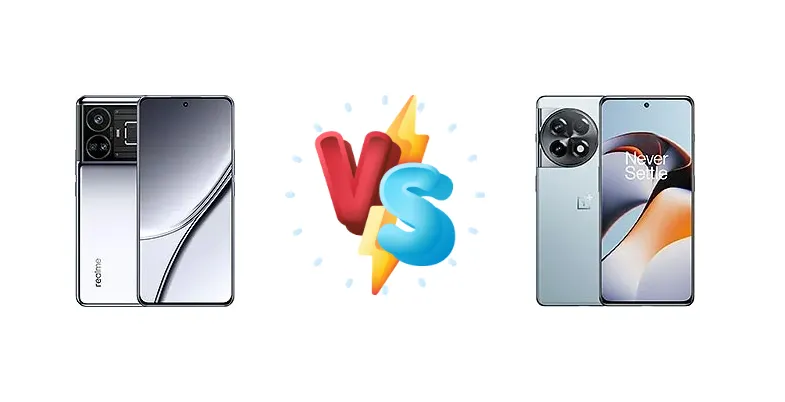
The Realme GT5 and OnePlus 11R represent a fascinating intersection of flagship power and aggressive pricing. The GT5 boasts the latest Snapdragon 8 Gen 2, while the 11R leverages the still-potent Snapdragon 8+ Gen 1. This comparison dissects the core differences to determine which device delivers the best experience for your money.
🏆 Quick Verdict
For users prioritizing raw performance and the fastest charging speeds, the Realme GT5 is the clear winner. Its Snapdragon 8 Gen 2 offers a noticeable performance uplift, and the 150W charging is significantly faster than the 11R’s 100W. However, the OnePlus 11R remains a compelling option for those seeking a balanced experience at a potentially lower price.
| Network |
|---|
| 2G bands | GSM 850 / 900 / 1800 / 1900 | GSM 850 / 900 / 1800 / 1900 |
| 3G bands | HSDPA 850 / 900 / 2100 | HSDPA 850 / 900 / 1700(AWS) / 2100 |
| 4G bands | 1, 3, 5, 7, 8, 28, 34, 38, 39, 40, 41 | 1, 3, 4, 5, 8, 28, 34, 38, 39, 40, 41 |
| 5G bands | 1, 3, 5, 8, 28, 41, 77, 78 SA/NSA | 1, 3, 5, 8, 28, 40, 41, 77, 78 SA/NSA |
| Speed | HSPA, LTE, 5G | HSPA, LTE (3CA), 5G |
| Technology | GSM / CDMA / HSPA / EVDO / LTE / 5G | GSM / CDMA / HSPA / LTE / 5G |
| | - | CDMA 800 |
| Launch |
|---|
| Announced | 2023, August 28 | 2023, February 07 |
| Status | Available. Released 2023, September 04 | Available. Released 2023, February 21 |
| Body |
|---|
| Build | Glass front, aluminum frame, glass back | Glass front, glass back (Gorilla Glass 5), plastic frame |
| Dimensions | 163.1 x 75.4 x 8.9 mm (6.42 x 2.97 x 0.35 in) | 163.4 x 74.3 x 8.7 mm (6.43 x 2.93 x 0.34 in) |
| SIM | Nano-SIM + Nano-SIM | Nano-SIM + Nano-SIM |
| Weight | 205 g (7.23 oz) | 204 g (7.20 oz) |
| Display |
|---|
| Resolution | 1240 x 2772 pixels, 20:9 ratio (~451 ppi density) | 1240 x 2772 pixels, 20:9 ratio (~451 ppi density) |
| Size | 6.74 inches, 109.2 cm2 (~88.8% screen-to-body ratio) | 6.74 inches, 109.2 cm2 (~90.0% screen-to-body ratio) |
| Type | AMOLED, 1B colors, 144Hz, HDR10+, 1400 nits (peak) | Fluid AMOLED, 1B colors, 120Hz, HDR10+, 1450 nits (peak) |
| Platform |
|---|
| CPU | Octa-core (1x3.2 GHz Cortex-X3 & 2x2.8 GHz Cortex-A715 & 2x2.8 GHz Cortex-A710 & 3x2.0 GHz Cortex-A510) | Octa-core (1x3.0 GHz Cortex-X2 & 3x2.5 GHz Cortex-A710 & 4x1.80 GHz Cortex-A510) |
| Chipset | Qualcomm SM8550-AB Snapdragon 8 Gen 2 (4 nm) | Qualcomm SM8475 Snapdragon 8+ Gen 1 (4 nm) |
| GPU | Adreno 740 | Adreno 730 |
| OS | Android 13, Realme UI 4.0 | Android 13, upgradable to Android 15, OxygenOS 15 |
| Memory |
|---|
| Card slot | No | No |
| Internal | 256GB 12GB RAM, 512GB 16GB RAM | 128GB 8GB RAM, 256GB 16GB RAM, 512GB 18GB RAM |
| | - | UFS 3.1 |
| Main Camera |
|---|
| Features | Dual-LED dual-tone flash, HDR, panorama | Color spectrum sensor, LED flash, HDR, panorama |
| Single | - | 16 MP, f/2.4, 24mm (wide), 1/3.09", 1.0µm |
| Triple | 50 MP, f/1.9, 24mm (wide), 1/1.56", 1.0µm, PDAF, OIS
8 MP, f/2.2, 16mm, 112˚ (ultrawide), 1/4.0", 1.12µm
2 MP (macro) | 50 MP, f/1.8, 24mm (wide), 1/1.56", 1.0µm, multi-directional PDAF, OIS
8 MP, f/2.2, 120˚ (ultrawide), 1/4.0", 1.12µm
2 MP (macro) |
| Video | 4K@30/60fps, 1080p@30/60fps, gyro-EIS | 4K@30/60fps, 1080p@30/60/240fps, gyro-EIS |
| Selfie camera |
|---|
| Features | HDR, panorama | HDR |
| Single | 16 MP, f/2.5, 25mm (wide), 1/3.09", 1.0µm | 16 MP, f/2.4, 24mm (wide), 1/3.09", 1.0µm |
| Video | 1080p@30fps, gyro-EIS | 1080p@30fps |
| Sound |
|---|
| 3.5mm jack | - | No |
| 35mm jack | No | No |
| Loudspeaker | Yes, with stereo speakers | Yes, with stereo speakers |
| | - | 24-bit/192kHz audio |
| Comms |
|---|
| Bluetooth | 5.3, A2DP, LE, aptX HD | 5.3, A2DP, LE, aptX HD |
| Infrared port | Yes | Yes |
| NFC | Yes | Yes |
| Positioning | GPS (L1+L2+L5), GLONASS, BDS, GALILEO, QZSS | GPS (L1+L5), GLONASS (G1), BDS (B1I+B1c+B2a), GALILEO (E1+E5a), QZSS (L1+L5) |
| Radio | No | No |
| USB | USB Type-C 2.0 | USB Type-C 2.0 |
| WLAN | Wi-Fi 802.11 a/b/g/n/ac/6/7, tri-band, Wi-Fi Direct | Wi-Fi 802.11 a/b/g/n/ac/6, dual-band |
| Features |
|---|
| Sensors | Fingerprint (under display, optical), accelerometer, gyro, proximity, compass | Fingerprint (under display, optical), accelerometer, gyro, proximity, compass |
| Battery |
|---|
| Charging | 150W wired, PD, 50% in 7 min | 100W wired |
| Type | 5240 mAh | Li-Po 5000 mAh |
| Misc |
|---|
| Colors | Flowing Silver, Starry Oasis | Galactic Silver, Sonic Black, Solar Red |
| Models | RMX3820 | CPH2487 |
| Price | About 380 EUR | About 600 EUR |
| SAR | - | 1.16 W/kg (head) 0.61 W/kg (body) |
Realme GT5
- Superior performance with Snapdragon 8 Gen 2
- Blazing-fast 150W charging
- More efficient 4nm process for better battery life
- Potentially higher price
- Realme’s UI may not appeal to all users
OnePlus 11R
- Excellent performance with Snapdragon 8+ Gen 1
- Potentially lower price point
- Refined OnePlus OxygenOS software experience
- Slower 100W charging
- Less efficient chipset compared to Snapdragon 8 Gen 2
Display Comparison
While both devices likely feature high refresh rate AMOLED displays (data not provided), the core difference lies in the processing power driving them. The Snapdragon 8 Gen 2 in the GT5 will handle graphically intensive tasks on the display more smoothly. The 4nm process node of the GT5’s chipset also contributes to better thermal management during prolonged use, preventing potential throttling that could impact display performance. We expect both to offer vibrant colors and good viewing angles, but the GT5 has the potential for a more consistently fluid experience.
Camera Comparison
Without specific camera sensor details, it’s difficult to make a definitive judgment. However, the chipset plays a crucial role in image processing. The Snapdragon 8 Gen 2’s improved ISP (Image Signal Processor) in the GT5 will likely result in better dynamic range, noise reduction, and overall image quality, particularly in challenging lighting conditions. The 11R’s 8+ Gen 1 is capable, but the GT5 has a clear advantage in computational photography. We anticipate both phones will offer similar video recording capabilities, but the GT5’s processing power could enable more advanced features.
Performance
The Realme GT5’s Snapdragon 8 Gen 2 is the key differentiator here. Built on a 4nm process, it features a Cortex-X3 prime core clocked at 3.2 GHz, offering a significant architectural advantage over the OnePlus 11R’s Snapdragon 8+ Gen 1. The 8+ Gen 1, while still powerful, utilizes a Cortex-X2 core clocked at 3.0 GHz. This translates to faster application loading, smoother multitasking, and higher sustained performance in demanding games. The GT5’s CPU configuration (1+2+2+3) also provides a more balanced approach to power and efficiency compared to the 11R’s (1+3+4).
Battery Life
The Realme GT5’s 150W wired charging is a game-changer. Claimed to reach 50% charge in just 7 minutes, it drastically reduces downtime. The OnePlus 11R’s 100W charging is still fast, but significantly slower. While battery capacity isn’t specified, the GT5’s more efficient Snapdragon 8 Gen 2 chipset will likely offset any potential capacity difference. The 4nm process node contributes to lower power consumption, extending battery life during typical usage. The GT5 prioritizes speed, while the 11R offers a more conventional fast-charging experience.
Buying Guide
Buy the Realme GT5 if you demand the absolute best performance for gaming and demanding tasks, and if minimizing charging time is a priority. Its Snapdragon 8 Gen 2 provides a future-proofed experience. Buy the OnePlus 11R if you value a refined software experience, a potentially lower price point, and still-excellent performance for everyday use and most gaming scenarios. It’s a smart choice for users who don’t necessarily need the bleeding edge.
Frequently Asked Questions
❓ Will the Realme GT5 get noticeably hotter than the OnePlus 11R during extended gaming sessions?
The Snapdragon 8 Gen 2 in the GT5, built on a 4nm process, is inherently more thermally efficient than the 8+ Gen 1 in the 11R. While both phones will likely get warm, the GT5 should exhibit less thermal throttling, maintaining higher sustained performance for longer periods. However, cooling system design within each phone also plays a significant role.
❓ Does the Snapdragon 8+ Gen 1 in the OnePlus 11R still hold up for demanding games like Genshin Impact or PUBG?
Yes, the Snapdragon 8+ Gen 1 remains a very capable chipset for gaming. It can comfortably run most popular titles at high settings. However, you might experience slightly lower frame rates or more noticeable frame drops compared to the GT5, especially during prolonged gaming sessions or with maxed-out graphics settings.
❓ Is the 150W charging on the Realme GT5 safe for the battery's long-term health?
Realme incorporates battery health management features to mitigate the potential impact of extremely fast charging. While rapid charging generates more heat, the GT5’s charging system is designed to regulate voltage and current to minimize battery degradation. However, consistently using 150W charging *may* slightly accelerate battery aging compared to slower charging methods.