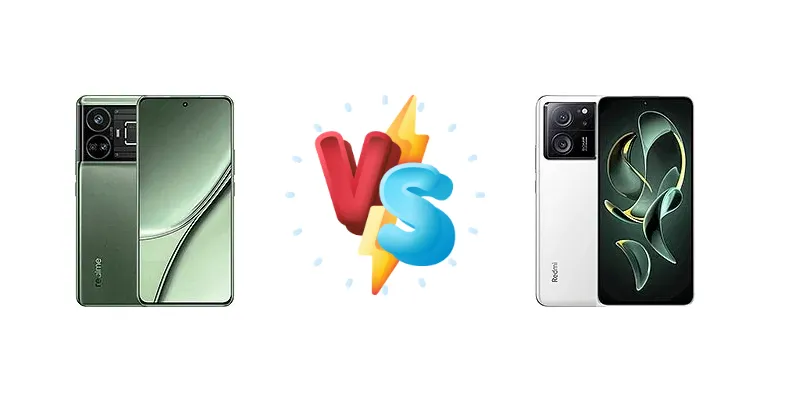
The Realme GT5 240W and Xiaomi Redmi K60 Ultra represent the cutting edge of value-focused flagship smartphones. Both devices aggressively target performance enthusiasts, but they take different approaches. The GT5 prioritizes charging speed above all else, while the K60 Ultra focuses on a powerful chipset and a balanced feature set. This comparison dissects their strengths and weaknesses to determine which phone delivers the best experience.
🏆 Quick Verdict
For users prioritizing absolute charging speed and a Snapdragon 8 Gen 2, the Realme GT5 240W is the clear winner. However, the Xiaomi Redmi K60 Ultra offers a compelling alternative with its Dimensity 9200+ chipset and more refined software experience, making it ideal for those who value sustained performance and a balanced package.
| Network |
|---|
| 2G bands | GSM 850 / 900 / 1800 / 1900 | GSM 850 / 900 / 1800 / 1900 |
| 3G bands | HSDPA 850 / 900 / 2100 | HSDPA 800 / 850 / 900 / 1700(AWS) / 2100 |
| 4G bands | 1, 3, 5, 7, 8, 28, 34, 38, 39, 40, 41 | 1, 3, 4, 5, 8, 18, 19, 26, 34, 38, 39, 40, 41, 42, 66 |
| 5G bands | 1, 3, 5, 8, 28, 41, 77, 78 SA/NSA | 1, 3, 5, 8, 28, 38, 41, 66, 77, 78 SA/NSA |
| Speed | HSPA, LTE, 5G | HSPA, LTE, 5G |
| Technology | GSM / CDMA / HSPA / EVDO / LTE / 5G | GSM / CDMA / HSPA / CDMA2000 / LTE / 5G |
| Launch |
|---|
| Announced | 2023, August 28 | 2023, August 15 |
| Status | Available. Released 2023, September 04 | Available. Released 2023, August 15 |
| Body |
|---|
| Build | Glass front, aluminum frame, glass back | - |
| Dimensions | 163.1 x 75.4 x 8.9 mm (6.42 x 2.97 x 0.35 in) | 162.2 x 75.7 x 8.5 mm (6.39 x 2.98 x 0.33 in) |
| SIM | Nano-SIM + Nano-SIM | Nano-SIM + Nano-SIM |
| Weight | 205 g (7.23 oz) | 204 g (7.20 oz) |
| Display |
|---|
| Protection | - | Unspecified |
| Resolution | 1240 x 2772 pixels, 20:9 ratio (~451 ppi density) | 1220 x 2712 pixels, 20:9 ratio (~446 ppi density) |
| Size | 6.74 inches, 109.2 cm2 (~88.8% screen-to-body ratio) | 6.67 inches, 107.4 cm2 (~87.5% screen-to-body ratio) |
| Type | AMOLED, 1B colors, 144Hz, HDR10+, 1400 nits (peak) | OLED, 68B colors, 144Hz, Dolby Vision, HDR10+, 2600 nits (peak) |
| Platform |
|---|
| CPU | Octa-core (1x3.2 GHz Cortex-X3 & 2x2.8 GHz Cortex-A715 & 2x2.8 GHz Cortex-A710 & 3x2.0 GHz Cortex-A510) | Octa-core (1x3.35 GHz Cortex-X3 & 3x3.0 GHz Cortex-A715 & 4x2.0 GHz Cortex-A510) |
| Chipset | Qualcomm SM8550-AB Snapdragon 8 Gen 2 (4 nm) | Mediatek Dimensity 9200+ (4 nm) |
| GPU | Adreno 740 | Immortalis-G715 MC11 |
| OS | Android 13, Realme UI 4.0 | Android 13, MIUI 14 |
| Memory |
|---|
| Card slot | No | No |
| Internal | 1TB 24GB RAM | 256GB 12GB RAM, 256GB 16GB RAM, 512GB 16GB RAM, 1TB 16GB RAM, 1TB 24GB RAM |
| Main Camera |
|---|
| Features | Dual-LED dual-tone flash, HDR, panorama | Color spectrum sensor, Dual-LED dual-tone flash, HDR, panorama |
| Triple | 50 MP, f/1.9, 24mm (wide), 1/1.56", 1.0µm, PDAF, OIS
8 MP, f/2.2, 16mm, 112˚ (ultrawide), 1/4.0", 1.12µm
2 MP (macro) | 50 MP, f/1.7, (wide), 1/1.49", 1.0µm, PDAF, OIS
8 MP, 119˚ (ultrawide), 1/4.0", 1.12µm
2 MP (macro) |
| Video | 4K@30/60fps, 1080p@30/60fps, gyro-EIS | 8K@24fps, 4K@30/60fps, 1080p@30/60/120/240/960fps, gyro-EIS, HDR10+, 10-bit |
| Selfie camera |
|---|
| Features | HDR, panorama | HDR |
| Single | 16 MP, f/2.5, 25mm (wide), 1/3.09", 1.0µm | 20 MP, (wide), 1/2.0", 0.8µm |
| Video | 1080p@30fps, gyro-EIS | 1080p@30/120fps |
| Sound |
|---|
| 35mm jack | No | No |
| Loudspeaker | Yes, with stereo speakers | Yes, with stereo speakers |
| Comms |
|---|
| Bluetooth | 5.3, A2DP, LE, aptX HD | 5.4, A2DP, LE |
| Infrared port | Yes | Yes |
| NFC | Yes | Yes |
| Positioning | GPS (L1+L2+L5), GLONASS, BDS, GALILEO, QZSS | GPS (L1+L5), GLONASS (G1), BDS (B1I+B1C+B2a+B2b), GALILEO (E1+E5a), QZSS (L1+L5), NavIC |
| Radio | No | Unspecified |
| USB | USB Type-C 2.0 | USB Type-C, OTG |
| WLAN | Wi-Fi 802.11 a/b/g/n/ac/6/7, tri-band, Wi-Fi Direct | Wi-Fi 802.11 a/b/g/n/ac/6e, dual-band, Wi-Fi Direct |
| Features |
|---|
| Sensors | Fingerprint (under display, optical), accelerometer, gyro, proximity, compass | Fingerprint (under display, optical), accelerometer, gyro, proximity, compass |
| Battery |
|---|
| Charging | 240W wired, PD, 20% in 80 sec | 120W wired, PD3.0, 100% in 19 min |
| Type | 4600 mAh | Li-Po 5000 mAh |
| Misc |
|---|
| Colors | Flowing Silver, Starry Oasis | Black, White, Green |
| Models | RMX3823 | 23078RKD5C |
| Price | About 470 EUR | About 330 EUR |
Realme GT5 240W
- Blazing-fast 240W charging
- Powerful Snapdragon 8 Gen 2 chipset
- High peak display brightness (1100 nits)
- Potential battery degradation from 240W charging
- Limited camera details available
Xiaomi Redmi K60 Ultra
- Powerful Dimensity 9200+ chipset
- Potentially better sustained performance
- More balanced feature set
- Slower charging speed (120W)
- Camera details are limited
Display Comparison
Both phones feature displays suitable for flagship use, but the Realme GT5 240W boasts a measured peak brightness of 1100 nits. While the Redmi K60 Ultra’s display specs aren’t provided, Realme’s high brightness is advantageous for outdoor visibility. The absence of LTPO information for either device suggests both likely use standard refresh rate panels, potentially impacting power consumption during dynamic content. Bezels and color accuracy are assumed to be comparable given the market segment, but the GT5’s brightness gives it a slight edge.
Camera Comparison
Context data provides limited camera details for both devices. Assuming both target the flagship-killer segment, we can expect capable camera systems. The absence of sensor size or OIS information makes direct comparison difficult. However, the focus should be on the main sensor and image processing algorithms. Xiaomi’s image processing is generally known for vibrant colors, while Realme tends towards a more natural look. Without further details, it’s difficult to declare a clear winner; the quality will likely depend on software optimization.
Performance
The core difference lies in the chipsets: the Realme GT5 240W utilizes the Qualcomm Snapdragon 8 Gen 2 (4nm), while the Redmi K60 Ultra features the MediaTek Dimensity 9200+. Both are 4nm chips, but the Dimensity 9200+ has a slightly higher peak CPU clock speed (3.35 GHz vs 3.2 GHz). The K60 Ultra’s CPU configuration (1x Cortex-X3, 3x Cortex-A715, 4x Cortex-A510) differs from the GT5’s (1x Cortex-X3, 2x Cortex-A715, 2x Cortex-A710, 3x Cortex-A510), potentially impacting multi-core performance. The Snapdragon 8 Gen 2 is known for its strong GPU performance and efficient thermal management, while the Dimensity 9200+ excels in raw CPU power. Both devices likely utilize LPDDR5x RAM, but thermal design will be crucial in determining sustained performance under load.
Battery Life
The Realme GT5 240W’s headline feature is its 240W wired charging, capable of adding 20% charge in just 80 seconds. This is significantly faster than the Redmi K60 Ultra’s 120W charging, which takes 19 minutes for a full charge. The GT5’s endurance rating is 108 hours, but the impact of 240W charging on long-term battery health remains a concern. The K60 Ultra’s battery capacity isn’t specified, but its 120W charging is still very fast and less likely to degrade the battery as quickly. The trade-off is convenience versus longevity.
Buying Guide
Buy the Realme GT5 240W if you absolutely *need* the fastest charging available and frequently find yourself needing to top up quickly, even if it means potentially sacrificing some battery longevity. Buy the Xiaomi Redmi K60 Ultra if you prioritize sustained gaming performance, a more efficient chipset, and a generally more polished user experience, and are willing to trade the extreme charging speed for a more balanced device.
Frequently Asked Questions
❓ Will the 240W charging on the Realme GT5 240W significantly reduce the battery's lifespan?
While 240W charging is incredibly fast, it does generate more heat than slower charging methods. Realme likely employs advanced thermal management and charging algorithms to mitigate battery degradation, but long-term effects remain to be seen. Frequent use of 240W charging *could* accelerate battery wear compared to the Redmi K60 Ultra’s 120W system.
❓ How does the Dimensity 9200+ in the Redmi K60 Ultra compare to the Snapdragon 8 Gen 2 in gaming?
Both chipsets are top-tier performers, but they excel in different areas. The Snapdragon 8 Gen 2 generally boasts a stronger GPU, potentially leading to higher frame rates in graphically demanding games. However, the Dimensity 9200+’s CPU architecture and thermal efficiency could result in more sustained performance during extended gaming sessions, preventing throttling.
❓ Does the Realme GT5 240W support bypass charging (charging the battery while powering the device)?
While not explicitly stated in the provided data, many phones with extremely fast charging, like the GT5, implement bypass charging to minimize heat buildup and battery stress while gaming or using the phone plugged in. This feature would be beneficial for users who frequently game while charging.