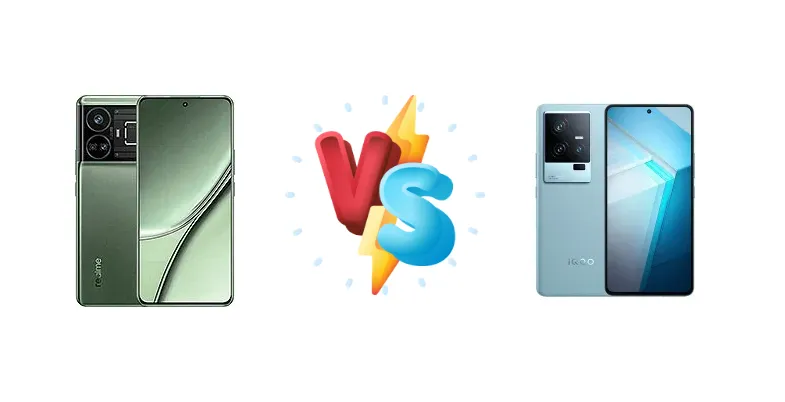
Both the Realme GT5 240W and the vivo iQOO 11S represent the pinnacle of Android flagship performance, powered by the Qualcomm Snapdragon 8 Gen 2. However, they diverge significantly in their approach to charging speed and overall user experience. The GT5 aggressively pushes the boundaries of wired charging, while the iQOO 11S focuses on a more balanced package with optimized software and a slightly more refined experience.
🏆 Quick Verdict
For the average user prioritizing absolute charging speed and a bold aesthetic, the Realme GT5 240W is the clear winner. Its 240W charging is a game-changer, replenishing the battery in under a minute. However, the iQOO 11S offers a more polished software experience and potentially better long-term battery health due to its slightly less aggressive charging.
| Network |
|---|
| 2G bands | GSM 850 / 900 / 1800 / 1900 | GSM 850 / 900 / 1800 / 1900 |
| 3G bands | HSDPA 850 / 900 / 2100 | HSDPA 800 / 850 / 900 / 1700(AWS) / 1900 / 2100 |
| 4G bands | 1, 3, 5, 7, 8, 28, 34, 38, 39, 40, 41 | 1, 2, 3, 4, 5, 7, 8, 12, 17, 18, 19, 20, 26, 28, 34, 38, 39, 40, 41 |
| 5G bands | 1, 3, 5, 8, 28, 41, 77, 78 SA/NSA | 1, 3, 5, 8, 28, 40, 41, 77, 78 SA/NSA |
| Speed | HSPA, LTE, 5G | HSPA, LTE, 5G |
| Technology | GSM / CDMA / HSPA / EVDO / LTE / 5G | GSM / CDMA / HSPA / CDMA2000 / LTE / 5G |
| Launch |
|---|
| Announced | 2023, August 28 | 2023, July 04 |
| Status | Available. Released 2023, September 04 | Available. Released 2023, July 10 |
| Body |
|---|
| Build | Glass front, aluminum frame, glass back | - |
| Dimensions | 163.1 x 75.4 x 8.9 mm (6.42 x 2.97 x 0.35 in) | 164.9 x 77.1 x 8.4 mm or 8.7 mm |
| SIM | Nano-SIM + Nano-SIM | Nano-SIM + Nano-SIM |
| Weight | 205 g (7.23 oz) | 207 g or 210 g (7.30 oz) |
| Display |
|---|
| Protection | - | Corning Gorilla Glass Victus |
| Resolution | 1240 x 2772 pixels, 20:9 ratio (~451 ppi density) | 1440 x 3200 pixels, 20:9 ratio (~518 ppi density) |
| Size | 6.74 inches, 109.2 cm2 (~88.8% screen-to-body ratio) | 6.78 inches, 111.0 cm2 (~87.3% screen-to-body ratio) |
| Type | AMOLED, 1B colors, 144Hz, HDR10+, 1400 nits (peak) | LTPO4 AMOLED, 1B colors, 144Hz, HDR10+, 1800 nits (peak) |
| Platform |
|---|
| CPU | Octa-core (1x3.2 GHz Cortex-X3 & 2x2.8 GHz Cortex-A715 & 2x2.8 GHz Cortex-A710 & 3x2.0 GHz Cortex-A510) | Octa-core (1x3.2 GHz Cortex-X3 & 2x2.8 GHz Cortex-A715 & 2x2.8 GHz Cortex-A710 & 3x2.0 GHz Cortex-A510) |
| Chipset | Qualcomm SM8550-AB Snapdragon 8 Gen 2 (4 nm) | Qualcomm SM8550-AB Snapdragon 8 Gen 2 (4 nm) |
| GPU | Adreno 740 | Adreno 740 |
| OS | Android 13, Realme UI 4.0 | Android 13, OriginOS 3 (China) |
| Memory |
|---|
| Card slot | No | No |
| Internal | 1TB 24GB RAM | 256GB 12GB RAM, 256GB 16GB RAM, 512GB 16GB RAM, 1TB 16GB RAM |
| Main Camera |
|---|
| Features | Dual-LED dual-tone flash, HDR, panorama | Dual-LED flash, HDR, panorama |
| Triple | 50 MP, f/1.9, 24mm (wide), 1/1.56", 1.0µm, PDAF, OIS
8 MP, f/2.2, 16mm, 112˚ (ultrawide), 1/4.0", 1.12µm
2 MP (macro) | 50 MP, f/1.9, 23mm (wide), 1/1.49", 1.0µm, PDAF, OIS
13 MP, f/2.5, 47mm (telephoto), PDAF, 2x optical zoom
8 MP, f/2.2, 16mm (ultrawide) |
| Video | 4K@30/60fps, 1080p@30/60fps, gyro-EIS | 8K@30fps, 4K@30/60fps, 1080p@30/60/120/240fps, gyro-EIS |
| Selfie camera |
|---|
| Features | HDR, panorama | HDR |
| Single | 16 MP, f/2.5, 25mm (wide), 1/3.09", 1.0µm | 16 MP, f/2.5, (wide) |
| Video | 1080p@30fps, gyro-EIS | 1080p@30fps, gyro-EIS |
| Sound |
|---|
| 35mm jack | No | No |
| Loudspeaker | Yes, with stereo speakers | Yes, with stereo speakers |
| Comms |
|---|
| Bluetooth | 5.3, A2DP, LE, aptX HD | 5.3, A2DP, LE, aptX HD, aptX Adaptive, aptX Lossless |
| Infrared port | Yes | Yes |
| NFC | Yes | Yes |
| Positioning | GPS (L1+L2+L5), GLONASS, BDS, GALILEO, QZSS | GPS, GLONASS, GALILEO, BDS, NavIC |
| Radio | No | No |
| USB | USB Type-C 2.0 | USB Type-C 2.0, OTG |
| WLAN | Wi-Fi 802.11 a/b/g/n/ac/6/7, tri-band, Wi-Fi Direct | Wi-Fi 802.11 a/b/g/n/ac/6, dual-band, Wi-Fi Direct |
| Features |
|---|
| Sensors | Fingerprint (under display, optical), accelerometer, gyro, proximity, compass | Fingerprint (under display, optical), accelerometer, gyro, proximity, compass |
| Battery |
|---|
| Charging | 240W wired, PD, 20% in 80 sec | 200W wired, PD3.0, UFCS |
| Type | 4600 mAh | 4700 mAh |
| Misc |
|---|
| Colors | Flowing Silver, Starry Oasis | Black, Sky Blue, Legendary White (BMW M branding) |
| Models | RMX3823 | V2304A |
| Price | About 470 EUR | About 500 EUR |
Realme GT5 240W
- Unrivaled 240W charging speed
- High peak display brightness (1100 nits)
- Snapdragon 8 Gen 2 performance
- Potentially reduced long-term battery health
- Aggressive design may not appeal to everyone
vivo iQOO 11S
- Optimized software experience (likely)
- Potentially better thermal management
- Fast 200W charging
- Slower charging than the Realme GT5
- Display specs less detailed
Display Comparison
Both devices utilize high-end displays, but specific details beyond peak brightness are limited. The Realme GT5 240W boasts a measured peak brightness of 1100 nits, suggesting excellent outdoor visibility. While the iQOO 11S’s display specs aren’t provided, vivo typically employs high-quality AMOLED panels. The absence of LTPO information for either device means we can’t assess adaptive refresh rate capabilities, a key feature for battery efficiency. The GT5’s brightness advantage is likely noticeable in direct sunlight.
Camera Comparison
Context data provides limited camera information for both devices. Given the flagship positioning, both likely feature multi-camera systems. However, without sensor size, aperture, or OIS details, a direct comparison is difficult. It’s reasonable to assume both will offer competent photo and video capabilities, but the iQOO 11S, based on vivo’s camera reputation, may prioritize image processing for more natural-looking results, while Realme often leans towards more vibrant, saturated colors. The absence of details makes it impossible to assess low-light performance or zoom capabilities.
Performance
Both the Realme GT5 240W and the vivo iQOO 11S are equipped with the Qualcomm SM8550-AB Snapdragon 8 Gen 2 (4 nm) chipset, featuring the same Octa-core CPU configuration (1x3.2 GHz Cortex-X3, 2x2.8 GHz Cortex-A715, 2x2.8 GHz Cortex-A710, and 3x2.0 GHz Cortex-A510). This means raw processing power will be nearly identical. Performance differences will likely stem from thermal management and software optimization. iQOO’s history suggests a focus on gaming optimization, potentially leading to more sustained performance under heavy load. The 4nm process node contributes to improved thermal efficiency compared to older generations, minimizing throttling during extended gaming sessions.
Battery Life
The Realme GT5 240W’s defining feature is its 240W wired charging, capable of adding 20% charge in just 80 seconds. This is significantly faster than the iQOO 11S’s 200W charging, despite both supporting PD and UFCS standards. While the iQOO 11S’s 200W is still incredibly fast, the GT5 offers a tangible advantage for users constantly on the go. The Realme GT5’s endurance rating of 108h suggests reasonable battery life, but the aggressive charging may impact long-term battery health. The iQOO 11S, with its slightly more conservative charging approach, might offer better battery longevity.
Buying Guide
Buy the Realme GT5 240W if you need the absolute fastest charging available and don't mind a more attention-grabbing design. It's ideal for users who frequently find themselves with critically low battery and need a quick top-up. Buy the vivo iQOO 11S if you prefer a more refined software experience, potentially better thermal management during sustained loads, and a slightly more conservative approach to battery technology. It's suited for gamers and power users who value stability and longevity.
Frequently Asked Questions
❓ Will the 240W charging of the Realme GT5 240W significantly degrade the battery over time?
While 240W charging is incredibly fast, it does generate more heat than slower charging methods. Realme likely employs advanced charging protocols and thermal management to mitigate battery degradation. However, users who consistently utilize the maximum charging speed may experience a slightly faster decline in battery health compared to those who charge at slower rates. The iQOO 11S’s 200W charging is less aggressive and may offer better long-term battery health.
❓ Does the iQOO 11S offer any gaming-specific features beyond the Snapdragon 8 Gen 2 chipset?
vivo’s iQOO sub-brand is known for its gaming focus. While specific features aren’t detailed in the provided context, it’s highly probable the iQOO 11S includes software optimizations for gaming, such as dedicated game modes, performance enhancements, and potentially advanced cooling solutions. These features aim to provide a smoother and more immersive gaming experience.
❓ What type of charging protocol does the Realme GT5 240W use, and is a special charger required?
The Realme GT5 240W utilizes a proprietary SuperVOOC charging protocol to achieve its 240W speeds. This means you *must* use the included charger to take advantage of the fastest charging. Standard PD chargers will charge the device, but at significantly slower speeds.