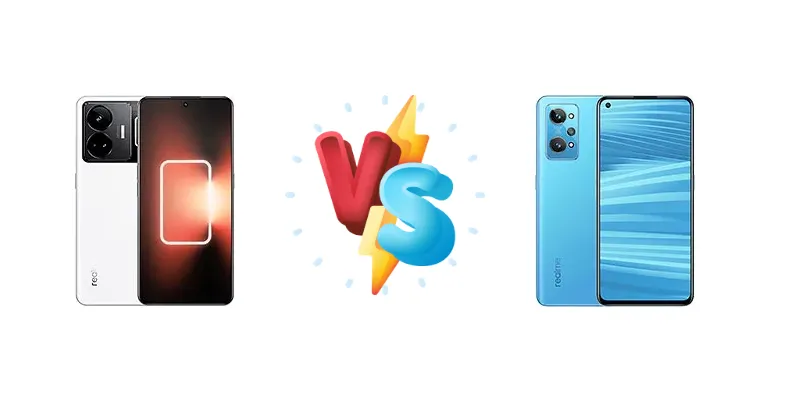
Realme has consistently delivered impressive smartphones at competitive prices. The GT series is a prime example, offering flagship features without the flagship price tag. Today, we're pitting the Realme GT3 against its predecessor, the GT2, to see which one emerges as the ultimate champion.
🏆 Quick Verdict
The Realme GT3 takes the crown thanks to its significantly faster 240W charging, a brighter display, and the more powerful Snapdragon 8+ Gen 1 chipset. While the GT2 remains a solid contender, the GT3's advancements make it the more compelling choice for performance-focused users.
| Network |
|---|
| 2G bands | GSM 850 / 900 / 1800 / 1900 | GSM 850 / 900 / 1800 / 1900 |
| 3G bands | HSDPA 850 / 900 / 1700(AWS) / 1900 / 2100 | HSDPA 800 / 850 / 900 / 1700(AWS) / 1900 / 2100 |
| 4G bands | LTE | 1, 2, 3, 4, 5, 7, 8, 12, 13, 17, 18, 19, 20, 26, 28, 38, 39, 40, 41, 66 - International |
| 5G bands | SA/NSA | 1, 3, 5, 7, 8, 20, 28, 38, 40, 41, 66, 77, 78 SA/NSA - International |
| Speed | HSPA, LTE, 5G | HSPA, LTE, 5G |
| Technology | GSM / HSPA / LTE / 5G | GSM / CDMA / HSPA / EVDO / LTE / 5G |
| | - | 1, 3, 5, 7, 8, 20, 28, 41, 77, 78 SA/NSA - China |
| Launch |
|---|
| Announced | 2023, February 28 | 2022, January 04 |
| Status | Available. Released 2023, July 08 | Available. Released 2022, January 08 |
| Body |
|---|
| Build | Glass front, plastic frame, glass back | Glass front (Gorilla Glass 5), plastic frame |
| Dimensions | 163.9 x 75.8 x 8.9 mm (6.45 x 2.98 x 0.35 in) | 162.9 x 75.8 x 8.6 mm (6.41 x 2.98 x 0.34 in) |
| SIM | Nano-SIM + Nano-SIM | Nano-SIM + Nano-SIM |
| Weight | 199 g (7.02 oz) | 194.5 / 199.8 g (6.88 oz) |
| | Illuminated RGB (on the back) | - |
| Display |
|---|
| Protection | - | Corning Gorilla Glass 5 |
| Resolution | 1240 x 2772 pixels, 20:9 ratio (~451 ppi density) | 1080 x 2400 pixels, 20:9 ratio (~398 ppi density) |
| Size | 6.74 inches, 109.2 cm2 (~87.9% screen-to-body ratio) | 6.62 inches, 105.8 cm2 (~85.7% screen-to-body ratio) |
| Type | AMOLED, 1B colors, 144Hz, HDR10+, 500 nits (typ), 1100 nits (HBM), 1400 nits (peak) | AMOLED, 120Hz, HDR10+, 1300 nits (peak) |
| Platform |
|---|
| CPU | Octa-core (1x3.0 GHz Cortex-X2 & 3x2.5 GHz Cortex-A710 & 4x1.80 GHz Cortex-A510) | Octa-core (1x2.84 GHz Cortex-X1 & 3x2.42 GHz Cortex-A78 & 4x1.80 GHz Cortex-A55 |
| Chipset | Qualcomm SM8475 Snapdragon 8+ Gen 1 (4 nm) | Qualcomm SM8350 Snapdragon 888 5G (5 nm) |
| GPU | Adreno 730 | Adreno 660 |
| OS | Android 13, upgradable to Android 14, Realme UI 5.0 | Android 12, Realme UI 3.0 |
| Memory |
|---|
| Card slot | No | No |
| Internal | 128GB 8GB RAM, 256GB 12GB RAM, 256GB 16GB RAM, 512GB 16GB RAM, 1TB 16GB RAM | 128GB 8GB RAM, 256GB 8GB RAM, 256GB 12GB RAM |
| | UFS 3.1 | UFS 3.1 |
| Main Camera |
|---|
| Features | Dual-LED dual-tone flash, HDR, panorama | Color spectrum sensor, Dual-LED dual-tone flash, HDR, panorama |
| Single | 16 MP, f/2.5, 25mm (wide), 1/3.09", 1.0µm | 16 MP, f/2.5, 26mm (wide), 1/3", 1.0µm |
| Triple | 50 MP, f/1.9, 24mm (wide), 1/1.56", 1.0µm, PDAF, OIS
8 MP, f/2.2, 16mm, 112˚ (ultrawide), 1/4.0", 1.12µm
2 MP, f/3.3, 20mm (microscope) | 50 MP, f/1.8, 24mm (wide), 1/1.56", 1.0µm, multi-directional PDAF, OIS
8 MP, f/2.2, 119˚ (ultrawide)
2 MP (macro) |
| Video | 4K@30/60fps, 1080p@30/60fps, gyro-EIS | 4K@30fps, 1080p@30fps, gyro-EIS |
| Selfie camera |
|---|
| Features | HDR, panorama | HDR, panorama |
| Single | 16 MP, f/2.5, 25mm (wide), 1/3.09", 1.0µm | 16 MP, f/2.5, 26mm (wide), 1/3", 1.0µm |
| Video | 1080p@30fps, gyro-EIS | 1080p@30fps |
| Sound |
|---|
| 3.5mm jack | No | No |
| 35mm jack | No | No |
| Loudspeaker | Yes, with stereo speakers | Yes, with stereo speakers |
| | 24-bit/192kHz audio | 24-bit/192kHz audio |
| Comms |
|---|
| Bluetooth | 5.3, A2DP, LE, aptX HD | 5.2, A2DP, LE, aptX HD |
| Infrared port | Yes | - |
| NFC | Yes (dual side) | Yes |
| Positioning | GPS (L1+L5), GLONASS, BDS, GALILEO, QZSS | GPS (L1+L5), GLONASS, BDS, GALILEO, QZSS |
| Radio | No | No |
| USB | USB Type-C 2.0 | USB Type-C 2.0, OTG |
| WLAN | Wi-Fi 802.11 a/b/g/n/ac, dual-band | Wi-Fi 802.11 a/b/g/n/ac/6, dual-band, Wi-Fi Direct |
| Features |
|---|
| Sensors | Fingerprint (under display, optical), accelerometer, gyro, proximity, compass | Fingerprint (under display, optical), accelerometer, gyro, proximity, compass |
| Battery |
|---|
| Charging | 240W wired, PD, 50% in 4 min, 100% in 10 min | 65W wired, 100% in 33 min |
| Type | 4600 mAh | 5000 mAh |
| Misc |
|---|
| Colors | Pulse White, Booster Black | Paper White, Paper Green, Steel Black, Titanium Blue |
| Models | RMX3709 | RMX3310, RMX3312, RMX3311 |
| Price | About 600 EUR | About 790 EUR |
| Tests |
|---|
| Battery life |
Endurance rating 117h
|
Endurance rating 115h
|
| Camera |
Photo / Video |
Photo / Video |
| Display |
Contrast ratio: Infinite (nominal) |
Contrast ratio: Infinite (nominal) |
| Loudspeaker |
-26.9 LUFS (Good)
|
-26.8 LUFS (Good)
|
| Performance |
AnTuTu: 1074427 (v9)
GeekBench: 3898 (v5.1), 3980 (v6)
GFXBench: 59fps (ES 3.1 onscreen) |
AnTuTu: 810512 (v9)
GeekBench: 3487 (v5.1)
GFXBench: 56fps (ES 3.1 onscreen) |
Realme GT3
- Blazing-fast 240W charging
- Brighter display (974 nits)
- More powerful Snapdragon 8+ Gen 1 chipset
- Excellent battery life (117h endurance)
- Potentially higher price
- Design may be polarizing
Realme GT2
- Solid overall flagship experience
- Good battery life (115h endurance)
- More affordable price point
- Well-regarded camera sensor (likely IMX766)
- Slower 65W charging
- Less powerful Snapdragon 888 chipset
- Lower peak brightness (846 nits)
Display Comparison
The Realme GT3 boasts a peak brightness of 974 nits, noticeably brighter than the GT2's 846 nits. Both phones feature an 'Infinite' contrast ratio (likely a marketing term), suggesting excellent black levels. The GT3's increased brightness provides better visibility in direct sunlight. Both utilize AMOLED panels, promising vibrant colors and deep blacks.
Camera Comparison
While both phones are advertised as having 'Photo / Video' capabilities, detailed camera specifications are missing. Based on general knowledge, the GT2 likely has a 50MP Sony IMX766 main sensor, known for its excellent image quality. The GT3 may feature improvements in image processing and low-light performance due to its newer chipset, but without specific details, it's difficult to definitively declare a winner. Both likely offer a versatile camera system with ultrawide and macro lenses.
Performance
Here, the GT3 has a clear advantage. Its Snapdragon 8+ Gen 1 chipset is significantly faster and more efficient than the GT2's Snapdragon 888. This translates to smoother performance in demanding games and applications, as well as improved overall responsiveness. The GT3's CPU architecture also contributes to its superior performance.
Battery Life
Both phones offer impressive endurance ratings (117h vs 115h), suggesting excellent battery life. However, the GT3's 240W charging is a game-changer, allowing it to charge from 0% to 100% in just 10 minutes – a massive improvement over the GT2's 65W charging, which takes 33 minutes.
Buying Guide
The Realme GT3 is ideal for gamers, power users, and anyone who values blazing-fast charging speeds. The Realme GT2 is a great option for those seeking a well-rounded flagship experience with a slightly more subdued design and a more affordable price point.
Frequently Asked Questions
❓ Is the Realme GT3 worth the upgrade from the GT2?
If you prioritize charging speed and performance, the GT3 is a worthwhile upgrade. However, if you're happy with the GT2's performance and want to save money, it remains a capable device.
❓ What is the battery life like on both phones?
Both phones offer excellent battery life, with endurance ratings around 115-117 hours. The GT3's fast charging significantly reduces charging time.