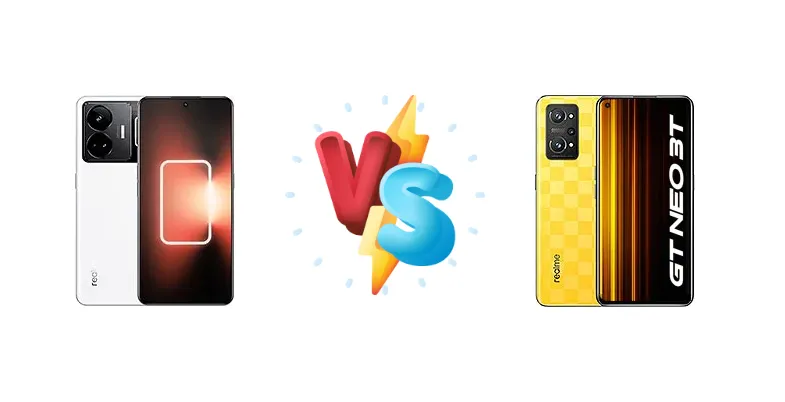
Realme continues to deliver impressive smartphones at competitive prices. The GT3 and GT Neo 3T are two popular contenders, each boasting unique strengths. This comprehensive comparison will break down their key differences to help you decide which one best suits your needs.
🏆 Quick Verdict
The Realme GT3 takes the crown with its blazing-fast 240W charging and superior Snapdragon 8+ Gen 1 chipset. However, the GT Neo 3T offers slightly better battery endurance and a more accessible price point, making it a strong contender for budget-conscious buyers.
| Network |
|---|
| 2G bands | GSM 850 / 900 / 1800 / 1900 | GSM 850 / 900 / 1800 / 1900 |
| 3G bands | HSDPA 850 / 900 / 1700(AWS) / 1900 / 2100 | HSDPA 800 / 850 / 900 / 1700(AWS) / 1900 / 2100 |
| 4G bands | LTE | 1, 2, 3, 4, 5, 7, 8, 12, 13, 17, 18, 19, 20, 26, 28, 38, 39, 40, 41, 66 |
| 5G bands | SA/NSA | 1, 3, 5, 8, 20, 28, 38, 40, 41, 66, 77, 78 SA/NSA |
| Speed | HSPA, LTE, 5G | HSPA, LTE, 5G |
| Technology | GSM / HSPA / LTE / 5G | GSM / CDMA / HSPA / CDMA2000 / LTE / 5G |
| | - | CDMA2000 1x |
| Launch |
|---|
| Announced | 2023, February 28 | 2022, June 07 |
| Status | Available. Released 2023, July 08 | Available. Released 2022, June 25 |
| Body |
|---|
| Build | Glass front, plastic frame, glass back | Glass front (Gorilla Glass 5), plastic back, plastic frame |
| Dimensions | 163.9 x 75.8 x 8.9 mm (6.45 x 2.98 x 0.35 in) | 162.9 x 75.8 x 8.7 mm (6.41 x 2.98 x 0.34 in) |
| SIM | Nano-SIM + Nano-SIM | Nano-SIM + Nano-SIM |
| Weight | 199 g (7.02 oz) | 194.5 g (6.88 oz) |
| | Illuminated RGB (on the back) | - |
| Display |
|---|
| Protection | - | Corning Gorilla Glass 5 |
| Resolution | 1240 x 2772 pixels, 20:9 ratio (~451 ppi density) | 1080 x 2400 pixels, 20:9 ratio (~398 ppi density) |
| Size | 6.74 inches, 109.2 cm2 (~87.9% screen-to-body ratio) | 6.62 inches, 105.8 cm2 (~85.7% screen-to-body ratio) |
| Type | AMOLED, 1B colors, 144Hz, HDR10+, 500 nits (typ), 1100 nits (HBM), 1400 nits (peak) | AMOLED, 120Hz, HDR10+, 1300 nits (peak) |
| Platform |
|---|
| CPU | Octa-core (1x3.0 GHz Cortex-X2 & 3x2.5 GHz Cortex-A710 & 4x1.80 GHz Cortex-A510) | Octa-core (1x3.2 GHz Kryo 585 & 3x2.42 GHz Kryo 585 & 4x1.80 GHz Kryo 585) |
| Chipset | Qualcomm SM8475 Snapdragon 8+ Gen 1 (4 nm) | Qualcomm SM8250-AC Snapdragon 870 5G (7 nm) |
| GPU | Adreno 730 | Adreno 650 |
| OS | Android 13, upgradable to Android 14, Realme UI 5.0 | Android 12, upgradable to Android 13, Realme UI 4.0 |
| Memory |
|---|
| Card slot | No | No |
| Internal | 128GB 8GB RAM, 256GB 12GB RAM, 256GB 16GB RAM, 512GB 16GB RAM, 1TB 16GB RAM | 128GB 6GB RAM, 128GB 8GB RAM, 256GB 8GB RAM |
| | UFS 3.1 | UFS 3.1 |
| Main Camera |
|---|
| Features | Dual-LED dual-tone flash, HDR, panorama | LED flash, HDR, panorama |
| Single | 16 MP, f/2.5, 25mm (wide), 1/3.09", 1.0µm | 16 MP, f/2.5, 26mm (wide), 1/3.09", 1.0µm |
| Triple | 50 MP, f/1.9, 24mm (wide), 1/1.56", 1.0µm, PDAF, OIS
8 MP, f/2.2, 16mm, 112˚ (ultrawide), 1/4.0", 1.12µm
2 MP, f/3.3, 20mm (microscope) | 64 MP, f/1.8, 25mm (wide), 1/2.0", 0.7µm, PDAF
8 MP, f/2.3, 16mm, 119˚ (ultrawide), 1/4.0", 1.12µm
2 MP (macro) |
| Video | 4K@30/60fps, 1080p@30/60fps, gyro-EIS | 4K@30/60fps, 1080p@30fps, gyro-EIS |
| Selfie camera |
|---|
| Features | HDR, panorama | HDR, panorama |
| Single | 16 MP, f/2.5, 25mm (wide), 1/3.09", 1.0µm | 16 MP, f/2.5, 26mm (wide), 1/3.09", 1.0µm |
| Video | 1080p@30fps, gyro-EIS | 1080p@30fps, gyro-EIS |
| Sound |
|---|
| 3.5mm jack | No | No |
| 35mm jack | No | No |
| Loudspeaker | Yes, with stereo speakers | Yes, with stereo speakers |
| | 24-bit/192kHz audio | 24-bit/192kHz audio |
| Comms |
|---|
| Bluetooth | 5.3, A2DP, LE, aptX HD | 5.2, A2DP, LE, aptX HD |
| Infrared port | Yes | - |
| NFC | Yes (dual side) | Yes (market/region dependent) |
| Positioning | GPS (L1+L5), GLONASS, BDS, GALILEO, QZSS | GPS (L1+L5), GLONASS, BDS, GALILEO, QZSS, NavIC |
| Radio | No | No |
| USB | USB Type-C 2.0 | USB Type-C 2.0 |
| WLAN | Wi-Fi 802.11 a/b/g/n/ac, dual-band | Wi-Fi 802.11 a/b/g/n/ac/6, dual-band, Wi-Fi Direct |
| Features |
|---|
| Sensors | Fingerprint (under display, optical), accelerometer, gyro, proximity, compass | Fingerprint (under display, optical), accelerometer, gyro, proximity, compass |
| Battery |
|---|
| Charging | 240W wired, PD, 50% in 4 min, 100% in 10 min | 80W wired |
| Type | 4600 mAh | 5000 mAh |
| Misc |
|---|
| Colors | Pulse White, Booster Black | Shade Black, Drifting White, Dash Yellow |
| Models | RMX3709 | RMX3372, RMX3371 |
| Price | About 600 EUR | About 780 EUR |
| Tests |
|---|
| Battery life |
Endurance rating 117h
|
Endurance rating 118h
|
| Camera |
Photo / Video |
Photo / Video |
| Display |
Contrast ratio: Infinite (nominal) |
Contrast ratio: Infinite (nominal) |
| Loudspeaker |
-26.9 LUFS (Good)
|
-25.2 LUFS (Very good)
|
| Performance |
AnTuTu: 1074427 (v9)
GeekBench: 3898 (v5.1), 3980 (v6)
GFXBench: 59fps (ES 3.1 onscreen) |
AnTuTu: 726007 (v9)
GeekBench: 3180 (v5.1)
GFXBench: 49fps (ES 3.1 onscreen) |
Realme GT3
- Blazing-fast 240W charging
- Superior Snapdragon 8+ Gen 1 chipset
- Brighter display
- Premium build quality (likely)
- Potentially higher price
- Slightly lower battery endurance (compared to GT Neo 3T)
- Camera details are unclear
Realme GT Neo 3T
- Excellent battery life
- Competitive price
- Solid Snapdragon 870 performance
- Good display
- Slower charging speed
- Less powerful chipset than GT3
- Display not as bright as GT3
Display Comparison
The Realme GT3 boasts a significantly brighter display at 974 nits compared to the GT Neo 3T's 803 nits. Both offer an 'Infinite' contrast ratio (likely a marketing term), suggesting deep blacks. While both displays are likely AMOLED, the GT3's higher brightness provides better visibility in direct sunlight. Color accuracy and refresh rate (likely 120Hz on both) are likely comparable.
Camera Comparison
Camera details are sparse in the provided specs. Both phones likely feature a triple-camera setup with a primary sensor, ultrawide, and macro lens. Image quality will likely be comparable in good lighting conditions, but the GT3's more powerful processor *could* offer slightly better image processing and low-light performance. Video recording capabilities are also likely similar.
Performance
The GT3's Snapdragon 8+ Gen 1 is a clear winner in the performance department. It's a newer and more powerful chipset than the GT Neo 3T's Snapdragon 870. Expect smoother multitasking, faster app loading times, and better gaming performance on the GT3. The GT Neo 3T still offers excellent performance for everyday tasks and most games, but the GT3 has a noticeable edge.
Battery Life
The GT Neo 3T edges out the GT3 slightly in endurance rating (118h vs 117h), suggesting marginally better real-world battery life. However, the GT3's 240W charging is a game-changer, allowing it to charge from 0% to 100% in just 10 minutes – a massive advantage.
Buying Guide
The Realme GT3 is ideal for power users who prioritize charging speed and top-tier performance. The GT Neo 3T is a great choice for those seeking a well-rounded smartphone with excellent battery life and a competitive price tag.
Frequently Asked Questions
❓ Is the Realme GT3 worth the extra money?
If you prioritize charging speed and top-tier performance, the GT3 is worth the investment. However, if you're on a budget, the GT Neo 3T offers excellent value.
❓ Which phone has better gaming performance?
The Realme GT3, thanks to its Snapdragon 8+ Gen 1 chipset, will provide a smoother and more responsive gaming experience.