
Realme GT2 vs Xiaomi 12T Pro: A Deep Dive into Flagship Performance and Value
| Phones Images | |||||
|---|---|---|---|---|---|
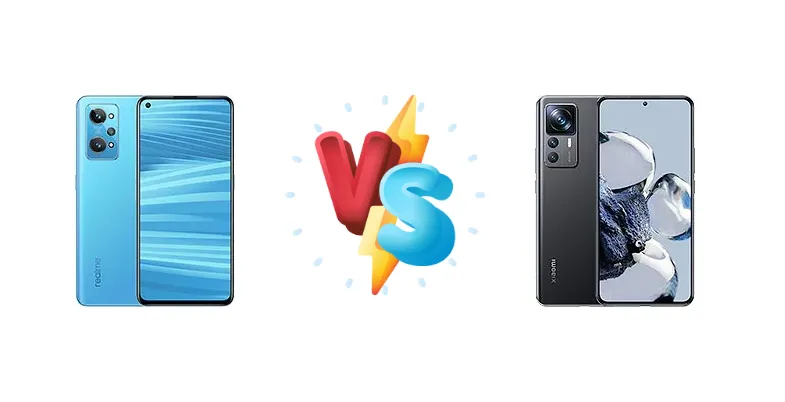
|
🏆 Quick Verdict
For most users, the Xiaomi 12T Pro emerges as the superior choice. Its Snapdragon 8+ Gen 1 chipset offers a noticeable performance uplift and improved thermal efficiency over the GT2’s Snapdragon 888. The significantly faster 120W charging further sweetens the deal, despite a slightly lower endurance rating.
| PHONES | ||
|---|---|---|
| Phone Names | Realme GT2 | Xiaomi 12T Pro |
| Network | ||
|---|---|---|
| 2G bands | GSM 850 / 900 / 1800 / 1900 | GSM 850 / 900 / 1800 / 1900 |
| 3G bands | HSDPA 800 / 850 / 900 / 1700(AWS) / 1900 / 2100 | HSDPA 800 / 850 / 900 / 1700(AWS) / 1900 / 2100 |
| 4G bands | 1, 2, 3, 4, 5, 7, 8, 12, 13, 17, 18, 19, 20, 26, 28, 38, 39, 40, 41, 66 - International | 1, 2, 3, 4, 5, 7, 8, 12, 13, 17, 18, 19, 20, 25, 26, 28, 32, 38, 39, 40, 41, 42, 48, 66 |
| 5G bands | 1, 3, 5, 7, 8, 20, 28, 38, 40, 41, 66, 77, 78 SA/NSA - International | 1, 3, 5, 7, 8, 20, 28, 38, 40, 41, 66, 77, 78, 75 SA/NSA |
| Speed | HSPA, LTE, 5G | HSPA, LTE, 5G |
| Technology | GSM / CDMA / HSPA / EVDO / LTE / 5G | GSM / HSPA / LTE / 5G |
| 1, 3, 5, 7, 8, 20, 28, 41, 77, 78 SA/NSA - China | - | |
| Launch | ||
|---|---|---|
| Announced | 2022, January 04 | 2022, October 04 |
| Status | Available. Released 2022, January 08 | Available. Released 2022, October 06 |
| Body | ||
|---|---|---|
| Build | Glass front (Gorilla Glass 5), plastic frame | - |
| Dimensions | 162.9 x 75.8 x 8.6 mm (6.41 x 2.98 x 0.34 in) | 163.1 x 75.9 x 8.6 mm (6.42 x 2.99 x 0.34 in) |
| SIM | Nano-SIM + Nano-SIM | · Nano-SIM + eSIM· Nano-SIM + Nano-SIM |
| Weight | 194.5 / 199.8 g (6.88 oz) | 205 g (7.23 oz) |
| - | IP53, dust and splash resistant | |
| Display | ||
|---|---|---|
| Protection | Corning Gorilla Glass 5 | Corning Gorilla Glass 5 |
| Resolution | 1080 x 2400 pixels, 20:9 ratio (~398 ppi density) | 1220 x 2712 pixels, 20:9 ratio (~446 ppi density) |
| Size | 6.62 inches, 105.8 cm2 (~85.7% screen-to-body ratio) | 6.67 inches, 107.4 cm2 (~86.7% screen-to-body ratio) |
| Type | AMOLED, 120Hz, HDR10+, 1300 nits (peak) | AMOLED, 68B colors, 120Hz, Dolby Vision, HDR10+, 500 nits (typ), 900 nits (peak) |
| Platform | ||
|---|---|---|
| CPU | Octa-core (1x2.84 GHz Cortex-X1 & 3x2.42 GHz Cortex-A78 & 4x1.80 GHz Cortex-A55 | Octa-core (1x3.19 GHz Cortex-X2 & 3x2.75 GHz Cortex-A710 & 4x2.0 GHz Cortex-A510) |
| Chipset | Qualcomm SM8350 Snapdragon 888 5G (5 nm) | Qualcomm SM8475 Snapdragon 8+ Gen 1 (4 nm) |
| GPU | Adreno 660 | Adreno 730 |
| OS | Android 12, Realme UI 3.0 | Android 12, upgradable to Android 14, HyperOS |
| Memory | ||
|---|---|---|
| Card slot | No | No |
| Internal | 128GB 8GB RAM, 256GB 8GB RAM, 256GB 12GB RAM | 128GB 8GB RAM, 256GB 8GB RAM, 256GB 12GB RAM |
| UFS 3.1 | UFS 3.1 | |
| Main Camera | ||
|---|---|---|
| Features | Color spectrum sensor, Dual-LED dual-tone flash, HDR, panorama | Color spectrum sensor, Dual-LED dual-tone flash, HDR, panorama |
| Single | 16 MP, f/2.5, 26mm (wide), 1/3", 1.0µm | - |
| Triple | 50 MP, f/1.8, 24mm (wide), 1/1.56", 1.0µm, multi-directional PDAF, OIS 8 MP, f/2.2, 119˚ (ultrawide) 2 MP (macro) | 200 MP, f/1.7, (wide), 1/1.22", 0.64µm, PDAF, OIS 8 MP, f/2.2, 120˚ (ultrawide), 1/4.0", 1.12µm 2 MP (macro) |
| Video | 4K@30fps, 1080p@30fps, gyro-EIS | 8K@24fps, 4K@30/60fps, 1080p@30/60/120/240fps, HDR10+ |
| Selfie camera | ||
|---|---|---|
| Features | HDR, panorama | HDR, panorama |
| Single | 16 MP, f/2.5, 26mm (wide), 1/3", 1.0µm | 20 MP, f/2.2, (wide), 1/3.47", 0.8µm |
| Video | 1080p@30fps | 1080p@30/60fps, HDR |
| Sound | ||
|---|---|---|
| 3.5mm jack | No | No |
| 35mm jack | No | No |
| Loudspeaker | Yes, with stereo speakers | Yes, with stereo speakers |
| 24-bit/192kHz audio | Tuned by Harman Kardon 24-bit/192kHz audio | |
| Comms | ||
|---|---|---|
| Bluetooth | 5.2, A2DP, LE, aptX HD | 5.2, A2DP, LE, aptX HD |
| Infrared port | - | Yes |
| NFC | Yes | Yes (market/region dependent) |
| Positioning | GPS (L1+L5), GLONASS, BDS, GALILEO, QZSS | GPS (L1+L5), GLONASS (L1), BDS (B1I+B1c+B2a), GALILEO (E1+E5a), QZSS (L1+L5), NavIC (L5) |
| Radio | No | No |
| USB | USB Type-C 2.0, OTG | USB Type-C 2.0, OTG |
| WLAN | Wi-Fi 802.11 a/b/g/n/ac/6, dual-band, Wi-Fi Direct | Wi-Fi 802.11 a/b/g/n/ac/6, dual-band, Wi-Fi Direct |
| Features | ||
|---|---|---|
| Sensors | Fingerprint (under display, optical), accelerometer, gyro, proximity, compass | Fingerprint (under display, optical), accelerometer, gyro, proximity, compass |
| Battery | ||
|---|---|---|
| Charging | 65W wired, 100% in 33 min | 120W wired, 100% in 19 min |
| Type | 5000 mAh | Li-Po 5000 mAh |
| Misc | ||
|---|---|---|
| Colors | Paper White, Paper Green, Steel Black, Titanium Blue | Black, Silver, Blue |
| Models | RMX3310, RMX3312, RMX3311 | 22081212UG, 22081212G |
| Price | About 790 EUR | $ 208.76 / € 167.62 |
| SAR | - | 1.08 W/kg (head) 1.07 W/kg (body) |
| SAR EU | - | 1.00 W/kg (head) 1.00 W/kg (body) |
| Tests | ||
|---|---|---|
| Battery life | Endurance rating 115h | Endurance rating 91h |
| Camera | Photo / Video | Photo / Video |
| Display | Contrast ratio: Infinite (nominal) | Contrast ratio: Infinite (nominal) |
| Loudspeaker | -26.8 LUFS (Good) | -24.1 LUFS (Very good) |
| Performance | AnTuTu: 810512 (v9) GeekBench: 3487 (v5.1) GFXBench: 56fps (ES 3.1 onscreen) | AnTuTu: 1032185 (v9) GeekBench: 4081 (v5.1) GFXBench: 65fps (ES 3.1 onscreen) |
Realme GT2
- Slightly better battery endurance rating
- Potentially lower price point (depending on market)
- Solid all-around performance
- Older Snapdragon 888 chipset
- Slower charging speed (65W)
- Lower peak display brightness
Xiaomi 12T Pro
- More powerful Snapdragon 8+ Gen 1 chipset
- Significantly faster 120W charging
- Brighter display for outdoor visibility
- Lower battery endurance rating
- Potentially higher price point
- May run slightly warmer under sustained load (though 8+ Gen 1 is efficient)
Display Comparison
Both the Realme GT2 and Xiaomi 12T Pro feature displays with an 'Infinite' (nominal) contrast ratio, typical for OLED panels. However, the Xiaomi 12T Pro boasts a higher peak brightness of 913 nits compared to the GT2’s 846 nits. This translates to better visibility under direct sunlight. While both offer excellent viewing experiences, the 12T Pro’s brighter display provides a slight advantage for outdoor use. Details regarding refresh rates and panel technology (LTPO) are missing, but given the flagship positioning, both likely support high refresh rates, though the GT2 may lack adaptive refresh rate technology.
Camera Comparison
Both devices are listed as having 'Photo / Video' capabilities, lacking specific details. Without sensor size or aperture information, a direct comparison is difficult. However, Xiaomi generally focuses on computational photography, potentially offering more refined image processing. The absence of details suggests neither phone features a particularly groundbreaking camera system, focusing instead on all-around competence. We can assume both will offer a range of shooting modes, but the 12T Pro’s more powerful ISP (Image Signal Processor) within the Snapdragon 8+ Gen 1 could provide an edge in low-light performance and video recording.
Performance
The core difference lies in the chipsets. The Xiaomi 12T Pro’s Snapdragon 8+ Gen 1 (4nm) is a significant upgrade over the Realme GT2’s Snapdragon 888 (5nm). The 4nm process node of the 8+ Gen 1 delivers superior power efficiency and thermal performance, meaning less throttling during sustained workloads like gaming. The 12T Pro’s CPU, featuring a Cortex-X2 prime core clocked at 3.19 GHz, outperforms the GT2’s Cortex-X1 (2.84 GHz). The newer Cortex-A710 cores in the 12T Pro also provide a performance boost over the GT2’s A78 cores. While both phones likely utilize LPDDR5 RAM, the 8+ Gen 1’s memory controller is more efficient, contributing to overall system responsiveness.
Battery Life
The Realme GT2 boasts an endurance rating of 115 hours, while the Xiaomi 12T Pro manages 91 hours. However, this doesn’t tell the whole story. The 12T Pro compensates for the lower endurance with its blazing-fast 120W charging, achieving a full charge in just 19 minutes. The GT2’s 65W charging takes 33 minutes. This difference in charging speed is substantial, making the 12T Pro more convenient for users who frequently need to top up their battery. The 8+ Gen 1’s efficiency also contributes to real-world battery life, mitigating the impact of the smaller battery capacity.
Buying Guide
Buy the Realme GT2 if you prioritize a slightly longer endurance rating and are comfortable with a chipset that, while still powerful, is a generation behind. It’s a solid option for users who don’t demand the absolute peak performance. Buy the Xiaomi 12T Pro if you value raw processing power, faster charging speeds, and a more modern chipset architecture, making it ideal for gamers and power users.