
Realme GT2 vs. vivo iQOO 9 Pro: A Deep Dive into Flagship Performance
| Phones Images | |||||
|---|---|---|---|---|---|
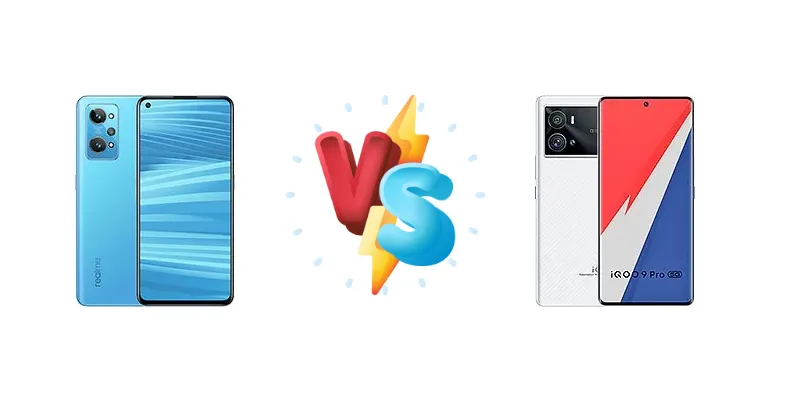
|
🏆 Quick Verdict
For most users, the vivo iQOO 9 Pro emerges as the superior choice. While the Realme GT2 offers respectable performance, the iQOO 9 Pro’s Snapdragon 8 Gen 1 chipset and significantly faster 120W charging (full charge in 20 minutes) justify the price premium. The brighter display is also a noticeable advantage.
| PHONES | ||
|---|---|---|
| Phone Names | Realme GT2 | vivo iQOO 9 Pro |
| Network | ||
|---|---|---|
| 2G bands | GSM 850 / 900 / 1800 / 1900 | GSM 850 / 900 / 1800 / 1900 |
| 3G bands | HSDPA 800 / 850 / 900 / 1700(AWS) / 1900 / 2100 | HSDPA 850 / 900 / 1700(AWS) / 1900 / 2100 |
| 4G bands | 1, 2, 3, 4, 5, 7, 8, 12, 13, 17, 18, 19, 20, 26, 28, 38, 39, 40, 41, 66 - International | 1, 2, 3, 4, 5, 7, 8, 12, 17, 18, 19, 20, 25, 26, 28, 32, 34, 38, 39, 40, 41, 42, 66 |
| 5G bands | 1, 3, 5, 7, 8, 20, 28, 38, 40, 41, 66, 77, 78 SA/NSA - International | 1, 3, 5, 7, 8, 20, 28, 38, 40, 41, 66, 77, 78, 79 SA/NSA |
| Speed | HSPA, LTE, 5G | HSPA, LTE, 5G |
| Technology | GSM / CDMA / HSPA / EVDO / LTE / 5G | GSM / CDMA / HSPA / CDMA2000 / LTE / 5G |
| 1, 3, 5, 7, 8, 20, 28, 41, 77, 78 SA/NSA - China | CDMA2000 1x | |
| Launch | ||
|---|---|---|
| Announced | 2022, January 04 | 2022, January 05 |
| Status | Available. Released 2022, January 08 | Available. Released 2022, January 12 |
| Body | ||
|---|---|---|
| Build | Glass front (Gorilla Glass 5), plastic frame | Glass front (Panda Glass), aluminum frame, glass back or aramid fiber back |
| Dimensions | 162.9 x 75.8 x 8.6 mm (6.41 x 2.98 x 0.34 in) | 164.8 x 75.2 x 8.8 mm |
| SIM | Nano-SIM + Nano-SIM | Nano-SIM + Nano-SIM |
| Weight | 194.5 / 199.8 g (6.88 oz) | 204 g or 210 g (7.20 oz) |
| - | Splash and dust resistant | |
| Display | ||
|---|---|---|
| Protection | Corning Gorilla Glass 5 | Panda Glass |
| Resolution | 1080 x 2400 pixels, 20:9 ratio (~398 ppi density) | 1440 x 3200 pixels, 20:9 ratio (~518 ppi density) |
| Size | 6.62 inches, 105.8 cm2 (~85.7% screen-to-body ratio) | 6.78 inches, 111.0 cm2 (~89.6% screen-to-body ratio) |
| Type | AMOLED, 120Hz, HDR10+, 1300 nits (peak) | LTPO2 AMOLED, 1B colors, 120Hz, HDR10+, Dolby Vision, 500 nits (typ), 1000 nits (HBM), 1500 nits (peak) |
| Platform | ||
|---|---|---|
| CPU | Octa-core (1x2.84 GHz Cortex-X1 & 3x2.42 GHz Cortex-A78 & 4x1.80 GHz Cortex-A55 | Octa-core (1x3.00 GHz Cortex-X2 & 3x2.50 GHz Cortex-A710 & 4x1.80 GHz Cortex-A510) |
| Chipset | Qualcomm SM8350 Snapdragon 888 5G (5 nm) | Qualcomm SM8450 Snapdragon 8 Gen 1 (4 nm) |
| GPU | Adreno 660 | Adreno 730 |
| OS | Android 12, Realme UI 3.0 | Android 12, Funtouch 12 (International), OriginOS Ocean (China) |
| Memory | ||
|---|---|---|
| Card slot | No | No |
| Internal | 128GB 8GB RAM, 256GB 8GB RAM, 256GB 12GB RAM | 256GB 8GB RAM, 256GB 12GB RAM, 512GB 12GB RAM |
| UFS 3.1 | UFS 3.1 (V6) | |
| Main Camera | ||
|---|---|---|
| Features | Color spectrum sensor, Dual-LED dual-tone flash, HDR, panorama | Dual-LED lash, HDR, panorama |
| Single | 16 MP, f/2.5, 26mm (wide), 1/3", 1.0µm | 16 MP, f/2.5, (wide), 1/3.1", 1.0µm |
| Triple | 50 MP, f/1.8, 24mm (wide), 1/1.56", 1.0µm, multi-directional PDAF, OIS 8 MP, f/2.2, 119˚ (ultrawide) 2 MP (macro) | 50 MP, f/1.8, (wide), 1/1.57", 1.0µm, PDAF, gimbal OIS 16 MP, f/2.2, 60mm (telephoto), 1/3.1", 1.0µm, PDAF, OIS, 2.5x optical zoom 50 MP, f/2.3, 15mm, 150˚ (ultrawide), 1/2.76", 0.64µm, AF |
| Video | 4K@30fps, 1080p@30fps, gyro-EIS | 8K@30fps, 4K@24/30/60fps, 1080p@30/60fps, gyro-EIS |
| Selfie camera | ||
|---|---|---|
| Features | HDR, panorama | HDR |
| Single | 16 MP, f/2.5, 26mm (wide), 1/3", 1.0µm | 16 MP, f/2.5, (wide), 1/3.1", 1.0µm |
| Video | 1080p@30fps | 1080p@30fps, gyro-EIS |
| Sound | ||
|---|---|---|
| 3.5mm jack | No | No |
| 35mm jack | No | No |
| Loudspeaker | Yes, with stereo speakers | Yes, with dual speakers |
| 24-bit/192kHz audio | 32-bit/384kHz audio | |
| Comms | ||
|---|---|---|
| Bluetooth | 5.2, A2DP, LE, aptX HD | 5.2, A2DP, LE, aptX HD, aptX Adaptive, aptX Lossless |
| Infrared port | - | Yes |
| NFC | Yes | Yes |
| Positioning | GPS (L1+L5), GLONASS, BDS, GALILEO, QZSS | GPS, GLONASS, GALILEO, BDS, QZSS |
| Radio | No | No |
| USB | USB Type-C 2.0, OTG | USB Type-C 2.0, OTG |
| WLAN | Wi-Fi 802.11 a/b/g/n/ac/6, dual-band, Wi-Fi Direct | Wi-Fi 802.11 a/b/g/n/ac/6, dual-band, Wi-Fi Direct |
| Features | ||
|---|---|---|
| Sensors | Fingerprint (under display, optical), accelerometer, gyro, proximity, compass | Fingerprint (under display, ultrasonic), accelerometer, gyro, proximity, compass |
| Battery | ||
|---|---|---|
| Charging | 65W wired, 100% in 33 min | 120W wired, 50% in 8 min, 100% in 20 min 50W wireless 10W reverse wireless |
| Type | 5000 mAh | 4700 mAh |
| Misc | ||
|---|---|---|
| Colors | Paper White, Paper Green, Steel Black, Titanium Blue | Legend (White w/ BMW M branding), Dark Cruise, Orange |
| Models | RMX3310, RMX3312, RMX3311 | V2172A, I2022 |
| Price | About 790 EUR | About 630 EUR |
| Tests | ||
|---|---|---|
| Battery life | Endurance rating 115h | Endurance rating 97h |
| Camera | Photo / Video | Photo / Video |
| Display | Contrast ratio: Infinite (nominal) | Contrast ratio: Infinite (nominal) |
| Loudspeaker | -26.8 LUFS (Good) | -24.8 LUFS (Very good) |
| Performance | AnTuTu: 810512 (v9) GeekBench: 3487 (v5.1) GFXBench: 56fps (ES 3.1 onscreen) | AnTuTu: 862324 (v8), 997948 (v9) GeekBench: 3708 (v5.1) GFXBench: 46fps (ES 3.1 onscreen) |
Realme GT2
- Potentially better battery endurance (115h rating)
- More affordable price point (likely)
- Solid Snapdragon 888 performance
- Slower charging speeds (65W)
- Less powerful chipset (Snapdragon 888)
- Dimmer display (846 nits)
vivo iQOO 9 Pro
- Significantly faster charging (120W wired, 50W wireless)
- More powerful chipset (Snapdragon 8 Gen 1)
- Brighter display (1000 nits)
- Reverse wireless charging
- Shorter battery endurance (97h rating)
- Higher price point
Display Comparison
The iQOO 9 Pro boasts a brighter display, reaching a measured 1000 nits compared to the Realme GT2’s 846 nits. This translates to better visibility outdoors under direct sunlight. Both displays share an 'Infinite' (nominal) contrast ratio, suggesting excellent black levels. While neither specification details refresh rate, both brands typically employ 120Hz panels in this class. The iQOO 9 Pro’s higher peak brightness is a clear advantage for multimedia consumption and outdoor usability.
Camera Comparison
Both devices are listed with 'Photo / Video' capabilities, lacking specific sensor details. However, given iQOO’s focus on performance, it’s reasonable to expect a more advanced camera system. The iQOO 9 Pro likely benefits from a more sophisticated image signal processor (ISP) within the Snapdragon 8 Gen 1, leading to improved image quality and video stabilization. Without detailed sensor specifications, it’s difficult to make a definitive judgment, but the iQOO 9 Pro’s chipset suggests a more capable camera experience.
Performance
The core difference lies in the chipsets. The iQOO 9 Pro’s Snapdragon 8 Gen 1 (4nm) represents a generational leap over the Realme GT2’s Snapdragon 888 (5nm). The 4nm process node of the Gen 1 offers improved power efficiency and thermal performance, potentially mitigating throttling during sustained workloads. The iQOO 9 Pro’s CPU features a Cortex-X2 prime core clocked at 3.00 GHz, exceeding the GT2’s 2.84 GHz Cortex-X1. The iQOO 9 Pro also utilizes newer Cortex-A710 performance cores, further enhancing multi-core performance. While both phones likely feature LPDDR5 RAM, the iQOO 9 Pro’s chipset advantage will be noticeable in demanding tasks like gaming and video editing.
Battery Life
The Realme GT2 offers an endurance rating of 115 hours, while the iQOO 9 Pro manages 97 hours. This suggests the GT2 has better overall battery stamina, likely due to the more efficient Snapdragon 888 and potentially a larger battery capacity (not specified). However, the iQOO 9 Pro compensates with significantly faster charging. Its 120W wired charging can reach 50% in just 8 minutes and 100% in 20 minutes, a massive advantage over the GT2’s 65W charging (33 minutes for a full charge). The iQOO 9 Pro also adds 50W wireless and 10W reverse wireless charging, features absent on the GT2.
Buying Guide
Buy the Realme GT2 if you prioritize a balance of performance and affordability, and are comfortable with slightly slower charging speeds. It’s ideal for users who enjoy mobile gaming but don’t demand the absolute highest frame rates. Buy the vivo iQOO 9 Pro if you demand the fastest possible performance, need rapid charging (especially the 50W wireless option), and value a brighter, more vibrant display. This phone is geared towards power users and mobile gamers.