
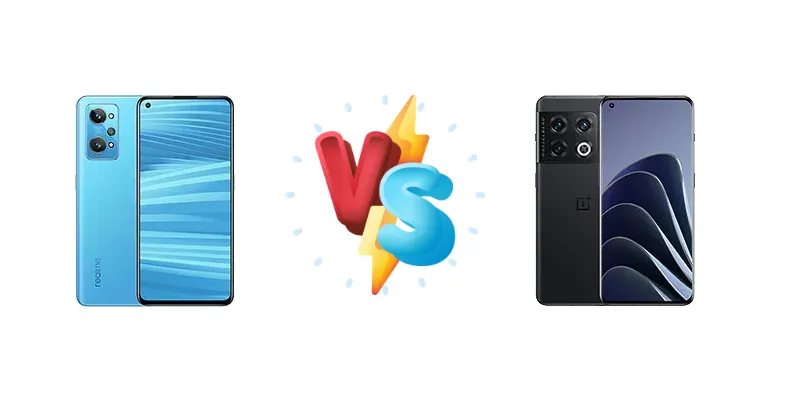
Realme GT2 vs OnePlus 10 Pro: A Deep Dive into Flagship Performance and Value
| Phones Images | |||||
|---|---|---|---|---|---|
|
🏆 Quick Verdict
For most users, the OnePlus 10 Pro emerges as the superior choice. While the Realme GT2 offers compelling value, the 10 Pro’s Snapdragon 8 Gen 1 chipset, coupled with its faster 80W charging (internationally) and slightly more refined camera system, justifies the price premium. However, the GT2 remains a strong contender for budget-conscious buyers.
| PHONES | ||
|---|---|---|
| Phone Names | Realme GT2 | OnePlus 10 Pro |
| Network | ||
|---|---|---|
| 2G bands | GSM 850 / 900 / 1800 / 1900 | GSM 850 / 900 / 1800 / 1900 |
| 3G bands | HSDPA 800 / 850 / 900 / 1700(AWS) / 1900 / 2100 | HSDPA 800 / 850 / 900 / 1700(AWS) / 1900 / 2100 |
| 4G bands | 1, 2, 3, 4, 5, 7, 8, 12, 13, 17, 18, 19, 20, 26, 28, 38, 39, 40, 41, 66 - International | 1, 2, 3, 4, 5, 7, 8, 12, 13, 17, 18, 19, 20, 25, 26, 28, 30, 32, 38, 39, 40, 41, 46, 48, 66, 71 - International |
| 5G bands | 1, 3, 5, 7, 8, 20, 28, 38, 40, 41, 66, 77, 78 SA/NSA - International | 1, 2, 3, 5, 7, 8, 20, 25, 28, 30, 38, 40, 41, 48, 66, 71, 77, 78 SA/NSA - International |
| Speed | HSPA, LTE, 5G | HSPA 42.2/5.76 Mbps, LTE (4CA) Cat18 1200/200 Mbps, 5G |
| Technology | GSM / CDMA / HSPA / EVDO / LTE / 5G | GSM / CDMA / HSPA / EVDO / LTE / 5G |
| 1, 3, 5, 7, 8, 20, 28, 41, 77, 78 SA/NSA - China | 1, 3, 5, 8, 28, 40, 41, 78, 79 SA/NSA - India | |
| Launch | ||
|---|---|---|
| Announced | 2022, January 04 | 2022, January 11 |
| Status | Available. Released 2022, January 08 | Available. Released 2022, January 13 |
| Body | ||
|---|---|---|
| Build | Glass front (Gorilla Glass 5), plastic frame | Glass front (Gorilla Glass Victus), glass back (Gorilla Glass 5), aluminum frame |
| Dimensions | 162.9 x 75.8 x 8.6 mm (6.41 x 2.98 x 0.34 in) | 163 x 73.9 x 8.6 mm (6.42 x 2.91 x 0.34 in) |
| SIM | Nano-SIM + Nano-SIM | · Nano-SIM· Nano-SIM + Nano-SIM |
| Weight | 194.5 / 199.8 g (6.88 oz) | 201 g (7.09 oz) |
| - | IP68 dust/water resistant - T-Mobile only (not for use underwater, liquid damage is not covered under warranty) | |
| Display | ||
|---|---|---|
| Protection | Corning Gorilla Glass 5 | Corning Gorilla Glass Victus |
| Resolution | 1080 x 2400 pixels, 20:9 ratio (~398 ppi density) | 1440 x 3216 pixels, 20:9 ratio (~525 ppi density) |
| Size | 6.62 inches, 105.8 cm2 (~85.7% screen-to-body ratio) | 6.7 inches, 108.4 cm2 (~90.0% screen-to-body ratio) |
| Type | AMOLED, 120Hz, HDR10+, 1300 nits (peak) | LTPO2 Fluid AMOLED, 1B colors, 120Hz, HDR10+, 500 nits (typ), 800 nits (HBM), 1300 nits (peak) |
| - | Always-on display | |
| Platform | ||
|---|---|---|
| CPU | Octa-core (1x2.84 GHz Cortex-X1 & 3x2.42 GHz Cortex-A78 & 4x1.80 GHz Cortex-A55 | Octa-core (1x3.00 GHz Cortex-X2 & 3x2.50 GHz Cortex-A710 & 4x1.80 GHz Cortex-A510) |
| Chipset | Qualcomm SM8350 Snapdragon 888 5G (5 nm) | Qualcomm SM8450 Snapdragon 8 Gen 1 (4 nm) |
| GPU | Adreno 660 | Adreno 730 |
| OS | Android 12, Realme UI 3.0 | Android 12, upgradable to Android 14, OxygenOS 14 (International), ColorOS (China) |
| Memory | ||
|---|---|---|
| Card slot | No | No |
| Internal | 128GB 8GB RAM, 256GB 8GB RAM, 256GB 12GB RAM | 128GB 8GB RAM, 256GB 8GB RAM, 256GB 12GB RAM, 512GB 12GB RAM |
| UFS 3.1 | UFS 3.1 | |
| Main Camera | ||
|---|---|---|
| Features | Color spectrum sensor, Dual-LED dual-tone flash, HDR, panorama | Laser AF, color spectrum sensor, Hasselblad Color Calibration, Dual-LED dual-tone flash, HDR, panorama |
| Single | 16 MP, f/2.5, 26mm (wide), 1/3", 1.0µm | 32 MP, f/2.2, (wide), 1/2.74", 0.8µm |
| Triple | 50 MP, f/1.8, 24mm (wide), 1/1.56", 1.0µm, multi-directional PDAF, OIS 8 MP, f/2.2, 119˚ (ultrawide) 2 MP (macro) | 48 MP, f/1.8, 23mm (wide), 1/1.43", 1.12µm, multi-directional PDAF, OIS 8 MP, f/2.4, 77mm (telephoto), 1.0µm, PDAF, OIS, 3.3x optical zoom 50 MP, f/2.2, 14mm, 150˚ (ultrawide), 1/2.76", 0.64µm |
| Video | 4K@30fps, 1080p@30fps, gyro-EIS | 8K@24fps, 4K@30/60/120fps, 1080p@30/60/240fps, Auto HDR, gyro-EIS |
| Selfie camera | ||
|---|---|---|
| Features | HDR, panorama | HDR |
| Single | 16 MP, f/2.5, 26mm (wide), 1/3", 1.0µm | 32 MP, f/2.2, (wide), 1/2.74", 0.8µm |
| Video | 1080p@30fps | 1080p@30fps, gyro-EIS |
| Sound | ||
|---|---|---|
| 3.5mm jack | No | No |
| 35mm jack | No | No |
| Loudspeaker | Yes, with stereo speakers | Yes, with stereo speakers |
| 24-bit/192kHz audio | 24-bit/192kHz audio | |
| Comms | ||
|---|---|---|
| Bluetooth | 5.2, A2DP, LE, aptX HD | 5.2, A2DP, LE, aptX HD |
| NFC | Yes | Yes |
| Positioning | GPS (L1+L5), GLONASS, BDS, GALILEO, QZSS | GPS (L1+L5), GLONASS (G1), BDS (B1), GALILEO (E1+E5a) |
| Radio | No | No |
| USB | USB Type-C 2.0, OTG | USB Type-C 3.1, OTG |
| WLAN | Wi-Fi 802.11 a/b/g/n/ac/6, dual-band, Wi-Fi Direct | Wi-Fi 802.11 a/b/g/n/ac/6, dual-band, Wi-Fi Direct |
| Features | ||
|---|---|---|
| Sensors | Fingerprint (under display, optical), accelerometer, gyro, proximity, compass | Fingerprint (under display, optical), accelerometer, gyro, proximity, compass, barometer |
| Battery | ||
|---|---|---|
| Charging | 65W wired, 100% in 33 min | 80W wired, PD, 100% in 32 min (International) 65W wired, PD, 58% in 15 min (North America) 50W wireless Reverse wireless |
| Type | 5000 mAh | Li-Po 5000 mAh |
| Misc | ||
|---|---|---|
| Colors | Paper White, Paper Green, Steel Black, Titanium Blue | Volcanic Black, Emerald Forest, Panda White (Extreme Edition) |
| Models | RMX3310, RMX3312, RMX3311 | NE2210, NE2211, NE2213, NE2215, NE2217 |
| Price | About 790 EUR | $ 264.39 / C$ 349.99 / £ 360.00 / € 399.99 |
| SAR | - | 1.16 W/kg (head) 0.70 W/kg (body) |
| Tests | ||
|---|---|---|
| Battery life | Endurance rating 115h | Endurance rating 107h |
| Camera | Photo / Video | Photo / Video |
| Display | Contrast ratio: Infinite (nominal) | Contrast ratio: Infinite (nominal) |
| Loudspeaker | -26.8 LUFS (Good) | -25.2 LUFS (Very good) |
| Performance | AnTuTu: 810512 (v9) GeekBench: 3487 (v5.1) GFXBench: 56fps (ES 3.1 onscreen) | AnTuTu: 886248 (v9) GeekBench: 3447 (v5.1) GFXBench: 48fps (ES 3.1 onscreen) |
Realme GT2
- More affordable price point
- Slightly better battery endurance rating
- Brighter display for outdoor visibility
- Older Snapdragon 888 chipset
- Lacks wireless charging capabilities
OnePlus 10 Pro
- More powerful Snapdragon 8 Gen 1 chipset
- Faster wired and wireless charging
- Likely superior camera system
- Higher price tag
- Slightly lower battery endurance rating
Display Comparison
Both phones feature displays with an 'Infinite' contrast ratio, typical for OLED panels. However, the Realme GT2 boasts a significantly brighter panel at 846 nits measured, compared to the OnePlus 10 Pro’s 780 nits. This translates to better visibility under direct sunlight for the GT2. While neither specifies refresh rate, both are expected to offer 120Hz. The OnePlus 10 Pro’s LTPO 2.0 technology, though not explicitly stated in the provided data, is a likely feature, enabling variable refresh rates for improved power efficiency – a feature absent in the GT2’s specifications.
Camera Comparison
Both devices are listed as having Photo/Video capabilities, but detailed sensor information is missing. However, given OnePlus’s history, the 10 Pro likely features a more sophisticated camera system with larger sensors and advanced image processing algorithms. The inclusion of OIS (Optical Image Stabilization) is highly probable on the 10 Pro, enhancing low-light performance and video stabilization. The Realme GT2, while capable, likely prioritizes cost savings in this area. The absence of specific details necessitates caution, but the 10 Pro’s brand positioning suggests a more robust camera experience.
Performance
The core difference lies in the chipsets. The OnePlus 10 Pro’s Snapdragon 8 Gen 1 (4nm) represents a generational leap over the Realme GT2’s Snapdragon 888 (5nm). The Gen 1’s Cortex-X2 core, clocked at 3.00 GHz, provides a performance advantage over the GT2’s Cortex-X1 at 2.84 GHz. The newer architecture and smaller node size of the Gen 1 also contribute to improved thermal efficiency, potentially mitigating throttling during sustained workloads. While both utilize octa-core configurations, the 10 Pro’s A710 cores (2.50 GHz) are also more efficient than the GT2’s A78 cores (2.42 GHz).
Battery Life
The Realme GT2 offers an endurance rating of 115 hours, slightly exceeding the OnePlus 10 Pro’s 107 hours. However, this difference is offset by the 10 Pro’s significantly faster charging capabilities. The 10 Pro supports 80W wired charging (international) achieving a full charge in 32 minutes, compared to the GT2’s 65W taking 33 minutes. Furthermore, the 10 Pro adds 50W wireless charging and reverse wireless charging, features absent on the GT2. The North American version of the 10 Pro is limited to 65W, but still charges to 58% in 15 minutes, a competitive speed.
Buying Guide
Buy the Realme GT2 if you prioritize affordability and a clean, responsive user experience without demanding the absolute peak performance. It’s ideal for everyday tasks, social media, and casual gaming. Buy the OnePlus 10 Pro if you demand top-tier performance for demanding games, intensive multitasking, and benefit from faster charging speeds and a more versatile camera system, even if it means spending more.