
Realme GT2 vs Motorola Edge X30: A Deep Dive into Snapdragon Generations
| Phones Images | |||||
|---|---|---|---|---|---|
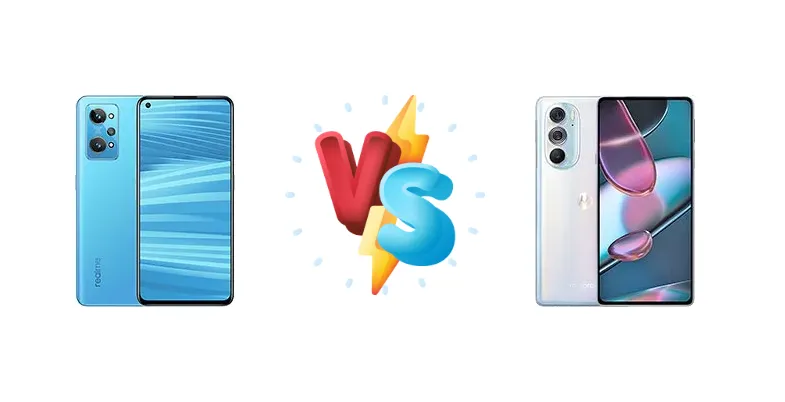
|
🏆 Quick Verdict
For most users, the Motorola Edge X30 emerges as the stronger choice. Its Snapdragon 8 Gen 1 chipset delivers a noticeable performance uplift over the GT2’s Snapdragon 888, despite a slightly longer charging time. While the GT2 offers respectable endurance, the Edge X30’s raw power justifies the minor compromise.
| PHONES | ||
|---|---|---|
| Phone Names | Realme GT2 | Motorola Edge X30 |
| Network | ||
|---|---|---|
| 2G bands | GSM 850 / 900 / 1800 / 1900 | GSM 850 / 900 / 1800 / 1900 |
| 3G bands | HSDPA 800 / 850 / 900 / 1700(AWS) / 1900 / 2100 | HSDPA 850 / 900 / 1800 / 1900 / 2100 |
| 4G bands | 1, 2, 3, 4, 5, 7, 8, 12, 13, 17, 18, 19, 20, 26, 28, 38, 39, 40, 41, 66 - International | 1, 2, 3, 4, 5, 7, 8, 12, 17, 34, 38, 39, 40, 41 |
| 5G bands | 1, 3, 5, 7, 8, 20, 28, 38, 40, 41, 66, 77, 78 SA/NSA - International | 1, 3, 5, 7, 8, 20, 28, 38, 41, 78 SA/NSA/Sub6 |
| Speed | HSPA, LTE, 5G | HSPA, LTE, 5G |
| Technology | GSM / CDMA / HSPA / EVDO / LTE / 5G | GSM / HSPA / LTE / 5G |
| 1, 3, 5, 7, 8, 20, 28, 41, 77, 78 SA/NSA - China | - | |
| Launch | ||
|---|---|---|
| Announced | 2022, January 04 | 2021, December 09 |
| Status | Available. Released 2022, January 08 | Available. Released 2021, December 15 |
| Body | ||
|---|---|---|
| Build | Glass front (Gorilla Glass 5), plastic frame | Glass front, glass back (Gorilla Glass 5) |
| Dimensions | 162.9 x 75.8 x 8.6 mm (6.41 x 2.98 x 0.34 in) | 163.6 x 75.6 x 8.5 mm (6.44 x 2.98 x 0.33 in) |
| SIM | Nano-SIM + Nano-SIM | Nano-SIM + Nano-SIM |
| Weight | 194.5 / 199.8 g (6.88 oz) | 194 g (6.84 oz) |
| - | Water-repellent design | |
| Display | ||
|---|---|---|
| Protection | Corning Gorilla Glass 5 | - |
| Resolution | 1080 x 2400 pixels, 20:9 ratio (~398 ppi density) | 1080 x 2400 pixels, 20:9 ratio (~393 ppi density) |
| Size | 6.62 inches, 105.8 cm2 (~85.7% screen-to-body ratio) | 6.7 inches, 108.4 cm2 (~87.6% screen-to-body ratio) |
| Type | AMOLED, 120Hz, HDR10+, 1300 nits (peak) | OLED, 1B colors, 144Hz, HDR10+, 500 nits (typ), 700 nits (HBM) |
| Platform | ||
|---|---|---|
| CPU | Octa-core (1x2.84 GHz Cortex-X1 & 3x2.42 GHz Cortex-A78 & 4x1.80 GHz Cortex-A55 | Octa-core (1x3.00 GHz Cortex-X2 & 3x2.50 GHz Cortex-A710 & 4x1.80 GHz Cortex-A510) |
| Chipset | Qualcomm SM8350 Snapdragon 888 5G (5 nm) | Qualcomm SM8450 Snapdragon 8 Gen 1 (4 nm) |
| GPU | Adreno 660 | Adreno 730 |
| OS | Android 12, Realme UI 3.0 | Android 12, MYUI 3.0 |
| Memory | ||
|---|---|---|
| Card slot | No | No |
| Internal | 128GB 8GB RAM, 256GB 8GB RAM, 256GB 12GB RAM | 128GB 8GB RAM, 256GB 8GB RAM, 256GB 12GB RAM |
| UFS 3.1 | UFS 3.1 | |
| Main Camera | ||
|---|---|---|
| Features | Color spectrum sensor, Dual-LED dual-tone flash, HDR, panorama | Dual-LED flash, panorama, HDR |
| Single | 16 MP, f/2.5, 26mm (wide), 1/3", 1.0µm | - |
| Triple | 50 MP, f/1.8, 24mm (wide), 1/1.56", 1.0µm, multi-directional PDAF, OIS 8 MP, f/2.2, 119˚ (ultrawide) 2 MP (macro) | 50 MP, f/1.9, (wide), 1/1.55", 1.0µm, dual pixel PDAF, OIS 50 MP, f/2.2, 114˚ (ultrawide), 1/2.76", 0.64µm Auxiliary lens |
| Video | 4K@30fps, 1080p@30fps, gyro-EIS | 4K@30fps, 1080p@30/60/120/240fps, 720p@960fps, 10-bit HDR10+, gyro-EIS |
| Selfie camera | ||
|---|---|---|
| Features | HDR, panorama | HDR |
| Single | 16 MP, f/2.5, 26mm (wide), 1/3", 1.0µm | 60 MP, f/2.2, (wide), 1/2.8", 0.61µm or 60 MP, f/2.2, (wide), 1/2.8", 0.61µm, under display |
| Video | 1080p@30fps | 4K@30fps, 1080p@30/120fps |
| Sound | ||
|---|---|---|
| 3.5mm jack | No | No |
| 35mm jack | No | No |
| Loudspeaker | Yes, with stereo speakers | Yes, with stereo speakers |
| 24-bit/192kHz audio | - | |
| Comms | ||
|---|---|---|
| Bluetooth | 5.2, A2DP, LE, aptX HD | 5.2, A2DP, LE, aptX HD, aptX Adaptive |
| NFC | Yes | Yes |
| Positioning | GPS (L1+L5), GLONASS, BDS, GALILEO, QZSS | GPS (L1+L5), GLONASS, BDS, GALILEO |
| Radio | No | No |
| USB | USB Type-C 2.0, OTG | USB Type-C |
| WLAN | Wi-Fi 802.11 a/b/g/n/ac/6, dual-band, Wi-Fi Direct | Wi-Fi 802.11 a/b/g/n/ac/6e, dual-band, Wi-Fi Direct |
| Features | ||
|---|---|---|
| Sensors | Fingerprint (under display, optical), accelerometer, gyro, proximity, compass | Fingerprint (side-mounted), accelerometer, gyro, proximity, compass |
| - | Ready For support | |
| Battery | ||
|---|---|---|
| Charging | 65W wired, 100% in 33 min | 68W wired, 100% in 35 min |
| Type | 5000 mAh | Market-dependent versions:· Li-Po 5000 mAh (regular version)· Li-Po 4800 mAh (under screen camera version) |
| Misc | ||
|---|---|---|
| Colors | Paper White, Paper Green, Steel Black, Titanium Blue | White, Black |
| Models | RMX3310, RMX3312, RMX3311 | XT2201-2, XT2201-6 |
| Price | About 790 EUR | About 420 EUR |
| Tests | ||
|---|---|---|
| Battery life | Endurance rating 115h | - |
| Camera | Photo / Video | - |
| Display | Contrast ratio: Infinite (nominal) | - |
| Loudspeaker | -26.8 LUFS (Good) | - |
| Performance | AnTuTu: 810512 (v9) GeekBench: 3487 (v5.1) GFXBench: 56fps (ES 3.1 onscreen) | - |
Realme GT2
- Proven Snapdragon 888 performance
- Fast 65W charging (33 minutes)
- Excellent display brightness (846 nits)
- Older chipset prone to thermal throttling
- Less powerful CPU compared to Snapdragon 8 Gen 1
Motorola Edge X30
- Latest Snapdragon 8 Gen 1 chipset
- Improved power efficiency (4nm process)
- Faster CPU and GPU performance
- Slightly slower charging (35 minutes)
- Potential for higher heat generation under sustained load
Display Comparison
The Realme GT2 boasts a display capable of reaching 846 nits of peak brightness, ensuring excellent visibility even in direct sunlight. While the Edge X30’s display specifications aren’t provided, Motorola typically prioritizes color accuracy in its flagship displays. The GT2’s ‘Infinite’ contrast ratio (nominal) suggests a standard OLED panel, while the Edge X30 may incorporate LTPO technology for variable refresh rates, potentially improving battery efficiency. Without specific details on the Edge X30’s panel, the GT2’s measured brightness gives it a slight edge for outdoor usability.
Camera Comparison
Both devices are listed with 'Photo / Video' capabilities, lacking specific details. However, given the market positioning, we can infer that the Edge X30 likely features a more advanced camera system. Motorola has been increasingly focusing on camera quality in its flagship devices. The Snapdragon 8 Gen 1’s improved ISP capabilities also contribute to better image processing. Without sensor size or aperture information, it’s difficult to make a definitive judgment, but the Edge X30’s newer chipset provides a foundation for superior image quality.
Performance
The core difference lies in the chipsets: the Realme GT2 utilizes the Qualcomm SM8350 Snapdragon 888 (5nm), while the Motorola Edge X30 features the SM8450 Snapdragon 8 Gen 1 (4nm). The 8 Gen 1’s 4nm process offers improved power efficiency and higher transistor density compared to the 888’s 5nm node, translating to better sustained performance and reduced thermal throttling. The Edge X30’s CPU, with its Cortex-X2 core clocked at 3.00 GHz, outperforms the GT2’s Cortex-X1 at 2.84 GHz. This difference is particularly noticeable in CPU-intensive tasks and gaming. The Edge X30’s newer architecture also benefits from improvements in AI processing and image signal processing.
Battery Life
The Realme GT2 has an endurance rating of 115 hours, indicating solid battery life. It supports 65W wired charging, achieving a 100% charge in 33 minutes. The Motorola Edge X30 offers 68W wired charging, taking 35 minutes for a full charge. While the Edge X30’s charging is slightly slower, the 4nm process of the Snapdragon 8 Gen 1 contributes to better power efficiency, potentially offsetting the minor charging speed difference. The GT2’s endurance rating suggests a well-optimized power management system, but the Edge X30’s more efficient chipset could deliver comparable real-world battery life despite potentially having a smaller battery capacity (spec not provided).
Buying Guide
Buy the Realme GT2 if you prioritize a proven, thermally stable chipset and are looking for a slightly more affordable flagship experience. It’s ideal for users who enjoy moderate gaming and value consistent performance over peak bursts. Buy the Motorola Edge X30 if you demand the latest processing power for demanding tasks like heavy gaming, video editing, or running resource-intensive applications. It’s the better choice for power users who want the fastest possible Android experience.