
Realme GT2 Pro vs Realme GT Neo 3: The Ultimate Showdown
| Phones Images | |||||
|---|---|---|---|---|---|
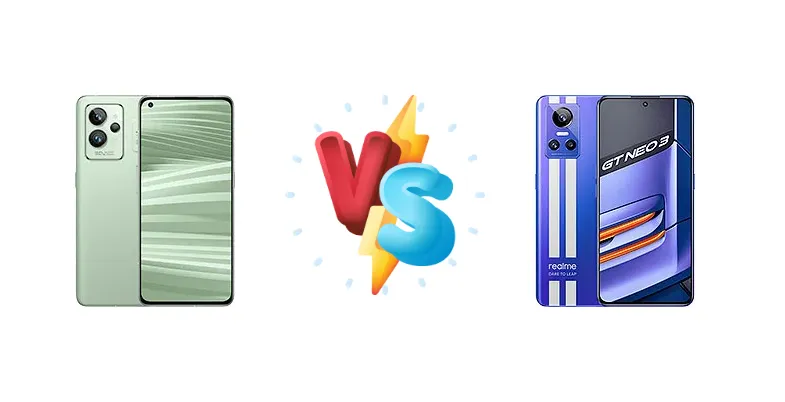
|
🏆 Quick Verdict
The GT Neo 3 boasts faster charging and a slightly brighter display, while the GT2 Pro features the more powerful Snapdragon 8 Gen 1 chipset. Ultimately, the GT2 Pro offers superior performance, while the Neo 3 provides better value for money with its quicker charging.
| PHONES | ||
|---|---|---|
| Phone Names | Realme GT2 Pro | Realme GT Neo 3 |
| Network | ||
|---|---|---|
| 2G bands | GSM 850 / 900 / 1800 / 1900 | GSM 850 / 900 / 1800 / 1900 |
| 3G bands | HSDPA 800 / 850 / 900 / 1700(AWS) / 1900 / 2100 | HSDPA 800 / 850 / 900 / 1700(AWS) / 1900 / 2100 |
| 4G bands | 1, 2, 3, 4, 5, 7, 8, 12, 13, 17, 18, 19, 20, 25, 26, 28, 66 - International | 1, 2, 3, 4, 5, 7, 8, 18, 19, 26, 28, 34, 38, 39, 40, 41 |
| 5G bands | 1, 3, 5, 7, 8, 20, 28, 38, 40, 41, 66, 77, 78 SA/NSA | 1, 3, 5, 8, 28, 40, 41, 77, 78 SA/NSA |
| Speed | HSPA, LTE, 5G | HSPA, LTE, 5G |
| Technology | GSM / CDMA / HSPA / EVDO / LTE / 5G | GSM / CDMA / HSPA / EVDO / LTE / 5G |
| 1, 2, 3, 4, 5, 7, 8, 12, 13, 17, 18, 19, 20, 25, 26, 28, 34, 38, 39, 40, 41, 42, 66 - China, India | CDMA2000 1xEV-DO | |
| Launch | ||
|---|---|---|
| Announced | 2022, January 04 | 2022, March 22 |
| Status | Available. Released 2022, January 08 | Available. Released 2022, March 30 |
| Body | ||
|---|---|---|
| Build | - | Glass front (Gorilla Glass 5), plastic frame, glass back |
| Dimensions | 163.2 x 74.7 x 8.2 mm (6.43 x 2.94 x 0.32 in) | 163.3 x 75.6 x 8.2 mm (6.43 x 2.98 x 0.32 in) |
| SIM | Nano-SIM + Nano-SIM | Nano-SIM + Nano-SIM |
| Weight | 189 / 199 g (6.67 oz) | 188 g (6.63 oz) |
| Splash resistant | - | |
| Display | ||
|---|---|---|
| Protection | Corning Gorilla Glass Victus | Corning Gorilla Glass 5 |
| Resolution | 1440 x 3216 pixels, 20:9 ratio (~526 ppi density) | 1080 x 2412 pixels, 20:9 ratio (~394 ppi density) |
| Size | 6.7 inches, 108.0 cm2 (~88.6% screen-to-body ratio) | 6.7 inches, 108.0 cm2 (~87.5% screen-to-body ratio) |
| Type | LTPO2 AMOLED, 1B colors, 120Hz, HDR10+, 500 nits (typ), 800 nits (HBM), 1400 nits (peak) | AMOLED, 1B colors, 120Hz, HDR10+ |
| Platform | ||
|---|---|---|
| CPU | Octa-core (1x3.00 GHz Cortex-X2 & 3x2.50 GHz Cortex-A710 & 4x1.80 GHz Cortex-A510) | Octa-core (4x2.85 GHz Cortex-A78 & 4x2.0 GHz Cortex-A55) |
| Chipset | Qualcomm SM8450 Snapdragon 8 Gen 1 (4 nm) | Mediatek Dimensity 8100 (5 nm) |
| GPU | Adreno 730 | Mali-G610 MC6 |
| OS | Android 12, upgradable to Android 13, Realme UI 4.0 | Android 12, upgradable to Android 13, Realme UI 3.0 |
| Memory | ||
|---|---|---|
| Card slot | No | No |
| Internal | 128GB 8GB RAM, 256GB 8GB RAM, 256GB 12GB RAM, 512GB 12GB RAM | 128GB 6GB RAM, 128GB 8GB RAM, 256GB 8GB RAM, 256GB 12GB RAM, 512GB 12GB RAM |
| UFS 3.1 | UFS 3.1 | |
| Main Camera | ||
|---|---|---|
| Features | Color spectrum sensor, Dual-LED dual-tone flash, HDR, panorama | Dual-LED dual-tone flash, HDR, panorama |
| Single | 32 MP, f/2.4, 26mm (wide), 1/2.74", 0.8µm | 16 MP, f/2.5, 26mm (wide), 1/3.09", 1.0µm |
| Triple | 50 MP, f/1.8, 24mm (wide), 1/1.56", 1.0µm, multi-directional PDAF, OIS 50 MP, f/2.2, 15mm, 150˚ (ultrawide), 1/2.76", 0.64µm 3 MP, f/3.3, 20mm (microscope), AF, 40x magnification | 50 MP, f/1.9, 24mm (wide), 1/1.56", 1.0µm, PDAF, OIS 8 MP, f/2.3, 15mm, 120˚ (ultrawide), 1/4.0", 1.12µm 2 MP (macro) |
| Video | 8K@24fps, 4K@30/60fps, 1080p@30/60/240fps, gyro-EIS | 4K@30/60fps, 1080p@30/60fps, gyro-EIS |
| Selfie camera | ||
|---|---|---|
| Features | HDR, panorama | HDR, panorama |
| Single | 32 MP, f/2.4, 26mm (wide), 1/2.74", 0.8µm | 16 MP, f/2.5, 26mm (wide), 1/3.09", 1.0µm |
| Video | 1080p@30fps | 1080p@30fps, gyro-EIS |
| Sound | ||
|---|---|---|
| 3.5mm jack | No | No |
| 35mm jack | No | No |
| Loudspeaker | Yes, with stereo speakers | Yes, with stereo speakers |
| 24-bit/192kHz audio | 24-bit/192kHz audio | |
| Comms | ||
|---|---|---|
| Bluetooth | 5.2, A2DP, LE, aptX HD | 5.3, A2DP, LE, aptX HD |
| NFC | Yes (dual side) | Yes (dual side) |
| Positioning | GPS (L1+L5), GLONASS, BDS, GALILEO, QZSS, NavIC | GPS (L1+L5), GLONASS, BDS, GALILEO, QZSS |
| Radio | No | No |
| USB | USB Type-C 2.0, OTG | USB Type-C 2.0 |
| WLAN | Wi-Fi 802.11 a/b/g/n/ac/6, dual-band, Wi-Fi Direct | Wi-Fi 802.11 a/b/g/n/ac/6, dual-band, Wi-Fi Direct |
| Features | ||
|---|---|---|
| Sensors | Fingerprint (under display, optical), accelerometer, gyro, proximity, compass | Fingerprint (under display, optical), accelerometer, gyro, proximity, compass |
| Battery | ||
|---|---|---|
| Charging | 65W wired, 100% in 33 min | 80W wired, 100% in 32 min |
| Type | 5000 mAh | 5000 mAh |
| Misc | ||
|---|---|---|
| Colors | Paper White, Paper Green, Steel Black, Titanium Blue | Plain Black (Asphalt Black), Silverstone White (Sprint White), Le Mans Blue (Nitro Blue) |
| Models | RMX3301, RMX3300 | RMX3561, RMX3560 |
| Price | € 221.41 | About 430 EUR |
| SAR | 1.16 W/kg (head) 0.53 W/kg (body) | - |
| Tests | ||
|---|---|---|
| Battery life | Endurance rating 117h | - |
| Camera | Photo / Video | Photo / Video |
| Display | Contrast ratio: Infinite (nominal) | Contrast ratio: Infinite (nominal) |
| Loudspeaker | -26.3 LUFS (Good) | -27.1 LUFS (Good) |
| Performance | AnTuTu: 966251 (v9) GeekBench: 3501 (v5.1) GFXBench: 48fps (ES 3.1 onscreen) | AnTuTu: 819348 (v9) GeekBench: 4079 (v5.1) GFXBench: 53fps (ES 3.1 onscreen) |
Realme GT2 Pro
- Superior Performance (Snapdragon 8 Gen 1)
- More Versatile Camera System
- Premium Design
- Excellent Display
- Slower Charging (65W)
- Potentially Higher Price
Realme GT Neo 3
- Faster Charging (80W)
- Slightly Brighter Display
- Excellent Value for Money
- Smooth Performance
- Less Powerful Chipset (Dimensity 8100)
- Camera Not as Versatile
- Design Less Premium
Display Comparison
Both phones feature excellent AMOLED displays with a 120Hz refresh rate and infinite contrast ratios. The GT Neo 3 edges out the GT2 Pro with a slightly higher peak brightness of 796 nits versus 778 nits, making it marginally better for outdoor visibility. However, both offer vibrant colors and smooth scrolling.
Camera Comparison
Both phones offer capable camera systems, but the GT2 Pro generally produces more detailed and natural-looking photos. The GT2 Pro's camera system is more versatile, offering better low-light performance and more advanced features. The GT Neo 3's camera is still good, but it doesn't quite match the GT2 Pro's overall quality.
Performance
The Realme GT2 Pro’s Snapdragon 8 Gen 1 is the clear winner here. It offers significantly more processing power than the GT Neo 3’s Dimensity 8100, resulting in smoother multitasking, faster app loading times, and better gaming performance. While the Dimensity 8100 is no slouch, the Snapdragon 8 Gen 1 provides a noticeable performance boost.
Battery Life
The GT Neo 3 takes the lead in charging speed with its 80W wired charging, reaching 100% in just 32 minutes. The GT2 Pro's 65W charging is still fast, but slower. While the GT2 Pro boasts an impressive endurance rating of 117h, the Neo 3's battery life is comparable in real-world usage, thanks to efficient power management.
Buying Guide
Who should buy the Realme GT2 Pro? Users prioritizing raw performance, especially for gaming and demanding apps, will appreciate the Snapdragon 8 Gen 1. Those seeking a premium design and slightly better camera versatility should also consider it. Who should buy the Realme GT Neo 3? Budget-conscious buyers who value fast charging and a vibrant display will find the GT Neo 3 an excellent choice.