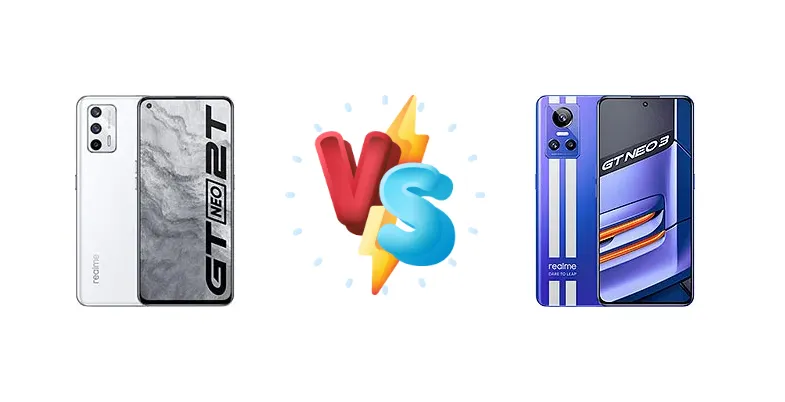
Realme's GT series has consistently delivered impressive performance at competitive prices. The GT Neo2T and GT Neo 3 are two popular contenders, each boasting unique strengths. This comprehensive comparison will break down their key differences to help you decide which phone is right for you.
🏆 Quick Verdict
The Realme GT Neo 3 emerges as the clear winner thanks to its significantly faster Dimensity 8100 chipset, brighter display, and faster 80W charging. While the Neo2T remains a capable device, the Neo 3 offers a noticeable upgrade in almost every key area, justifying its slightly higher price.
| Network |
|---|
| 2G bands | GSM 850 / 900 / 1800 / 1900 | GSM 850 / 900 / 1800 / 1900 |
| 3G bands | HSDPA 850 / 900 / 1700(AWS) / 1900 / 2100 | HSDPA 800 / 850 / 900 / 1700(AWS) / 1900 / 2100 |
| 4G bands | 1, 2, 3, 4, 5, 7, 8, 28, 34, 38, 39, 40, 41 | 1, 2, 3, 4, 5, 7, 8, 18, 19, 26, 28, 34, 38, 39, 40, 41 |
| 5G bands | 1, 28, 40, 41, 77, 78, 79 SA/NSA | 1, 3, 5, 8, 28, 40, 41, 77, 78 SA/NSA |
| Speed | HSPA, LTE, 5G | HSPA, LTE, 5G |
| Technology | GSM / CDMA / HSPA / EVDO / LTE / 5G | GSM / CDMA / HSPA / EVDO / LTE / 5G |
| | CDMA2000 1xEV-DO | CDMA2000 1xEV-DO |
| Launch |
|---|
| Announced | 2021, October 19 | 2022, March 22 |
| Status | Available. Released 2021, November 01 | Available. Released 2022, March 30 |
| Body |
|---|
| Build | Glass front, plastic frame, plastic back | Glass front (Gorilla Glass 5), plastic frame, glass back |
| Dimensions | 158.5 x 73.3 x 8.4 mm (6.24 x 2.89 x 0.33 in) | 163.3 x 75.6 x 8.2 mm (6.43 x 2.98 x 0.32 in) |
| SIM | Nano-SIM + Nano-SIM | Nano-SIM + Nano-SIM |
| Weight | 186 g (6.56 oz) | 188 g (6.63 oz) |
| Display |
|---|
| Protection | - | Corning Gorilla Glass 5 |
| Resolution | 1080 x 2400 pixels, 20:9 ratio (~409 ppi density) | 1080 x 2412 pixels, 20:9 ratio (~394 ppi density) |
| Size | 6.43 inches, 99.8 cm2 (~85.9% screen-to-body ratio) | 6.7 inches, 108.0 cm2 (~87.5% screen-to-body ratio) |
| Type | Super AMOLED, 120Hz, 1000 nits (peak) | AMOLED, 1B colors, 120Hz, HDR10+ |
| Platform |
|---|
| CPU | Octa-core (1x3.0 GHz Cortex-A78 & 3x2.6 GHz Cortex-A78 & 4x2.0 GHz Cortex-A55) | Octa-core (4x2.85 GHz Cortex-A78 & 4x2.0 GHz Cortex-A55) |
| Chipset | Mediatek Dimensity 1200 (6 nm) | Mediatek Dimensity 8100 (5 nm) |
| GPU | Mali-G77 MC9 | Mali-G610 MC6 |
| OS | Android 11, Realme UI 2.0 | Android 12, upgradable to Android 13, Realme UI 3.0 |
| Memory |
|---|
| Card slot | No | No |
| Internal | 128GB 8GB RAM, 256GB 8GB RAM, 256GB 12GB RAM | 128GB 6GB RAM, 128GB 8GB RAM, 256GB 8GB RAM, 256GB 12GB RAM, 512GB 12GB RAM |
| | UFS 3.1 | UFS 3.1 |
| Main Camera |
|---|
| Features | Dual-LED dual-tone flash, HDR, panorama | Dual-LED dual-tone flash, HDR, panorama |
| Single | 16 MP, f/2.5, 26mm (wide), 1/3.1", 1.0µm | 16 MP, f/2.5, 26mm (wide), 1/3.09", 1.0µm |
| Triple | 64 MP, f/1.8, 26mm (wide), 1/2.0", 0.7µm, PDAF
8 MP, f/2.3, 16mm, 120˚ (ultrawide), 1/4.0", 1.12µm
2 MP (macro) | 50 MP, f/1.9, 24mm (wide), 1/1.56", 1.0µm, PDAF, OIS
8 MP, f/2.3, 15mm, 120˚ (ultrawide), 1/4.0", 1.12µm
2 MP (macro) |
| Video | 4K@30/60fps, 1080p@30/60/480fps, gyro-EIS | 4K@30/60fps, 1080p@30/60fps, gyro-EIS |
| Selfie camera |
|---|
| Features | HDR, panorama | HDR, panorama |
| Single | 16 MP, f/2.5, 26mm (wide), 1/3.1", 1.0µm | 16 MP, f/2.5, 26mm (wide), 1/3.09", 1.0µm |
| Video | 1080p@30fps | 1080p@30fps, gyro-EIS |
| Sound |
|---|
| 3.5mm jack | Yes | No |
| 35mm jack | Yes | No |
| Loudspeaker | Yes, with stereo speakers | Yes, with stereo speakers |
| | 24-bit/192kHz audio | 24-bit/192kHz audio |
| Comms |
|---|
| Bluetooth | 5.1, A2DP, LE, aptX HD | 5.3, A2DP, LE, aptX HD |
| NFC | Yes | Yes (dual side) |
| Positioning | GPS (L1+L5), GLONASS, BDS, GALILEO, QZSS | GPS (L1+L5), GLONASS, BDS, GALILEO, QZSS |
| Radio | No | No |
| USB | USB Type-C 2.0, OTG | USB Type-C 2.0 |
| WLAN | Wi-Fi 802.11 a/b/g/n/ac/6, dual-band, Wi-Fi Direct | Wi-Fi 802.11 a/b/g/n/ac/6, dual-band, Wi-Fi Direct |
| Features |
|---|
| Sensors | Fingerprint (under display, optical), accelerometer, gyro, proximity, compass | Fingerprint (under display, optical), accelerometer, gyro, proximity, compass |
| Battery |
|---|
| Charging | 65W wired
5W reverse wired | 80W wired, 100% in 32 min |
| Type | 4500 mAh | 5000 mAh |
| Misc |
|---|
| Colors | Black, White | Plain Black (Asphalt Black), Silverstone White (Sprint White), Le Mans Blue (Nitro Blue) |
| Models | RMX3357 | RMX3561, RMX3560 |
| Price | About 260 EUR | About 430 EUR |
| Tests |
|---|
| Camera | - |
Photo / Video |
| Display | - |
Contrast ratio: Infinite (nominal) |
| Loudspeaker | - |
-27.1 LUFS (Good)
|
| Performance | - |
AnTuTu: 819348 (v9)
GeekBench: 4079 (v5.1)
GFXBench: 53fps (ES 3.1 onscreen) |
Realme GT Neo2T
- Slightly more mature design
- Good value for money
- Capable performance for everyday tasks
- 65W fast charging
- Older chipset
- Less bright display
- Slower charging compared to Neo 3
- Potentially less future-proof
Realme GT Neo 3
- Significantly faster Dimensity 8100 chipset
- Brighter and more vibrant display
- 80W super-fast charging
- Improved gaming performance
- More future-proof
- Slightly higher price
- Design may be considered more 'youthful' by some
Display Comparison
The Realme GT Neo 3 boasts a measured peak brightness of 796 nits, significantly brighter than the Neo2T. While the Neo2T's display is perfectly adequate, the Neo 3's offers better outdoor visibility and a more vibrant viewing experience. The Neo 3 also touts an 'infinite' contrast ratio, suggesting excellent blacks and dynamic range, though this is a nominal claim.
Camera Comparison
While both phones offer capable camera systems, detailed camera comparisons are difficult without specific testing data. Generally, the Neo 3 is expected to offer slightly improved image processing and low-light performance due to the newer chipset and potentially updated camera sensors. Both phones likely offer similar video recording capabilities.
Performance
This is where the Neo 3 truly shines. The Dimensity 8100 chipset (5nm) is a substantial upgrade over the Neo2T's Dimensity 1200 (6nm). Expect noticeably faster app loading times, smoother multitasking, and significantly improved gaming performance on the Neo 3. The Neo 3's CPU also has slightly higher clock speeds.
Battery Life
The Neo 3 takes a clear lead in charging speed with its 80W wired charging, capable of reaching 100% in just 32 minutes. The Neo2T's 65W charging is still fast, but not as impressive. Battery capacity is likely similar between the two devices, meaning the Neo 3's faster charging provides a significant advantage.
Buying Guide
Who should buy the Realme GT Neo2T? Those on a tighter budget who prioritize a slightly more mature design and don't need the absolute latest performance. Who should buy the Realme GT Neo 3? Gamers, power users, and anyone seeking a faster, brighter, and more future-proof smartphone experience.
Frequently Asked Questions
❓ Is the Realme GT Neo 3 worth the upgrade from the Neo2T?
If you prioritize performance, a brighter display, and faster charging, then yes, the Neo 3 is a worthwhile upgrade. However, if you're on a tight budget and are satisfied with the Neo2T's performance, the upgrade might not be necessary.
❓ What is the difference between the Dimensity 1200 and Dimensity 8100 chipsets?
The Dimensity 8100 is a newer and more powerful chipset built on a smaller 5nm process, offering significantly improved CPU and GPU performance compared to the 6nm Dimensity 1200.