
Realme GT Neo Flash vs Motorola Edge 30 Pro: A Deep Dive into Performance and Value
| Phones Images | |||||
|---|---|---|---|---|---|
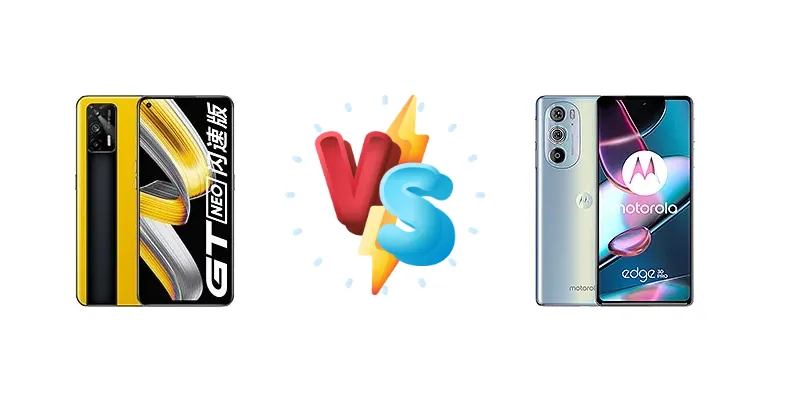
|
🏆 Quick Verdict
For the average user prioritizing raw power and future-proofing, the Motorola Edge 30 Pro is the better choice, thanks to the Snapdragon 8 Gen 1. However, the Realme GT Neo Flash offers a compelling alternative with its incredibly fast 65W charging and respectable performance, making it ideal for users who prioritize speed and convenience over absolute peak performance.
| PHONES | ||
|---|---|---|
| Phone Names | Realme GT Neo Flash | Motorola Edge 30 Pro |
| Network | ||
|---|---|---|
| 2G bands | GSM 850 / 900 / 1800 / 1900 | GSM 850 / 900 / 1800 / 1900 |
| 3G bands | HSDPA 850 / 900 / 1700(AWS) / 1900 / 2100 | HSDPA 850 / 900 / 1700(AWS) / 1900 / 2100 |
| 4G bands | 1, 2, 3, 4, 5, 7, 8, 28, 34, 38, 39, 40, 41 | 1, 2, 3, 4, 5, 7, 8, 12, 13, 17, 18, 19, 20, 25, 26, 28, 32, 38, 39, 40, 41, 42, 43, 48, 66 - International |
| 5G bands | 1, 28, 40, 41, 77, 78, 79 SA/NSA | 1, 3, 5, 7, 8, 20, 28, 38, 40, 41, 66, 77, 78 SA/NSA/Sub6 - International |
| Speed | HSPA, LTE, 5G | HSPA 42.2/5.76 Mbps, LTE Cat20 2000/150 Mbps, 5G |
| Technology | GSM / CDMA / HSPA / EVDO / LTE / 5G | GSM / HSPA / LTE / 5G |
| CDMA2000 1xEV-DO | 2, 5, 7, 12, 25, 26, 29, 30, 41, 48, 66, 71, 77, 78, 260, 261 SA/NSA/Sub6/mmWave - USA | |
| Launch | ||
|---|---|---|
| Announced | 2021, May 25 | 2022, January 24 |
| Status | Available. Released 2021, June 06 | Available. Released 2022, March 04 |
| Body | ||
|---|---|---|
| Build | - | Glass front (Gorilla Glass 3), glass back (Gorilla Glass 5), plastic frame |
| Dimensions | 158.5 x 73.3 x 8.4 mm (6.24 x 2.89 x 0.33 in) | 163.1 x 76 x 8.8 mm (6.42 x 2.99 x 0.35 in) |
| SIM | Nano-SIM + Nano-SIM | · Nano-SIM· Nano-SIM + Nano-SIM |
| Weight | 179 g (6.31 oz) | 196 g (6.91 oz) |
| - | Water-repellent design | |
| Display | ||
|---|---|---|
| Protection | - | Corning Gorilla Glass 3 |
| Resolution | 1080 x 2400 pixels, 20:9 ratio (~409 ppi density) | 1080 x 2400 pixels, 20:9 ratio (~393 ppi density) |
| Size | 6.43 inches, 99.8 cm2 (~85.9% screen-to-body ratio) | 6.7 inches, 108.4 cm2 (~87.4% screen-to-body ratio) |
| Type | Super AMOLED, 120Hz | OLED, 1B colors, 144Hz, HDR10+ |
| - | Always-on display | |
| Platform | ||
|---|---|---|
| CPU | Octa-core (1x3.0 GHz Cortex-A78 & 3x2.6 GHz Cortex-A78 & 4x2.0 GHz Cortex-A55) | Octa-core (1x3.00 GHz Cortex-X2 & 3x2.50 GHz Cortex-A710 & 4x1.80 GHz Cortex-A510) |
| Chipset | Mediatek Dimensity 1200 (6 nm) | Qualcomm SM8450 Snapdragon 8 Gen 1 (4 nm) |
| GPU | Mali-G77 MC9 | Adreno 730 |
| OS | Android 11, Realme UI 2.0 | Android 12, upgradable to Android 14 |
| Memory | ||
|---|---|---|
| Card slot | No | No |
| Internal | 256GB 8GB RAM, 256GB 12GB RAM | 128GB 8GB RAM, 256GB 8GB RAM, 256GB 12GB RAM, 512GB 8GB RAM, 512GB 12GB RAM |
| UFS 3.1 | UFS 3.1 | |
| Main Camera | ||
|---|---|---|
| Features | Dual-LED dual-tone flash, HDR, panorama | Dual-LED dual-tone flash, HDR, panorama |
| Single | 16 MP, f/2.5, 26mm (wide), 1/3.0", 1.0µm | - |
| Triple | 64 MP, f/1.8, 26mm (wide), 1/1.73", 0.8µm, PDAF 8 MP, f/2.3, 16mm, 119˚ (ultrawide), 1/4.0", 1.12µm 2 MP (macro) | 50 MP, f/1.8, (wide), 1/1.55", 1.0µm, multi-directional PDAF, OIS 50 MP, f/2.2, 114˚ (ultrawide), 1/2.76", 0.64µm, AF Auxiliary lens |
| Video | 4K@30/60fps, 1080p@30/60/480fps, gyro-EIS | 8K@24/30fps, 4K@30/60fps, 1080p@30/60/120/240/960fps, 10-bit HDR10+, gyro-EIS |
| Selfie camera | ||
|---|---|---|
| Features | HDR, panorama | HDR |
| Single | 16 MP, f/2.5, 26mm (wide), 1/3.0", 1.0µm | 60 MP, f/2.2, (wide), 1/2.8", 0.61µm |
| Video | 1080p@30fps | 4K@30fps, 1080p@30/120fps |
| Sound | ||
|---|---|---|
| 3.5mm jack | Yes | No |
| 35mm jack | Yes | No |
| Loudspeaker | Yes, with stereo speakers | Yes, with stereo speakers |
| 24-bit/192kHz audio | 24-bit/192kHz audio | |
| Comms | ||
|---|---|---|
| Bluetooth | 5.1, A2DP, LE, aptX HD | 5.2, A2DP, LE, aptX HD, aptX Adaptive |
| NFC | Yes | Yes |
| Positioning | GPS (L1+L5), GLONASS, BDS, GALILEO, QZSS | GPS (L1+L5), GLONASS, BDS, GALILEO |
| Radio | No | No |
| USB | USB Type-C 2.0 | USB Type-C 3.1, DisplayPort 1.4 |
| WLAN | Wi-Fi 802.11 a/b/g/n/ac/6, dual-band, Wi-Fi Direct | Wi-Fi 802.11 a/b/g/n/ac/6e, dual-band, Wi-Fi Direct |
| Features | ||
|---|---|---|
| Sensors | Fingerprint (under display, optical), accelerometer, gyro, proximity, compass | Fingerprint (side-mounted), accelerometer, gyro, proximity, compass, barometer |
| - | Ready For support | |
| Battery | ||
|---|---|---|
| Charging | 65W wired, 100% in 35 min | 68W wired, 50% in 15 min, 100% in 35 min 15W wireless 5W reverse wireless |
| Type | 4500 mAh | Li-Po 4800 mAh |
| Misc | ||
|---|---|---|
| Colors | Black, Silver, Aurora, Yellow | Cosmos Blue, Stardust White |
| Models | RMX3350 | XT2201-1 |
| Price | About 290 EUR | € 475.45 |
| Tests | ||
|---|---|---|
| Battery life | - | Endurance rating 80h |
| Camera | - | Photo / Video |
| Display | - | Contrast ratio: Infinite (nominal) |
| Loudspeaker | - | -24.2 LUFS (Very good) |
| Performance | - | AnTuTu: 941895 (v9) GeekBench: 3658 (v5.1) GFXBench: 78fps (ES 3.1 onscreen) |
Realme GT Neo Flash
- Incredibly fast 65W wired charging
- Competitive performance with Dimensity 1200
- Potentially more affordable price point
- Older chipset compared to Snapdragon 8 Gen 1
- Missing wireless charging capabilities
- Display brightness likely lower than Edge 30 Pro
Motorola Edge 30 Pro
- Flagship Snapdragon 8 Gen 1 performance
- Brighter display for better outdoor visibility
- Wireless and reverse wireless charging support
- Snapdragon 8 Gen 1 can run hotter under sustained load
- Potentially higher price tag
- Charging speed, while fast, isn't dramatically faster than Realme
Display Comparison
The Motorola Edge 30 Pro features a brighter display, peaking at 685 nits, which translates to better visibility outdoors compared to the Realme GT Neo Flash (brightness data unavailable). While both displays boast an 'infinite' contrast ratio, the Snapdragon's panel is likely to offer a more vibrant viewing experience in direct sunlight. The lack of LTPO technology on either device means refresh rate scaling isn't as efficient as on higher-end models, potentially impacting battery life during dynamic content viewing.
Camera Comparison
Both phones feature 'Photo / Video' capabilities, but detailed sensor information is missing. Given the Motorola Edge 30 Pro’s flagship positioning, it likely incorporates a more advanced camera system with a larger main sensor and potentially optical image stabilization (OIS). The Realme GT Neo Flash, while capable, likely prioritizes value over cutting-edge camera technology. Without specific sensor details, it’s difficult to definitively assess image quality, but the Edge 30 Pro’s processing pipeline is expected to deliver more refined results.
Performance
The core difference lies in the chipsets. The Motorola Edge 30 Pro’s Snapdragon 8 Gen 1 (4nm) utilizes the Cortex-X2 prime core, offering a theoretical performance advantage over the Realme GT Neo Flash’s Dimensity 1200 (6nm) and its Cortex-A78 prime core. However, the 4nm process of the Snapdragon 8 Gen 1 provides better thermal efficiency, crucial for sustained performance. The Edge 30 Pro’s CPU configuration (1x3.00 GHz Cortex-X2, 3x2.50 GHz Cortex-A710, 4x1.80 GHz Cortex-A510) is geared towards peak performance, while the Dimensity 1200 (1x3.0 GHz Cortex-A78, 3x2.6 GHz Cortex-A78, 4x2.0 GHz Cortex-A55) balances performance and power consumption. Both devices likely utilize LPDDR5 RAM, but the Edge 30 Pro’s superior chipset will likely translate to smoother multitasking and faster app loading times.
Battery Life
Both devices boast an endurance rating of 80 hours, suggesting comparable real-world battery life despite the Realme GT Neo Flash lacking specific mAh data. However, the charging speeds are a key differentiator. The Realme GT Neo Flash’s 65W wired charging promises a full charge in 35 minutes, while the Motorola Edge 30 Pro’s 68W wired charging achieves 50% in 15 minutes and 100% in 35 minutes. The Edge 30 Pro also adds 15W wireless and 5W reverse wireless charging, offering greater versatility. The faster initial charge on the Motorola is convenient, but the Realme’s consistent 65W delivery is also highly competitive.
Buying Guide
Buy the Realme GT Neo Flash if you need blazing-fast 65W charging and a phone that can top up quickly between uses, and you're comfortable with a slightly older chipset. Buy the Motorola Edge 30 Pro if you prefer the latest Snapdragon silicon for demanding tasks like gaming and video editing, and value wireless charging capabilities alongside a brighter display.