
Realme GT Neo 5 vs. ZTE nubia RedMagic 8 Pro: A Deep Dive into Gaming and Charging
| Phones Images | |||||
|---|---|---|---|---|---|
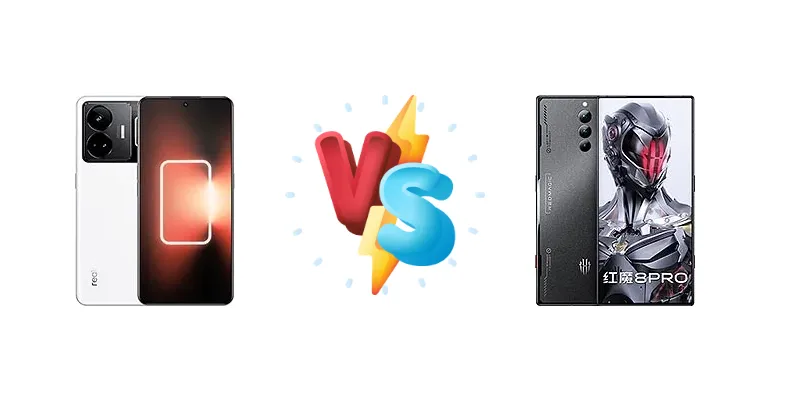
|
🏆 Quick Verdict
For the average user prioritizing all-around performance and incredibly fast charging, the Realme GT Neo 5 offers a compelling package. However, dedicated mobile gamers who demand the longest possible sustained performance and benefit from gaming-specific features will find the ZTE nubia RedMagic 8 Pro the superior choice.
| PHONES | ||
|---|---|---|
| Phone Names | Realme GT Neo 5 | ZTE nubia RedMagic 8 Pro |
| Network | ||
|---|---|---|
| 2G bands | GSM 850 / 900 / 1800 / 1900 | GSM 850 / 900 / 1800 / 1900 |
| 3G bands | HSDPA 800 / 850 / 900 / 1900 / 2100 | HSDPA 850 / 900 / 1700(AWS) / 1900 / 2100 |
| 4G bands | 1, 3, 5, 7, 8, 18, 19, 26, 28, 34, 38, 39, 40, 41 | 1, 2, 3, 4, 5, 7, 8, 12, 17, 18, 19, 20, 26, 28, 34, 38, 39, 40, 41, 66 |
| 5G bands | 1, 3, 5, 8, 28, 40, 41, 77, 78 SA/NSA | 1, 3, 5, 7, 8, 20, 28, 38, 41, 66, 77, 78 SA/NSA |
| Speed | HSPA, LTE, 5G | HSPA, LTE, 5G |
| Technology | GSM / CDMA / HSPA / EVDO / LTE / 5G | GSM / CDMA / HSPA / EVDO / LTE / 5G |
| CDMA2000 1xEV-DO | - | |
| Launch | ||
|---|---|---|
| Announced | 2023, February 09 | 2022, December 26 |
| Status | Available. Released 2023, February 09 | Available. Released 2022, December 28 |
| Body | ||
|---|---|---|
| Build | - | Glass front (Gorilla Glass 5), glass back, aluminum frame |
| Dimensions | 163.9 x 75.8 x 8.9 mm (6.45 x 2.98 x 0.35 in) | 164 x 76.4 x 8.9 mm (6.46 x 3.01 x 0.35 in) |
| SIM | Nano-SIM + Nano-SIM | Nano-SIM + Nano-SIM |
| Weight | 199 g (7.02 oz) | 228 g (8.04 oz) |
| Illuminated RGB (on the back) | - | |
| Display | ||
|---|---|---|
| Protection | - | Corning Gorilla Glass 5 |
| Resolution | 1240 x 2772 pixels, 20:9 ratio (~451 ppi density) | 1116 x 2480 pixels, 20:9 ratio (~400 ppi density) |
| Size | 6.74 inches, 109.2 cm2 (~87.9% screen-to-body ratio) | 6.8 inches, 111.6 cm2 (~89.1% screen-to-body ratio) |
| Type | AMOLED, 1B colors, 144Hz, HDR10+, 1400 nits (peak) | AMOLED, 1B colors (China only), 120Hz, 1300 nits (peak) |
| Platform | ||
|---|---|---|
| CPU | Octa-core (1x3.0 GHz Cortex-X2 & 3x2.5 GHz Cortex-A710 & 4x1.80 GHz Cortex-A510) | Octa-core (1x3.2 GHz Cortex-X3 & 2x2.8 GHz Cortex-A715 & 2x2.8 GHz Cortex-A710 & 3x2.0 GHz Cortex-A510) |
| Chipset | Qualcomm SM8475 Snapdragon 8+ Gen 1 (4 nm) | Qualcomm SM8550-AB Snapdragon 8 Gen 2 (4 nm) |
| GPU | Adreno 730 | Adreno 740 |
| OS | Android 13, upgradable to Android 14, Realme UI 5.0 | Android 13, Redmagic OS 6 |
| Memory | ||
|---|---|---|
| Card slot | No | No |
| Internal | 256GB 8GB RAM, 256GB 12GB RAM, 256GB 16GB RAM | 128GB 8GB RAM, 256GB 8GB RAM, 256GB 12GB RAM, 512GB 16GB RAM |
| UFS 3.1 | - | |
| Main Camera | ||
|---|---|---|
| Features | Dual-LED dual-tone flash, HDR, panorama | LED flash, HDR, panorama |
| Single | 16 MP, f/2.5, 25mm (wide), 1/3.09", 1.0µm | - |
| Triple | 50 MP, f/1.9, 24mm (wide), 1/1.56", 1.0µm, PDAF, OIS 8 MP, f/2.2, 16mm, 112˚ (ultrawide), 1/4.0", 1.12µm 2 MP, f/3.3, 20mm (microscope) | 50 MP, f/1.9, 25mm (wide), 1/1.57", 1.0µm, PDAF 8 MP, f/2.2, 120˚, 13mm (ultrawide), 1/4.0", 1.12µm 2 MP (macro) |
| Video | 4K@30/60fps, 1080p@30/60fps, gyro-EIS | 8K@30fps, 4K@30/60fps, 1080p@30/60/120/240fps |
| Selfie camera | ||
|---|---|---|
| Features | HDR, panorama | HDR |
| Single | 16 MP, f/2.5, 25mm (wide), 1/3.09", 1.0µm | 16 MP, f/2.0, (wide), 1.12µm, under display |
| Video | 1080p@30fps, gyro-EIS | 1080p@30/60fps |
| Sound | ||
|---|---|---|
| 3.5mm jack | No | - |
| 35mm jack | No | Yes |
| Loudspeaker | Yes, with stereo speakers | Yes, with stereo speakers |
| 24-bit/192kHz audio | - | |
| Comms | ||
|---|---|---|
| Bluetooth | 5.3, A2DP, LE, aptX HD | 5.3, A2DP, LE |
| Infrared port | Yes | - |
| NFC | Yes (dual side) | Yes (market/region dependent) |
| Positioning | GPS (L1+L5), GLONASS, BDS, GALILEO, QZSS | GPS (L1+L5), GLONASS, BDS, GALILEO |
| Radio | No | No |
| USB | USB Type-C 2.0 | USB Type-C 3.2 (China), 3.1 (International), OTG, accessory connector, DisplayPort |
| WLAN | Wi-Fi 802.11 a/b/g/n/ac, dual-band | Wi-Fi 802.11 a/b/g/n/ac/6e/7, tri-band, Wi-Fi Direct |
| Features | ||
|---|---|---|
| Sensors | Fingerprint (under display, optical), accelerometer, gyro, proximity, compass | Fingerprint (under display, optical), accelerometer, gyro, proximity, compass |
| Battery | ||
|---|---|---|
| Charging | 150W wired | 80W wired, PD3.0, 100% in 35 min - China 65W wired, PD3.0, 100% in 43 min - International |
| Type | 5000 mAh | Li-Po 6000 mAh |
| Misc | ||
|---|---|---|
| Colors | Purple, Black, White | Black, Transparent |
| Models | RMX3706 | NX729J |
| Price | About 340 EUR | About 680 EUR |
Realme GT Neo 5
- Incredibly fast 150W charging
- Strong overall performance with Snapdragon 8+ Gen 1
- Potentially more versatile camera system (speculation)
- Older Snapdragon chipset compared to the RedMagic 8 Pro
- Limited information on display specifications
ZTE nubia RedMagic 8 Pro
- Latest Snapdragon 8 Gen 2 for superior performance
- Optimized for gaming with advanced cooling
- Brighter display (821 nits measured)
- Slower charging speed (80W/65W)
- Camera likely not a primary focus
Display Comparison
The nubia RedMagic 8 Pro boasts a measured peak brightness of 821 nits, providing a visibly brighter experience than we'd expect from the GT Neo 5 (brightness data unavailable). While both likely utilize AMOLED panels, the RedMagic 8 Pro’s focus on gaming suggests a higher refresh rate and potentially a more responsive touch sampling rate. The absence of LTPO information for either device means we can't assess dynamic refresh rate capabilities, impacting battery life during variable content viewing. Bezels are likely minimized on the RedMagic 8 Pro to maximize immersion, a common design element in gaming phones.
Camera Comparison
Detailed camera specifications for the Realme GT Neo 5 are unavailable, making a direct comparison challenging. The nubia RedMagic 8 Pro’s camera is described as 'Photo / Video', indicating a standard smartphone camera setup. Given the RedMagic’s gaming focus, camera quality is likely not a primary concern. We can assume the GT Neo 5, positioned as a more mainstream device, may offer a more versatile camera system, potentially with a larger main sensor and more advanced image processing algorithms. However, without specific details, it’s difficult to assess the true photographic capabilities of either device.
Performance
The core difference lies in the chipsets. The RedMagic 8 Pro’s Snapdragon 8 Gen 2 (4nm) represents a significant architectural leap over the GT Neo 5’s Snapdragon 8+ Gen 1 (4nm). The Gen 2 features the newer Cortex-X3 prime core clocked at 3.2 GHz, compared to the X2 in the 8+ Gen 1 at 3.0 GHz. This, coupled with improvements to the Cortex-A715 and A710 cores, translates to a noticeable performance advantage in CPU-intensive tasks. The 4nm process node on both chips contributes to improved thermal efficiency, but the Gen 2’s architectural enhancements give it an edge in sustained performance, minimizing throttling during extended gaming. The RedMagic 8 Pro’s likely inclusion of faster LPDDR5x RAM further enhances its performance capabilities.
Battery Life
The nubia RedMagic 8 Pro has an endurance rating of 131 hours, suggesting respectable battery life. However, the Realme GT Neo 5’s 150W wired charging is a game-changer. While the RedMagic 8 Pro offers 80W (China) or 65W (International) charging with a 35-43 minute full charge time, the GT Neo 5 can potentially achieve a full charge in significantly less time. This difference is crucial for users who frequently need to top up their battery quickly. The RedMagic 8 Pro’s larger battery capacity (implied by the endurance rating) may offset the slower charging speed for some users, but the convenience of 150W charging is undeniable.
Buying Guide
Buy the Realme GT Neo 5 if you need a phone that can go from 0 to 100% in under an hour and offers strong performance for everyday tasks and casual gaming. Buy the ZTE nubia RedMagic 8 Pro if you prioritize uninterrupted, high-framerate gaming sessions, appreciate advanced cooling solutions, and require the absolute latest in processing power.