
Realme GT Neo 5 vs. Samsung Galaxy S23 FE: A Deep Dive Comparison
| Phones Images | |||||
|---|---|---|---|---|---|
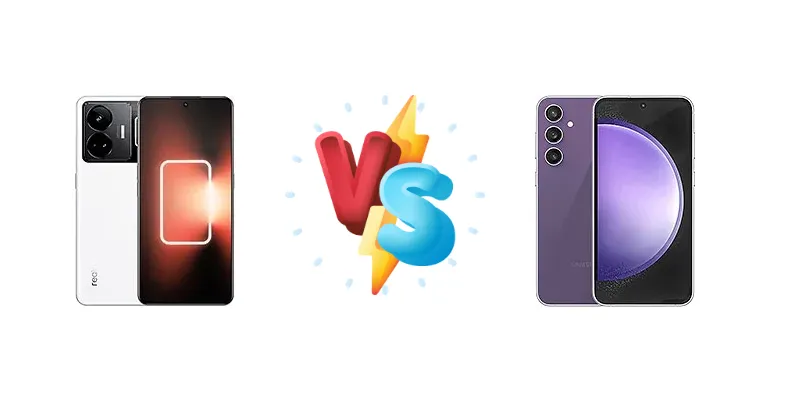
|
🏆 Quick Verdict
For the average user prioritizing a refined experience and reliable camera, the Samsung Galaxy S23 FE is the better choice. However, if raw speed, incredibly fast charging, and gaming performance are paramount, the Realme GT Neo 5 delivers exceptional value.
| PHONES | ||
|---|---|---|
| Phone Names | Realme GT Neo 5 | Samsung Galaxy S23 FE |
| Network | ||
|---|---|---|
| 2G bands | GSM 850 / 900 / 1800 / 1900 | GSM 850 / 900 / 1800 / 1900 |
| 3G bands | HSDPA 800 / 850 / 900 / 1900 / 2100 | HSDPA 850 / 900 / 1700(AWS) / 1900 / 2100 |
| 4G bands | 1, 3, 5, 7, 8, 18, 19, 26, 28, 34, 38, 39, 40, 41 | 1, 2, 3, 4, 5, 7, 8, 12, 13, 17, 20, 26, 28, 38, 40, 41, 66 - International |
| 5G bands | 1, 3, 5, 8, 28, 40, 41, 77, 78 SA/NSA | 1, 2, 3, 5, 7, 8, 20, 28, 38, 40, 41, 66, 77, 78 SA/NSA/Sub6 - International |
| Speed | HSPA, LTE, 5G | HSPA, LTE, 5G |
| Technology | GSM / CDMA / HSPA / EVDO / LTE / 5G | GSM / HSPA / LTE / 5G |
| CDMA2000 1xEV-DO | - | |
| Launch | ||
|---|---|---|
| Announced | 2023, February 09 | 2023, October 04 |
| Status | Available. Released 2023, February 09 | Available. Released 2023, October 05 |
| Body | ||
|---|---|---|
| Build | - | Glass front (Gorilla Glass 5), glass back (Gorilla Glass 5), aluminum frame |
| Dimensions | 163.9 x 75.8 x 8.9 mm (6.45 x 2.98 x 0.35 in) | 158 x 76.5 x 8.2 mm (6.22 x 3.01 x 0.32 in) |
| SIM | Nano-SIM + Nano-SIM | · Nano-SIM· Nano-SIM + Nano-SIM· Nano-SIM + Nano-SIM + eSIM (max 2 at a time) |
| Weight | 199 g (7.02 oz) | 209 g (7.37 oz) |
| Illuminated RGB (on the back) | - | |
| Display | ||
|---|---|---|
| Protection | - | Corning Gorilla Glass 5 |
| Resolution | 1240 x 2772 pixels, 20:9 ratio (~451 ppi density) | 1080 x 2340 pixels, 19.5:9 ratio (~403 ppi density) |
| Size | 6.74 inches, 109.2 cm2 (~87.9% screen-to-body ratio) | 6.4 inches, 100.5 cm2 (~83.2% screen-to-body ratio) |
| Type | AMOLED, 1B colors, 144Hz, HDR10+, 1400 nits (peak) | Dynamic AMOLED 2X, 120Hz, HDR10+, 1450 nits (peak) |
| Platform | ||
|---|---|---|
| CPU | Octa-core (1x3.0 GHz Cortex-X2 & 3x2.5 GHz Cortex-A710 & 4x1.80 GHz Cortex-A510) | Octa-core (1x2.8 GHz Cortex-X2 & 3x2.50 GHz Cortex-A710 & 4x1.8 GHz Cortex-A510) - InternationalOcta-core (1x3.00 GHz Cortex-X2 & 3x2.50 GHz Cortex-A710 & 4x1.80 GHz Cortex-A510) - USA |
| Chipset | Qualcomm SM8475 Snapdragon 8+ Gen 1 (4 nm) | Exynos 2200 (4 nm) - InternationalQualcomm SM8450 Snapdragon 8 Gen 1 (4 nm) - USA |
| GPU | Adreno 730 | Xclipse 920 - InternationalAdreno 730 - USA |
| OS | Android 13, upgradable to Android 14, Realme UI 5.0 | Android 13, up to 4 major Android upgrades, One UI 8 |
| Memory | ||
|---|---|---|
| Card slot | No | No |
| Internal | 256GB 8GB RAM, 256GB 12GB RAM, 256GB 16GB RAM | 128GB 8GB RAM, 256GB 8GB RAM |
| UFS 3.1 | - | |
| Main Camera | ||
|---|---|---|
| Features | Dual-LED dual-tone flash, HDR, panorama | LED flash, HDR, panorama |
| Single | 16 MP, f/2.5, 25mm (wide), 1/3.09", 1.0µm | - |
| Triple | 50 MP, f/1.9, 24mm (wide), 1/1.56", 1.0µm, PDAF, OIS 8 MP, f/2.2, 16mm, 112˚ (ultrawide), 1/4.0", 1.12µm 2 MP, f/3.3, 20mm (microscope) | 50 MP, f/1.8, 23mm (wide), 1/1.57", 1.0µm, dual pixel PDAF, OIS 8 MP, f/2.4, 76mm (telephoto), 1/4.5", 1.0µm, PDAF, OIS, 3x optical zoom 12 MP, f/2.2, 13mm, 123˚ (ultrawide), 1/3.0", 1.12µm |
| Video | 4K@30/60fps, 1080p@30/60fps, gyro-EIS | 8K@24fps, 4K@30/60fps, 1080p@30/60/120/240fps |
| Selfie camera | ||
|---|---|---|
| Features | HDR, panorama | - |
| Single | 16 MP, f/2.5, 25mm (wide), 1/3.09", 1.0µm | 10 MP, f/2.4, 25mm (wide), 1/3.0", 1.22µm |
| Video | 1080p@30fps, gyro-EIS | 4K@30/60fps, 1080p@30/60fps; gyro-EIS |
| Sound | ||
|---|---|---|
| 3.5mm jack | No | - |
| 35mm jack | No | No |
| Loudspeaker | Yes, with stereo speakers | Yes, with stereo speakers |
| 24-bit/192kHz audio | - | |
| Comms | ||
|---|---|---|
| Bluetooth | 5.3, A2DP, LE, aptX HD | 5.3, A2DP, LE |
| Infrared port | Yes | - |
| NFC | Yes (dual side) | Yes |
| Positioning | GPS (L1+L5), GLONASS, BDS, GALILEO, QZSS | GPS, GLONASS, GALILEO, BDS |
| Radio | No | Unspecified |
| USB | USB Type-C 2.0 | USB Type-C, OTG |
| WLAN | Wi-Fi 802.11 a/b/g/n/ac, dual-band | Wi-Fi 802.11 a/b/g/n/ac/6e, dual-band, Wi-Fi Direct |
| Features | ||
|---|---|---|
| Sensors | Fingerprint (under display, optical), accelerometer, gyro, proximity, compass | Fingerprint (under display, optical), accelerometer, gyro, compass |
| Battery | ||
|---|---|---|
| Charging | 150W wired | 25W wired, PD3.0, 50% in 30 min 15W wireless Reverse wireless |
| Type | 5000 mAh | Li-Ion 4500 mAh |
| Misc | ||
|---|---|---|
| Colors | Purple, Black, White | Mint, Cream, Graphite, Purple, Indigo, Tangerine |
| Models | RMX3706 | SM-S711B, SM-S711B/DS, SM-S711U1, SM-S711U, SM-S711W, SM-S7110, SM-S711N |
| Price | About 340 EUR | $ 219.95 / C$ 327.90 / £ 248.99 / € 272.00 / ₹ 34,999 |
| SAR | - | 0.80 W/kg (head) 0.72 W/kg (body) |
| SAR EU | - | 0.76 W/kg (head) 1.04 W/kg (body) |
Realme GT Neo 5
- Blazing-fast 150W charging
- Powerful Snapdragon 8+ Gen 1 processor
- Potentially more aggressive pricing
- Camera performance is less certain
- Software experience may not be as refined as Samsung's
Samsung Galaxy S23 FE
- Polished Samsung One UI software
- Reliable camera system with strong image processing
- Good battery life and wireless charging
- Slower charging speed (25W)
- Exynos 2200 (International) may throttle under sustained load
Display Comparison
The Samsung Galaxy S23 FE boasts a measured peak brightness of 985 nits, providing excellent visibility outdoors. While the Realme GT Neo 5’s display specs aren’t provided, Realme typically prioritizes high refresh rates. The S23 FE’s panel likely benefits from Samsung’s color science and calibration, offering more accurate colors out of the box. The S23 FE’s display is likely a more refined experience, though the GT Neo 5 may offer a higher refresh rate for smoother scrolling and gaming.
Camera Comparison
The context data for both phones lacks detailed camera specifications beyond 'Photo/Video' for the S23 FE. However, Samsung’s image processing is renowned for its vibrant colors and detail. The S23 FE likely features a more versatile camera system with better software optimization. The GT Neo 5’s camera performance is less predictable without specific sensor details, but Realme has been improving its camera capabilities in recent generations. The S23 FE’s established camera reputation gives it an advantage, assuming it follows Samsung’s typical flagship-lite formula.
Performance
The Realme GT Neo 5, equipped with the Qualcomm Snapdragon 8+ Gen 1 (4nm), holds a performance edge over the international variant of the Galaxy S23 FE, which uses the Exynos 2200 (4nm). The Snapdragon 8+ Gen 1’s architecture, while a generation older, is known for its efficiency and sustained performance. The USA variant of the S23 FE uses the Snapdragon 8 Gen 1 (4nm), which is closer in performance to the 8+ Gen 1, but still generally trails it. Both CPUs feature a Cortex-X2 prime core, but the 8+ Gen 1’s improved thermal management allows it to maintain peak clock speeds for longer. The GT Neo 5 is the clear winner for sustained gaming and demanding applications.
Battery Life
The Galaxy S23 FE achieves an active use score of 8:28h, demonstrating solid battery life. The Realme GT Neo 5’s battery capacity is not specified, but its 150W wired charging is a game-changer. This allows for a full charge in under 30 minutes, significantly reducing downtime. The S23 FE offers 25W charging, which, while supporting PD3.0 and offering 50% charge in 30 minutes, is considerably slower. The GT Neo 5’s charging speed offsets any potential battery capacity disadvantage.
Buying Guide
Buy the Realme GT Neo 5 if you need uncompromising performance for gaming and demanding tasks, and value the convenience of 150W charging above all else. You're willing to trade some camera polish and software refinement for this power. Buy the Samsung Galaxy S23 FE if you prefer a more balanced smartphone experience with a strong emphasis on camera quality, a polished user interface, and long-term software support, even if it means sacrificing some peak performance and charging speed.