
Realme GT Neo 3 vs Xiaomi 12T: A Detailed Showdown
| Phones Images | |||||
|---|---|---|---|---|---|
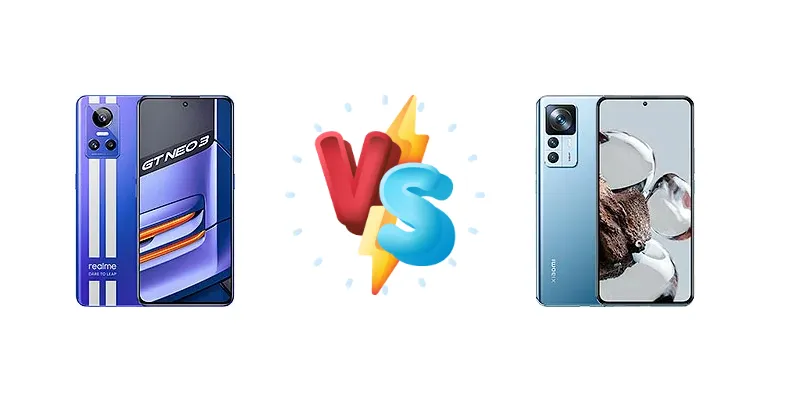
|
🏆 Quick Verdict
The Xiaomi 12T edges out the Realme GT Neo 3 thanks to its significantly faster charging, brighter display, and slightly more powerful chipset (Dimensity 8100 Ultra). However, the Realme GT Neo 3 remains a compelling option, especially if you prioritize value.
| PHONES | ||
|---|---|---|
| Phone Names | Realme GT Neo 3 | Xiaomi 12T |
| Network | ||
|---|---|---|
| 2G bands | GSM 850 / 900 / 1800 / 1900 | GSM 850 / 900 / 1800 / 1900 |
| 3G bands | HSDPA 800 / 850 / 900 / 1700(AWS) / 1900 / 2100 | HSDPA 800 / 850 / 900 / 1700(AWS) / 1900 / 2100 |
| 4G bands | 1, 2, 3, 4, 5, 7, 8, 18, 19, 26, 28, 34, 38, 39, 40, 41 | 1, 2, 3, 4, 5, 7, 8, 12, 13, 17, 18, 19, 20, 26, 28, 32, 38, 40, 41, 66 |
| 5G bands | 1, 3, 5, 8, 28, 40, 41, 77, 78 SA/NSA | 1, 3, 5, 7, 8, 20, 28, 38, 40, 41, 66, 77, 78 SA/NSA |
| Speed | HSPA, LTE, 5G | HSPA, LTE, 5G |
| Technology | GSM / CDMA / HSPA / EVDO / LTE / 5G | GSM / HSPA / LTE / 5G |
| CDMA2000 1xEV-DO | - | |
| Launch | ||
|---|---|---|
| Announced | 2022, March 22 | 2022, October 04 |
| Status | Available. Released 2022, March 30 | Available. Released 2022, October 06 |
| Body | ||
|---|---|---|
| Build | Glass front (Gorilla Glass 5), plastic frame, glass back | - |
| Dimensions | 163.3 x 75.6 x 8.2 mm (6.43 x 2.98 x 0.32 in) | 163.1 x 75.9 x 8.6 mm (6.42 x 2.99 x 0.34 in) |
| SIM | Nano-SIM + Nano-SIM | Nano-SIM + Nano-SIM |
| Weight | 188 g (6.63 oz) | 202 g (7.13 oz) |
| Display | ||
|---|---|---|
| Protection | Corning Gorilla Glass 5 | Corning Gorilla Glass 5 |
| Resolution | 1080 x 2412 pixels, 20:9 ratio (~394 ppi density) | 1220 x 2712 pixels, 20:9 ratio (~446 ppi density) |
| Size | 6.7 inches, 108.0 cm2 (~87.5% screen-to-body ratio) | 6.67 inches, 107.4 cm2 (~86.7% screen-to-body ratio) |
| Type | AMOLED, 1B colors, 120Hz, HDR10+ | AMOLED, 68B colors, 120Hz, HDR10+, 500 nits (typ), 900 nits (peak) |
| Platform | ||
|---|---|---|
| CPU | Octa-core (4x2.85 GHz Cortex-A78 & 4x2.0 GHz Cortex-A55) | Octa-core (4x2.85 GHz Cortex-A78 & 4x2.0 GHz Cortex-A55) |
| Chipset | Mediatek Dimensity 8100 (5 nm) | Mediatek Dimensity 8100 Ultra (5 nm) |
| GPU | Mali-G610 MC6 | Mali-G610 MC6 |
| OS | Android 12, upgradable to Android 13, Realme UI 3.0 | Android 12, upgradable to Android 14, MIUI 14 |
| Memory | ||
|---|---|---|
| Card slot | No | No |
| Internal | 128GB 6GB RAM, 128GB 8GB RAM, 256GB 8GB RAM, 256GB 12GB RAM, 512GB 12GB RAM | 128GB 8GB RAM, 256GB 8GB RAM |
| UFS 3.1 | UFS 3.1 | |
| Main Camera | ||
|---|---|---|
| Features | Dual-LED dual-tone flash, HDR, panorama | Color spectrum sensor, Dual-LED dual-tone flash, HDR, panorama |
| Single | 16 MP, f/2.5, 26mm (wide), 1/3.09", 1.0µm | - |
| Triple | 50 MP, f/1.9, 24mm (wide), 1/1.56", 1.0µm, PDAF, OIS 8 MP, f/2.3, 15mm, 120˚ (ultrawide), 1/4.0", 1.12µm 2 MP (macro) | 108 MP, f/1.7, 24mm (wide), 1/1.67", 0.64µm, PDAF, OIS 8 MP, f/2.2, 120˚ (ultrawide), 1/4.0", 1.12µm 2 MP (macro) |
| Video | 4K@30/60fps, 1080p@30/60fps, gyro-EIS | 4K@30fps, 1080p@30/60/120/240fps, HDR |
| Selfie camera | ||
|---|---|---|
| Features | HDR, panorama | HDR, panorama |
| Single | 16 MP, f/2.5, 26mm (wide), 1/3.09", 1.0µm | 20 MP, f/2.2, (wide), 1/3.47", 0.8µm |
| Video | 1080p@30fps, gyro-EIS | 1080p@30/60fps, HDR |
| Sound | ||
|---|---|---|
| 3.5mm jack | No | No |
| 35mm jack | No | No |
| Loudspeaker | Yes, with stereo speakers | Yes, with stereo speakers |
| 24-bit/192kHz audio | 24-bit/192kHz audio | |
| Comms | ||
|---|---|---|
| Bluetooth | 5.3, A2DP, LE, aptX HD | 5.3, A2DP, LE |
| Infrared port | - | Yes |
| NFC | Yes (dual side) | Yes (market/region dependent) |
| Positioning | GPS (L1+L5), GLONASS, BDS, GALILEO, QZSS | GPS (L1+L5), GLONASS (L1), BDS (B1I+B1c+B2a), GALILEO (E1+E5a), QZSS (L1+L5), NavIC (L5) |
| Radio | No | No |
| USB | USB Type-C 2.0 | USB Type-C 2.0, OTG |
| WLAN | Wi-Fi 802.11 a/b/g/n/ac/6, dual-band, Wi-Fi Direct | Wi-Fi 802.11 a/b/g/n/ac/6, dual-band, Wi-Fi Direct |
| Features | ||
|---|---|---|
| Sensors | Fingerprint (under display, optical), accelerometer, gyro, proximity, compass | Fingerprint (under display, optical), accelerometer, gyro, proximity, compass |
| Battery | ||
|---|---|---|
| Charging | 80W wired, 100% in 32 min | 120W wired, 100% in 19 min |
| Type | 5000 mAh | Li-Po 5000 mAh |
| Misc | ||
|---|---|---|
| Colors | Plain Black (Asphalt Black), Silverstone White (Sprint White), Le Mans Blue (Nitro Blue) | Black, Silver, Blue |
| Models | RMX3561, RMX3560 | 22071212AG |
| Price | About 430 EUR | € 181.96 / £ 283.32 |
| SAR | - | 1.09 W/kg (head) 1.09 W/kg (body) |
| SAR EU | - | 0.99 W/kg (head) 0.99 W/kg (body) |
| Tests | ||
|---|---|---|
| Battery life | - | Endurance rating 104h |
| Camera | Photo / Video | Photo / Video |
| Display | Contrast ratio: Infinite (nominal) | Contrast ratio: Infinite (nominal) |
| Loudspeaker | -27.1 LUFS (Good) | -25.0 LUFS (Very good) |
| Performance | AnTuTu: 819348 (v9) GeekBench: 4079 (v5.1) GFXBench: 53fps (ES 3.1 onscreen) | AnTuTu: 780204 (v9) GeekBench: 3756 (v5.1) |
Realme GT Neo 3
- Excellent value for money
- Fast 80W charging
- Powerful Dimensity 8100 chipset
- Good display quality
- Lower peak brightness than Xiaomi 12T
- Slightly slower charging than Xiaomi 12T
- Camera performance needs further evaluation
Xiaomi 12T
- Blazing-fast 120W charging
- Brighter display (954 nits)
- Slightly more powerful Dimensity 8100 Ultra chipset
- Excellent battery life (104h endurance)
- Potentially higher price than Realme GT Neo 3
- Design might be less distinctive
- Camera performance needs further evaluation
Display Comparison
The Xiaomi 12T boasts a noticeable advantage with its 954 nits max brightness compared to the Realme GT Neo 3's 796 nits. Both have excellent contrast ratios (infinite, nominally), but the Xiaomi's display will be more visible in direct sunlight. Both likely use AMOLED panels with 120Hz refresh rates for smooth scrolling.
Camera Comparison
Camera performance is likely comparable given the similar hardware. Both phones offer versatile camera systems, but image quality will depend on software processing. Expect good results in well-lit conditions, but low-light performance might vary. Detailed camera tests are needed for a definitive comparison.
Performance
While both phones utilize the Dimensity 8100 chipset, the Xiaomi 12T features the 'Ultra' variant, which offers a slight performance boost. In real-world usage, the difference might not be drastic, but the Xiaomi 12T will likely handle demanding tasks and games with a bit more headroom. Both phones should provide a fluid and responsive user experience.
Battery Life
The Xiaomi 12T takes a commanding lead in charging speed with its 120W wired charging, reaching 100% in just 19 minutes. The Realme GT Neo 3's 80W charging is still fast, but takes around 32 minutes. Both phones likely have similar battery capacities (around 5000mAh), and the Xiaomi 12T's endurance rating of 104h suggests excellent battery life.
Buying Guide
The Realme GT Neo 3 is ideal for gamers and users who want a powerful phone at a more affordable price. The Xiaomi 12T is a better choice for those who prioritize fast charging, a brighter screen for outdoor use, and a slightly more premium feel.