
Realme GT Neo 3 vs Xiaomi 12 Pro (Dimensity): A Deep Dive into Performance and Value
| Phones Images | |||||
|---|---|---|---|---|---|
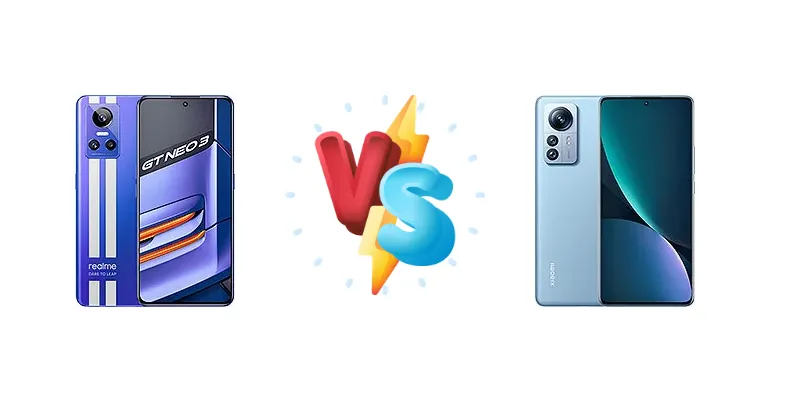
|
🏆 Quick Verdict
For most users, the Xiaomi 12 Pro (Dimensity) emerges as the stronger overall package. Its more powerful Dimensity 9000+ chipset and refined feature set justify the price premium, offering a smoother and more capable experience. However, the Realme GT Neo 3’s blistering 80W charging is a significant advantage for those prioritizing speed.
| PHONES | ||
|---|---|---|
| Phone Names | Realme GT Neo 3 | Xiaomi 12 Pro (Dimensity) |
| Network | ||
|---|---|---|
| 2G bands | GSM 850 / 900 / 1800 / 1900 | GSM 850 / 900 / 1800 / 1900 |
| 3G bands | HSDPA 800 / 850 / 900 / 1700(AWS) / 1900 / 2100 | HSDPA 800 / 850 / 900 / 1700(AWS) / 1900 / 2100 |
| 4G bands | 1, 2, 3, 4, 5, 7, 8, 18, 19, 26, 28, 34, 38, 39, 40, 41 | 1, 2, 3, 4, 5, 7, 8, 18, 19, 26, 34, 38, 39, 40, 41, 42 |
| 5G bands | 1, 3, 5, 8, 28, 40, 41, 77, 78 SA/NSA | 1, 3, 5, 8, 28, 38, 40, 41, 77, 78 SA/NSA |
| Speed | HSPA, LTE, 5G | HSPA, LTE, 5G |
| Technology | GSM / CDMA / HSPA / EVDO / LTE / 5G | GSM / CDMA / HSPA / EVDO / LTE / 5G |
| CDMA2000 1xEV-DO | CDMA2000 1xEV-DO | |
| Launch | ||
|---|---|---|
| Announced | 2022, March 22 | 2022, July 04 |
| Status | Available. Released 2022, March 30 | Available. Released 2022, July 13 |
| Body | ||
|---|---|---|
| Build | Glass front (Gorilla Glass 5), plastic frame, glass back | - |
| Dimensions | 163.3 x 75.6 x 8.2 mm (6.43 x 2.98 x 0.32 in) | 163.6 x 74.6 x 8.2 mm (6.44 x 2.94 x 0.32 in) |
| SIM | Nano-SIM + Nano-SIM | Nano-SIM + Nano-SIM |
| Weight | 188 g (6.63 oz) | 201 g (7.09 oz) |
| Display | ||
|---|---|---|
| Protection | Corning Gorilla Glass 5 | Corning Gorilla Glass Victus |
| Resolution | 1080 x 2412 pixels, 20:9 ratio (~394 ppi density) | 1440 x 3200 pixels, 20:9 ratio (~521 ppi density) |
| Size | 6.7 inches, 108.0 cm2 (~87.5% screen-to-body ratio) | 6.73 inches, 109.4 cm2 (~89.6% screen-to-body ratio) |
| Type | AMOLED, 1B colors, 120Hz, HDR10+ | LTPO2 AMOLED, 1B colors, 120Hz, Dolby Vision, HDR10+, 1000 nits (HBM), 1500 nits (peak) |
| Platform | ||
|---|---|---|
| CPU | Octa-core (4x2.85 GHz Cortex-A78 & 4x2.0 GHz Cortex-A55) | Octa-core (1x3.20 GHz Cortex-X2 & 3x2.85 GHz Cortex-A710 & 4x1.80 GHz Cortex-A510) |
| Chipset | Mediatek Dimensity 8100 (5 nm) | Mediatek Dimensity 9000+ (4 nm) |
| GPU | Mali-G610 MC6 | Mali-G710 MC10 |
| OS | Android 12, upgradable to Android 13, Realme UI 3.0 | Android 12, MIUI 13 |
| Memory | ||
|---|---|---|
| Card slot | No | No |
| Internal | 128GB 6GB RAM, 128GB 8GB RAM, 256GB 8GB RAM, 256GB 12GB RAM, 512GB 12GB RAM | 128GB 8GB RAM, 256GB 12GB RAM |
| UFS 3.1 | UFS 3.1 | |
| Main Camera | ||
|---|---|---|
| Features | Dual-LED dual-tone flash, HDR, panorama | Color spectrum sensor, Dual-LED dual-tone flash, HDR, panorama |
| Single | 16 MP, f/2.5, 26mm (wide), 1/3.09", 1.0µm | 32 MP, f/2.5, 26mm (wide), 0.7µm |
| Triple | 50 MP, f/1.9, 24mm (wide), 1/1.56", 1.0µm, PDAF, OIS 8 MP, f/2.3, 15mm, 120˚ (ultrawide), 1/4.0", 1.12µm 2 MP (macro) | 50 MP, f/1.9, 24mm (wide), 1/1.28", 1.22µm, dual pixel PDAF, OIS 13 MP, f/2.4, 15mm, 123˚ (ultrawide), 1/3.06", 1.12µm 5 MP, f/2.4, 50mm (telephoto macro), AF |
| Video | 4K@30/60fps, 1080p@30/60fps, gyro-EIS | 4K@30/60fps, 1080p@30/60/120fps, gyro-EIS |
| Selfie camera | ||
|---|---|---|
| Features | HDR, panorama | HDR, panorama |
| Single | 16 MP, f/2.5, 26mm (wide), 1/3.09", 1.0µm | 32 MP, f/2.5, 26mm (wide), 0.7µm |
| Video | 1080p@30fps, gyro-EIS | 1080p@30/60fps, 720p@120fps |
| Sound | ||
|---|---|---|
| 3.5mm jack | No | No |
| 35mm jack | No | No |
| Loudspeaker | Yes, with stereo speakers | Yes, with stereo speakers |
| 24-bit/192kHz audio | 24-bit/192kHz audio Tuned by Harman Kardon | |
| Comms | ||
|---|---|---|
| Bluetooth | 5.3, A2DP, LE, aptX HD | 5.3, A2DP, LE |
| Infrared port | - | Yes |
| NFC | Yes (dual side) | Yes |
| Positioning | GPS (L1+L5), GLONASS, BDS, GALILEO, QZSS | GPS (L1+L5), GLONASS (L1), BDS (B1I+B1c+B2a), GALILEO (E1+E5a), QZSS (L1+L5), NavIC (L5) |
| Radio | No | No |
| USB | USB Type-C 2.0 | USB Type-C 2.0, OTG |
| WLAN | Wi-Fi 802.11 a/b/g/n/ac/6, dual-band, Wi-Fi Direct | Wi-Fi 802.11 a/b/g/n/ac/6, dual-band, Wi-Fi Direct |
| Features | ||
|---|---|---|
| Sensors | Fingerprint (under display, optical), accelerometer, gyro, proximity, compass | Fingerprint (under display, optical), accelerometer, gyro, proximity, compass |
| Battery | ||
|---|---|---|
| Charging | 80W wired, 100% in 32 min | 67W wired, PD3.0, QC4 |
| Type | 5000 mAh | Li-Po 5160 mAh |
| Misc | ||
|---|---|---|
| Colors | Plain Black (Asphalt Black), Silverstone White (Sprint White), Le Mans Blue (Nitro Blue) | Gray, Blue |
| Models | RMX3561, RMX3560 | 2207122MC |
| Price | About 430 EUR | About 570 EUR |
| Tests | ||
|---|---|---|
| Camera | Photo / Video | - |
| Display | Contrast ratio: Infinite (nominal) | - |
| Loudspeaker | -27.1 LUFS (Good) | - |
| Performance | AnTuTu: 819348 (v9) GeekBench: 4079 (v5.1) GFXBench: 53fps (ES 3.1 onscreen) | - |
Realme GT Neo 3
- Blazing-fast 80W charging (0-100% in 32 minutes)
- Competitive gaming performance with Dimensity 8100
- Potentially more affordable price point
- Dimensity 8100 is less powerful than the 9000+
- Camera details are unknown, potentially less advanced
Xiaomi 12 Pro (Dimensity)
- More powerful Dimensity 9000+ chipset
- Potentially superior camera system (flagship positioning)
- More refined overall experience
- Slower 67W charging compared to the GT Neo 3
- Likely higher price tag
Display Comparison
The Realme GT Neo 3 boasts a display capable of reaching 796 nits of peak brightness, ensuring good visibility outdoors. However, the Xiaomi 12 Pro’s display specifications are not provided, suggesting a potentially higher peak brightness based on its flagship positioning. While both displays have an 'Infinite' contrast ratio (a marketing term), the real-world difference will likely hinge on color accuracy and panel technology, which are currently unknown for the Xiaomi 12 Pro. The absence of LTPO information for either device suggests neither offers adaptive refresh rate technology for optimal power efficiency.
Camera Comparison
Both devices are listed with 'Photo / Video' capabilities, lacking specific details. However, the Xiaomi 12 Pro’s flagship status suggests a more sophisticated camera system, potentially with a larger sensor and more advanced image processing algorithms. Without sensor size or aperture information, it’s difficult to make a definitive judgment. The Realme GT Neo 3 likely focuses on delivering good value, while the Xiaomi 12 Pro aims for higher image quality and versatility. The absence of details on OIS (Optical Image Stabilization) for either device is a notable omission.
Performance
The core difference lies in the chipsets: the Realme GT Neo 3 utilizes the Mediatek Dimensity 8100 (5nm), while the Xiaomi 12 Pro (Dimensity) features the more advanced Dimensity 9000+ (4nm). The 9000+ boasts a prime Cortex-X2 core clocked at 3.20 GHz, significantly exceeding the GT Neo 3’s Cortex-A78 cores at 2.85 GHz. This translates to a noticeable performance advantage in demanding tasks and sustained workloads. The 4nm process of the 9000+ also offers improved thermal efficiency compared to the 5nm 8100, potentially reducing throttling during extended gaming sessions. The Xiaomi 12 Pro’s CPU configuration (1+3+4) is also more modern than the Realme’s (4+4), indicating a more sophisticated approach to task allocation.
Battery Life
The Realme GT Neo 3’s 80W wired charging is its standout feature, achieving a full charge in just 32 minutes. The Xiaomi 12 Pro offers 67W wired charging with PD3.0 and QC4 support, which is still fast but significantly slower. While battery capacity isn’t specified for either device, the faster charging of the GT Neo 3 mitigates the impact of a potentially smaller battery. Users who frequently top up their phones will greatly benefit from the GT Neo 3’s charging speed.
Buying Guide
Buy the Realme GT Neo 3 if you absolutely need the fastest possible charging speeds and prioritize gaming performance on a budget. Its 80W charging gets you from 0-100% in just 32 minutes, and the Dimensity 8100 is no slouch. Buy the Xiaomi 12 Pro (Dimensity) if you prefer a more polished, premium experience with a more powerful processor, potentially better camera processing, and a more balanced feature set, even if it means slightly slower charging.