
Realme GT Neo 3 vs Samsung Galaxy S22+: A Detailed Comparison
| Phones Images | |||||
|---|---|---|---|---|---|
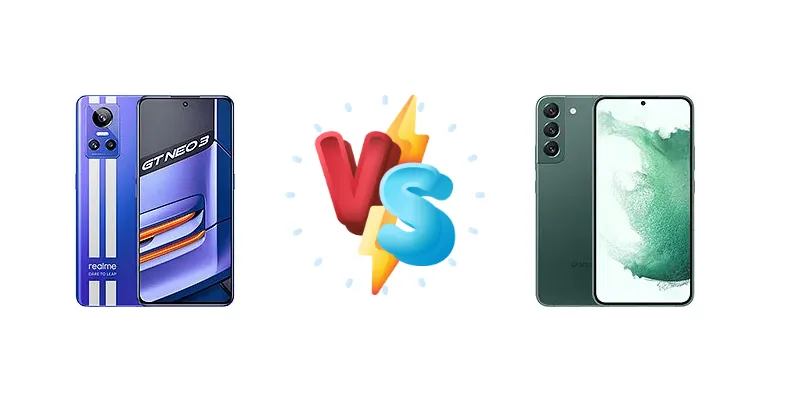
|
🏆 Quick Verdict
For the average user prioritizing a vibrant display, reliable software, and a more premium feel, the Samsung Galaxy S22+ 5G is the better choice. However, gamers and power users who value rapid charging and peak performance will find the Realme GT Neo 3 a compelling alternative.
| PHONES | ||
|---|---|---|
| Phone Names | Realme GT Neo 3 | Samsung Galaxy S22+ 5G |
| Network | ||
|---|---|---|
| 2G bands | GSM 850 / 900 / 1800 / 1900 | GSM 850 / 900 / 1800 / 1900 |
| 3G bands | HSDPA 800 / 850 / 900 / 1700(AWS) / 1900 / 2100 | HSDPA 850 / 900 / 1700(AWS) / 1900 / 2100 |
| 4G bands | 1, 2, 3, 4, 5, 7, 8, 18, 19, 26, 28, 34, 38, 39, 40, 41 | 1, 2, 3, 4, 5, 7, 8, 12, 13, 17, 18, 19, 20, 25, 26, 28, 32, 38, 39, 40, 41, 66 - International |
| 5G bands | 1, 3, 5, 8, 28, 40, 41, 77, 78 SA/NSA | 1, 2, 3, 5, 7, 8, 12, 20, 25, 28, 38, 40, 41, 66, 75, 77, 78 SA/NSA/Sub6 - International |
| Speed | HSPA, LTE, 5G | HSPA 42.2/5.76 Mbps, LTE (7CA) Cat20 2000/200 Mbps, 5G (5+ Gbps DL) |
| Technology | GSM / CDMA / HSPA / EVDO / LTE / 5G | GSM / CDMA / HSPA / EVDO / LTE / 5G |
| CDMA2000 1xEV-DO | 1, 3, 5, 7, 8, 20, 28, 38, 41, 66, 71, 260, 261 SA/NSA/Sub6/mmWave - USA | |
| Launch | ||
|---|---|---|
| Announced | 2022, March 22 | 2022, February 09 |
| Status | Available. Released 2022, March 30 | Available. Released 2022, February 25 |
| Body | ||
|---|---|---|
| Build | Glass front (Gorilla Glass 5), plastic frame, glass back | Glass front (Gorilla Glass Victus+), glass back (Gorilla Glass Victus+), aluminum frame |
| Dimensions | 163.3 x 75.6 x 8.2 mm (6.43 x 2.98 x 0.32 in) | 157.4 x 75.8 x 7.6 mm (6.20 x 2.98 x 0.30 in) |
| SIM | Nano-SIM + Nano-SIM | · Nano-SIM + eSIM· Nano-SIM + Nano-SIM + eSIM (max 2 at a time) |
| Weight | 188 g (6.63 oz) | 195 g / 196 g (mmWave) (6.88 oz) |
| - | IP68 dust/water resistant (up to 1.5m for 30 min) Armor aluminum frame with tougher drop and scratch resistance (advertised) | |
| Display | ||
|---|---|---|
| Protection | Corning Gorilla Glass 5 | Corning Gorilla Glass Victus+ |
| Resolution | 1080 x 2412 pixels, 20:9 ratio (~394 ppi density) | 1080 x 2340 pixels, 19.5:9 ratio (~393 ppi density) |
| Size | 6.7 inches, 108.0 cm2 (~87.5% screen-to-body ratio) | 6.6 inches, 105.3 cm2 (~88.3% screen-to-body ratio) |
| Type | AMOLED, 1B colors, 120Hz, HDR10+ | Dynamic AMOLED 2X, 120Hz, HDR10+, 1750 nits (peak) |
| - | Always-on display | |
| Platform | ||
|---|---|---|
| CPU | Octa-core (4x2.85 GHz Cortex-A78 & 4x2.0 GHz Cortex-A55) | Octa-core (1x2.8 GHz Cortex-X2 & 3x2.50 GHz Cortex-A710 & 4x1.8 GHz Cortex-A510) - EuropeOcta-core (1x3.00 GHz Cortex-X2 & 3x2.50 GHz Cortex-A710 & 4x1.80 GHz Cortex-A510) - ROW |
| Chipset | Mediatek Dimensity 8100 (5 nm) | Exynos 2200 (4 nm) - EuropeQualcomm SM8450 Snapdragon 8 Gen 1 (4 nm) - ROW |
| GPU | Mali-G610 MC6 | Xclipse 920 - EuropeAdreno 730 - ROW |
| OS | Android 12, upgradable to Android 13, Realme UI 3.0 | Android 12, up to 4 major Android upgrades, One UI 6.1.1 |
| Memory | ||
|---|---|---|
| Card slot | No | No |
| Internal | 128GB 6GB RAM, 128GB 8GB RAM, 256GB 8GB RAM, 256GB 12GB RAM, 512GB 12GB RAM | 128GB 8GB RAM, 256GB 8GB RAM |
| UFS 3.1 | UFS 3.1 | |
| Main Camera | ||
|---|---|---|
| Features | Dual-LED dual-tone flash, HDR, panorama | LED flash, auto-HDR, panorama |
| Single | 16 MP, f/2.5, 26mm (wide), 1/3.09", 1.0µm | - |
| Triple | 50 MP, f/1.9, 24mm (wide), 1/1.56", 1.0µm, PDAF, OIS 8 MP, f/2.3, 15mm, 120˚ (ultrawide), 1/4.0", 1.12µm 2 MP (macro) | 50 MP, f/1.8, 23mm (wide), 1/1.56", 1.0µm, dual pixel PDAF, OIS 10 MP, f/2.4, 70mm (telephoto), 1/3.94", 1.0µm, PDAF, OIS, 3x optical zoom 12 MP, f/2.2, 13mm, 120˚ (ultrawide), 1/2.55" 1.4µm, Super Steady video |
| Video | 4K@30/60fps, 1080p@30/60fps, gyro-EIS | 8K@24fps, 4K@30/60fps, 1080p@30/60/120/240fps, HDR10+, stereo sound rec., gyro-EIS |
| Selfie camera | ||
|---|---|---|
| Features | HDR, panorama | HDR |
| Single | 16 MP, f/2.5, 26mm (wide), 1/3.09", 1.0µm | 10 MP, f/2.2, 26mm (wide), 1/3.24", 1.22µm, dual pixel PDAF |
| Video | 1080p@30fps, gyro-EIS | 4K@30/60fps, 1080p@30fps |
| Sound | ||
|---|---|---|
| 3.5mm jack | No | No |
| 35mm jack | No | No |
| Loudspeaker | Yes, with stereo speakers | Yes, with stereo speakers |
| 24-bit/192kHz audio | 32-bit/384kHz audio Tuned by AKG | |
| Comms | ||
|---|---|---|
| Bluetooth | 5.3, A2DP, LE, aptX HD | 5.2, A2DP, LE |
| NFC | Yes (dual side) | Yes |
| Positioning | GPS (L1+L5), GLONASS, BDS, GALILEO, QZSS | GPS, GLONASS, BDS, GALILEO |
| Radio | No | No |
| USB | USB Type-C 2.0 | USB Type-C 3.2, OTG |
| WLAN | Wi-Fi 802.11 a/b/g/n/ac/6, dual-band, Wi-Fi Direct | Wi-Fi 802.11 a/b/g/n/ac/6e, dual-band, Wi-Fi Direct |
| Features | ||
|---|---|---|
| Sensors | Fingerprint (under display, optical), accelerometer, gyro, proximity, compass | Fingerprint (under display, ultrasonic), accelerometer, gyro, proximity, compass, barometer |
| - | Samsung DeX, Samsung Wireless DeX (desktop experience support) Bixby natural language commands and dictation Samsung Pay (Visa, MasterCard certified) Ultra Wideband (UWB) support | |
| Battery | ||
|---|---|---|
| Charging | 80W wired, 100% in 32 min | 45W wired, PD3.0 15W wireless (Qi) 4.5W reverse wireless |
| Type | 5000 mAh | Li-Ion 4500 mAh |
| Misc | ||
|---|---|---|
| Colors | Plain Black (Asphalt Black), Silverstone White (Sprint White), Le Mans Blue (Nitro Blue) | Phantom Black, White, Pink Gold, Green, Graphite, Sky Blue, Violet, Cream, Bora Purple |
| Models | RMX3561, RMX3560 | SM-S906B, SM-S906B/DS, SM-S906U, SM-S906U1, SM-S906W, SM-S906N, SM-S9060, SM-S906E, SM-S906E/DS, SM-S906L |
| Price | About 430 EUR | € 236.99 / $ 194.37 / £ 349.00 |
| SAR | - | 1.19 W/kg (head) 1.08 W/kg (body) |
| SAR EU | - | 0.57 W/kg (head) 1.40 W/kg (body) |
| Tests | ||
|---|---|---|
| Battery life | - | Endurance rating 97h |
| Camera | Photo / Video | Photo / Video |
| Display | Contrast ratio: Infinite (nominal) | Contrast ratio: Infinite (nominal) |
| Loudspeaker | -27.1 LUFS (Good) | -26.0 LUFS (Very good) |
| Performance | AnTuTu: 819348 (v9) GeekBench: 4079 (v5.1) GFXBench: 53fps (ES 3.1 onscreen) | AnTuTu: 722495 (v8), 886916 (v9) GeekBench: 3528 (v5.1) GFXBench: 68fps (ES 3.1 onscreen) |
Realme GT Neo 3
- Blazing-fast 80W wired charging
- Potentially better thermal management with Dimensity 8100
- Competitive price point
- No wireless charging
- Less refined software experience
- Lower peak display brightness
Samsung Galaxy S22+ 5G
- Brighter, more color-accurate display
- Wireless and reverse wireless charging
- Polished software experience with longer update support
- Slower 45W wired charging
- Potential for thermal throttling (Exynos variant)
- Higher price
Display Comparison
The Samsung Galaxy S22+ boasts a significantly brighter display, reaching a measured 1214 nits compared to the Realme GT Neo 3’s 796 nits. This translates to superior visibility under direct sunlight. Both displays share an 'Infinite' contrast ratio (typical for OLED panels), but the S22+'s higher peak brightness is a clear advantage. While both are excellent, the S22+ offers a more visually impactful experience, especially for media consumption. The S22+ also benefits from Samsung’s well-regarded display calibration, likely offering greater color accuracy out of the box.
Camera Comparison
Both phones feature capable photo and video capabilities, but detailed sensor information is lacking in the provided data. The S22+'s established image processing pipeline and likely superior optics (based on Samsung’s camera reputation) give it an edge in image quality, particularly in challenging lighting conditions. The Realme GT Neo 3 will likely focus on delivering vibrant, social media-ready images. Without specific sensor details, it’s difficult to assess low-light performance or dynamic range accurately. The inclusion of a 2MP macro camera on the GT Neo 3 is unlikely to significantly impact the overall camera experience.
Performance
The chipset choice is a major differentiator. The Realme GT Neo 3 utilizes the Mediatek Dimensity 8100 (5nm), while the S22+ comes in two variants: the Exynos 2200 (4nm) in Europe and the Qualcomm Snapdragon 8 Gen 1 (4nm) in other regions. The Dimensity 8100’s octa-core configuration (4x2.85 GHz Cortex-A78 & 4x2.0 GHz Cortex-A55) is optimized for efficiency, potentially leading to better sustained performance under load. The Snapdragon 8 Gen 1 generally outperforms the Exynos 2200, but both are prone to thermal throttling. The S22+'s CPU, with its Cortex-X2 core, offers a theoretical single-core performance advantage, but real-world differences may be minimal. The 5nm process of the Dimensity 8100 could give the GT Neo 3 an edge in thermal management.
Battery Life
The Samsung Galaxy S22+ achieves an impressive 97-hour endurance rating, despite a slower 45W wired charging speed. The Realme GT Neo 3, however, dramatically cuts down charging times with its 80W wired charging, reaching 100% in just 32 minutes. While the S22+ offers 15W wireless and 4.5W reverse wireless charging, the GT Neo 3 lacks wireless charging altogether. The S22+'s endurance rating suggests better overall battery life, but the GT Neo 3’s rapid charging mitigates range anxiety, allowing for quick top-ups throughout the day.
Buying Guide
Buy the Realme GT Neo 3 if you need blistering fast 80W charging, prioritize gaming performance, and are comfortable with a less refined software experience. Buy the Samsung Galaxy S22+ 5G if you prefer a brighter, more color-accurate display, a more polished software experience with longer update support, and wireless charging capabilities.