
Realme GT Neo 3 vs Motorola Edge 30 Pro: A Deep Dive into Performance and Value
| Phones Images | |||||
|---|---|---|---|---|---|
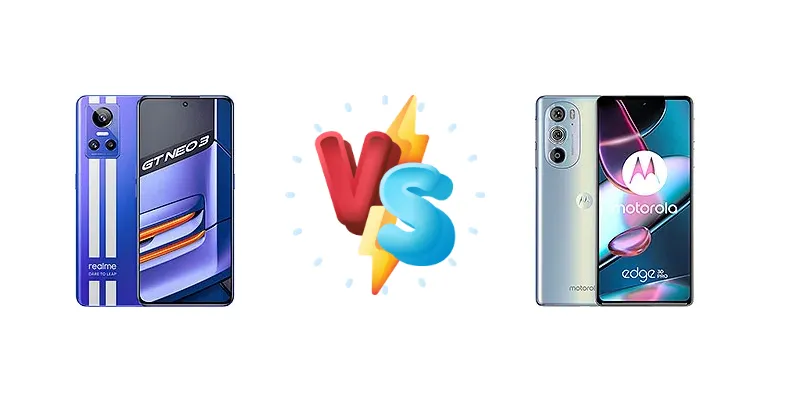
|
🏆 Quick Verdict
For most users, the Realme GT Neo 3 emerges as the stronger choice. Its 80W charging significantly outperforms the Motorola Edge 30 Pro’s 68W, and the Dimensity 8100 offers excellent performance with better thermal management, making it ideal for sustained gaming and daily use. While the Edge 30 Pro boasts a more powerful CPU core, the GT Neo 3’s overall package is more balanced.
| PHONES | ||
|---|---|---|
| Phone Names | Realme GT Neo 3 | Motorola Edge 30 Pro |
| Network | ||
|---|---|---|
| 2G bands | GSM 850 / 900 / 1800 / 1900 | GSM 850 / 900 / 1800 / 1900 |
| 3G bands | HSDPA 800 / 850 / 900 / 1700(AWS) / 1900 / 2100 | HSDPA 850 / 900 / 1700(AWS) / 1900 / 2100 |
| 4G bands | 1, 2, 3, 4, 5, 7, 8, 18, 19, 26, 28, 34, 38, 39, 40, 41 | 1, 2, 3, 4, 5, 7, 8, 12, 13, 17, 18, 19, 20, 25, 26, 28, 32, 38, 39, 40, 41, 42, 43, 48, 66 - International |
| 5G bands | 1, 3, 5, 8, 28, 40, 41, 77, 78 SA/NSA | 1, 3, 5, 7, 8, 20, 28, 38, 40, 41, 66, 77, 78 SA/NSA/Sub6 - International |
| Speed | HSPA, LTE, 5G | HSPA 42.2/5.76 Mbps, LTE Cat20 2000/150 Mbps, 5G |
| Technology | GSM / CDMA / HSPA / EVDO / LTE / 5G | GSM / HSPA / LTE / 5G |
| CDMA2000 1xEV-DO | 2, 5, 7, 12, 25, 26, 29, 30, 41, 48, 66, 71, 77, 78, 260, 261 SA/NSA/Sub6/mmWave - USA | |
| Launch | ||
|---|---|---|
| Announced | 2022, March 22 | 2022, January 24 |
| Status | Available. Released 2022, March 30 | Available. Released 2022, March 04 |
| Body | ||
|---|---|---|
| Build | Glass front (Gorilla Glass 5), plastic frame, glass back | Glass front (Gorilla Glass 3), glass back (Gorilla Glass 5), plastic frame |
| Dimensions | 163.3 x 75.6 x 8.2 mm (6.43 x 2.98 x 0.32 in) | 163.1 x 76 x 8.8 mm (6.42 x 2.99 x 0.35 in) |
| SIM | Nano-SIM + Nano-SIM | · Nano-SIM· Nano-SIM + Nano-SIM |
| Weight | 188 g (6.63 oz) | 196 g (6.91 oz) |
| - | Water-repellent design | |
| Display | ||
|---|---|---|
| Protection | Corning Gorilla Glass 5 | Corning Gorilla Glass 3 |
| Resolution | 1080 x 2412 pixels, 20:9 ratio (~394 ppi density) | 1080 x 2400 pixels, 20:9 ratio (~393 ppi density) |
| Size | 6.7 inches, 108.0 cm2 (~87.5% screen-to-body ratio) | 6.7 inches, 108.4 cm2 (~87.4% screen-to-body ratio) |
| Type | AMOLED, 1B colors, 120Hz, HDR10+ | OLED, 1B colors, 144Hz, HDR10+ |
| - | Always-on display | |
| Platform | ||
|---|---|---|
| CPU | Octa-core (4x2.85 GHz Cortex-A78 & 4x2.0 GHz Cortex-A55) | Octa-core (1x3.00 GHz Cortex-X2 & 3x2.50 GHz Cortex-A710 & 4x1.80 GHz Cortex-A510) |
| Chipset | Mediatek Dimensity 8100 (5 nm) | Qualcomm SM8450 Snapdragon 8 Gen 1 (4 nm) |
| GPU | Mali-G610 MC6 | Adreno 730 |
| OS | Android 12, upgradable to Android 13, Realme UI 3.0 | Android 12, upgradable to Android 14 |
| Memory | ||
|---|---|---|
| Card slot | No | No |
| Internal | 128GB 6GB RAM, 128GB 8GB RAM, 256GB 8GB RAM, 256GB 12GB RAM, 512GB 12GB RAM | 128GB 8GB RAM, 256GB 8GB RAM, 256GB 12GB RAM, 512GB 8GB RAM, 512GB 12GB RAM |
| UFS 3.1 | UFS 3.1 | |
| Main Camera | ||
|---|---|---|
| Features | Dual-LED dual-tone flash, HDR, panorama | Dual-LED dual-tone flash, HDR, panorama |
| Single | 16 MP, f/2.5, 26mm (wide), 1/3.09", 1.0µm | - |
| Triple | 50 MP, f/1.9, 24mm (wide), 1/1.56", 1.0µm, PDAF, OIS 8 MP, f/2.3, 15mm, 120˚ (ultrawide), 1/4.0", 1.12µm 2 MP (macro) | 50 MP, f/1.8, (wide), 1/1.55", 1.0µm, multi-directional PDAF, OIS 50 MP, f/2.2, 114˚ (ultrawide), 1/2.76", 0.64µm, AF Auxiliary lens |
| Video | 4K@30/60fps, 1080p@30/60fps, gyro-EIS | 8K@24/30fps, 4K@30/60fps, 1080p@30/60/120/240/960fps, 10-bit HDR10+, gyro-EIS |
| Selfie camera | ||
|---|---|---|
| Features | HDR, panorama | HDR |
| Single | 16 MP, f/2.5, 26mm (wide), 1/3.09", 1.0µm | 60 MP, f/2.2, (wide), 1/2.8", 0.61µm |
| Video | 1080p@30fps, gyro-EIS | 4K@30fps, 1080p@30/120fps |
| Sound | ||
|---|---|---|
| 3.5mm jack | No | No |
| 35mm jack | No | No |
| Loudspeaker | Yes, with stereo speakers | Yes, with stereo speakers |
| 24-bit/192kHz audio | 24-bit/192kHz audio | |
| Comms | ||
|---|---|---|
| Bluetooth | 5.3, A2DP, LE, aptX HD | 5.2, A2DP, LE, aptX HD, aptX Adaptive |
| NFC | Yes (dual side) | Yes |
| Positioning | GPS (L1+L5), GLONASS, BDS, GALILEO, QZSS | GPS (L1+L5), GLONASS, BDS, GALILEO |
| Radio | No | No |
| USB | USB Type-C 2.0 | USB Type-C 3.1, DisplayPort 1.4 |
| WLAN | Wi-Fi 802.11 a/b/g/n/ac/6, dual-band, Wi-Fi Direct | Wi-Fi 802.11 a/b/g/n/ac/6e, dual-band, Wi-Fi Direct |
| Features | ||
|---|---|---|
| Sensors | Fingerprint (under display, optical), accelerometer, gyro, proximity, compass | Fingerprint (side-mounted), accelerometer, gyro, proximity, compass, barometer |
| - | Ready For support | |
| Battery | ||
|---|---|---|
| Charging | 80W wired, 100% in 32 min | 68W wired, 50% in 15 min, 100% in 35 min 15W wireless 5W reverse wireless |
| Type | 5000 mAh | Li-Po 4800 mAh |
| Misc | ||
|---|---|---|
| Colors | Plain Black (Asphalt Black), Silverstone White (Sprint White), Le Mans Blue (Nitro Blue) | Cosmos Blue, Stardust White |
| Models | RMX3561, RMX3560 | XT2201-1 |
| Price | About 430 EUR | € 475.45 |
| Tests | ||
|---|---|---|
| Battery life | - | Endurance rating 80h |
| Camera | Photo / Video | Photo / Video |
| Display | Contrast ratio: Infinite (nominal) | Contrast ratio: Infinite (nominal) |
| Loudspeaker | -27.1 LUFS (Good) | -24.2 LUFS (Very good) |
| Performance | AnTuTu: 819348 (v9) GeekBench: 4079 (v5.1) GFXBench: 53fps (ES 3.1 onscreen) | AnTuTu: 941895 (v9) GeekBench: 3658 (v5.1) GFXBench: 78fps (ES 3.1 onscreen) |
Realme GT Neo 3
- Incredibly fast 80W wired charging
- More efficient Dimensity 8100 chipset for sustained performance
- Potentially better thermal management
- Lacks wireless charging
- Limited camera specification details
Motorola Edge 30 Pro
- More powerful Snapdragon 8 Gen 1 CPU core
- Wireless and reverse wireless charging support
- Potentially better image processing
- Slower 68W wired charging
- Potential for thermal throttling under heavy load
Display Comparison
Both phones feature displays with an 'Infinite' contrast ratio, suggesting typical OLED characteristics. However, the Realme GT Neo 3 boasts a measured peak brightness of 796 nits, noticeably exceeding the Motorola Edge 30 Pro’s 685 nits. This translates to better visibility in direct sunlight for the GT Neo 3. While both likely employ high refresh rates (not specified in the data), the brighter panel on the Realme gives it an edge for outdoor usability. The lack of information on panel technology (LTPO, PWM dimming) prevents a deeper analysis of display quality beyond peak brightness.
Camera Comparison
Both devices are listed as having 'Photo / Video' capabilities, offering minimal insight. Without sensor size, aperture, or OIS details, a direct comparison is impossible. The presence of a 2MP macro camera on either device is unlikely to be a significant factor in image quality. The Snapdragon 8 Gen 1’s ISP (Image Signal Processor) is generally considered more advanced, potentially offering better image processing capabilities, but this advantage is dependent on software optimization. The lack of specific camera specs makes it difficult to determine a clear winner.
Performance
The Motorola Edge 30 Pro’s Snapdragon 8 Gen 1 (4nm) features a Cortex-X2 prime core clocked at 3.00 GHz, aiming for top-tier single-core performance. However, the Realme GT Neo 3’s Dimensity 8100 (5nm) utilizes four Cortex-A78 cores at 2.85 GHz, offering a more sustained performance profile due to its more efficient 5nm fabrication process. The Snapdragon 8 Gen 1 is known to generate more heat under prolonged load, potentially leading to throttling. The Edge 30 Pro’s CPU architecture includes Cortex-A710 and A510 cores, while the GT Neo 3 uses A55 cores. While the A710 is theoretically faster than the A55, the 5nm process of the Dimensity 8100 mitigates this advantage, especially in real-world scenarios. The impact of RAM speed (LPDDR5x) is not specified, but is likely similar on both devices.
Battery Life
The Motorola Edge 30 Pro boasts an endurance rating of 80 hours, but this is a broad metric. The Realme GT Neo 3’s standout feature is its 80W wired charging, achieving a full charge in just 32 minutes. The Edge 30 Pro’s 68W charging takes 35 minutes for a full charge, and also includes 15W wireless and 5W reverse wireless charging – features absent on the GT Neo 3. While the Edge 30 Pro’s endurance rating suggests comparable battery life, the GT Neo 3’s significantly faster charging provides a more convenient user experience, especially for power users. The faster charging offsets any potential minor differences in battery capacity.
Buying Guide
Buy the Realme GT Neo 3 if you prioritize incredibly fast charging, efficient performance for extended gaming sessions, and a more balanced thermal profile. Buy the Motorola Edge 30 Pro if you absolutely need the highest possible peak CPU performance, value wireless charging, and are willing to potentially manage some thermal throttling during demanding tasks. The Edge 30 Pro also appeals to users deeply integrated into the Motorola ecosystem.