
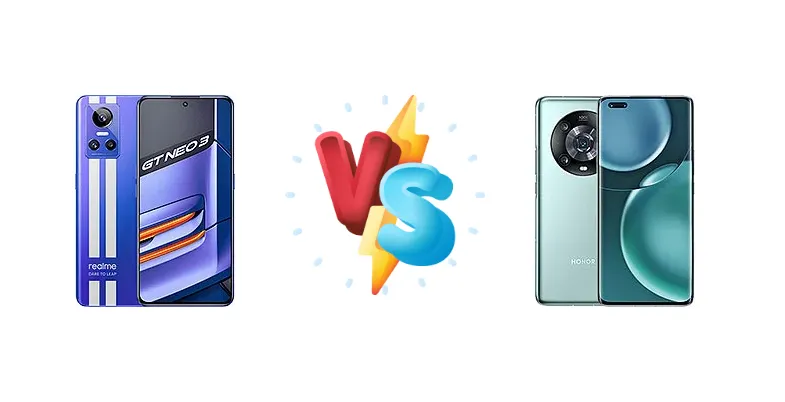
Realme GT Neo 3 150W vs Honor Magic4 Pro: A Deep Dive Comparison
| Phones Images | |||||
|---|---|---|---|---|---|
|
🏆 Quick Verdict
For the average user prioritizing speed and value, the Realme GT Neo 3 150W is the clear winner. Its 150W charging is unmatched, and the Dimensity 8100 delivers excellent performance. However, the Honor Magic4 Pro excels in camera quality and offers the convenience of wireless charging, making it ideal for photography enthusiasts.
| PHONES | ||
|---|---|---|
| Phone Names | Realme GT Neo 3 150W | Honor Magic4 Pro |
| Network | ||
|---|---|---|
| 2G bands | GSM 850 / 900 / 1800 / 1900 | GSM 850 / 900 / 1800 / 1900 |
| 3G bands | HSDPA 800 / 850 / 900 / 1700(AWS) / 1900 / 2100 | HSDPA 800 / 850 / 900 / 1700(AWS) / 1900 / 2100 |
| 4G bands | 1, 2, 3, 4, 5, 7, 8, 18, 19, 26, 28, 34, 38, 39, 40, 41 | 1, 2, 3, 4, 5, 7, 8, 12, 17, 18, 19, 20, 26, 28, 34, 38, 39, 40, 41 - China |
| 5G bands | 1, 3, 5, 8, 28, 40, 41, 77, 78 SA/NSA | 1, 3, 5, 8, 28, 38, 41, 77, 78, 79 SA/NSA - China |
| Speed | HSPA, LTE, 5G | HSPA, LTE, 5G |
| Technology | GSM / CDMA / HSPA / EVDO / LTE / 5G | GSM / CDMA / HSPA / EVDO / LTE / 5G |
| CDMA2000 1xEV-DO | CDMA2000 1xEV-DO | |
| Launch | ||
|---|---|---|
| Announced | 2022, March 22 | 2022, February 28 |
| Status | Available. Released 2022, March 30 | Available. Released 2022, April 09 |
| Body | ||
|---|---|---|
| Build | - | Glass front, aluminum frame, glass back |
| Dimensions | 163.3 x 75.6 x 8.2 mm (6.43 x 2.98 x 0.32 in) | 163.6 x 74.7 x 9.1 mm or 9.2 mm |
| SIM | Nano-SIM + Nano-SIM | · Nano-SIM + eSIM· Nano-SIM + Nano-SIM |
| Weight | 188 g (6.63 oz) | 209 g / 215 g (7.37 oz) |
| - | IP68 dust/water resistant (up to 1.5m for 30 min) | |
| Display | ||
|---|---|---|
| Protection | Corning Gorilla Glass 5 | Aluminosilicate glass |
| Resolution | 1080 x 2412 pixels, 20:9 ratio (~394 ppi density) | 1312 x 2848 pixels, 19.5:9 ratio (~460 ppi density) |
| Size | 6.7 inches, 108.0 cm2 (~87.5% screen-to-body ratio) | 6.81 inches, 113.7 cm2 (~93.0% screen-to-body ratio) |
| Type | AMOLED, 1B colors, 120Hz, HDR10+ | LTPO OLED, 1B colors, 120Hz, HDR10+, 1000 nits (peak) |
| Platform | ||
|---|---|---|
| CPU | Octa-core (4x2.85 GHz Cortex-A78 & 4x2.0 GHz Cortex-A55) | Octa-core (1x3.00 GHz Cortex-X2 & 3x2.50 GHz Cortex-A710 & 4x1.80 GHz Cortex-A510) |
| Chipset | Mediatek Dimensity 8100 (5 nm) | Qualcomm SM8450 Snapdragon 8 Gen 1 (4 nm) |
| GPU | Mali-G610 MC6 | Adreno 730 |
| OS | Android 12, upgradable to Android 13, Realme UI 3.0 | Android 12, Magic UI 6 |
| Memory | ||
|---|---|---|
| Card slot | No | No |
| Internal | 256GB 8GB RAM, 256GB 12GB RAM | 256GB 8GB RAM, 256GB 12GB RAM, 512GB 12GB RAM |
| UFS 3.1 | - | |
| Main Camera | ||
|---|---|---|
| Features | Dual-LED dual-tone flash, HDR, panorama | Laser AF, color spectrum sensor, LED flash, HDR, panorama |
| Single | 16 MP, f/2.5, 26mm (wide), 1/3.09", 1.0µm | 12 MP, f/2.4, 100˚ (ultrawide), 1.22µm TOF 3D, (depth/biometrics sensor) |
| Triple | 50 MP, f/1.9, 24mm (wide), 1/1.56", 1.0µm, PDAF, OIS 8 MP, f/2.3, 15mm, 120˚ (ultrawide), 1/4.0", 1.12µm 2 MP (macro) | 50 MP, f/1.8, 23mm (wide), 1/1.56", 1.0µm, multi-directional PDAF 50 MP, f/2.2, 122˚ (ultrawide), 1/2.5", AF 64 MP, f/3.5, 90mm (periscope telephoto), 1/2.0", 0.7µm, PDAF, OIS, 3.5x optical zoom TOF 3D (depth) |
| Video | 4K@30/60fps, 1080p@30/60fps, gyro-EIS | 4K@30/60fps, 1080p@30/60fps, gyro-EIS, HDR10, 10-bit video |
| Selfie camera | ||
|---|---|---|
| Features | HDR, panorama | HDR |
| Single | 16 MP, f/2.5, 26mm (wide), 1/3.09", 1.0µm | 12 MP, f/2.4, 100˚ (ultrawide), 1.22µm TOF 3D, (depth/biometrics sensor) |
| Video | 1080p@30fps, gyro-EIS | 4K@30fps, 1080p@30fps |
| Sound | ||
|---|---|---|
| 3.5mm jack | No | No |
| 35mm jack | No | No |
| Loudspeaker | Yes, with stereo speakers | Yes, with stereo speakers |
| 24-bit/192kHz audio | 24-bit audio stereo recording | |
| Comms | ||
|---|---|---|
| Bluetooth | 5.3, A2DP, LE, aptX HD | 5.2, A2DP, LE, aptX HD |
| Infrared port | - | Yes |
| NFC | Yes (dual side) | Yes |
| Positioning | GPS (L1+L5), GLONASS, BDS, GALILEO, QZSS | GPS (L1+L5), GLONASS (L1), BDS (B1I+B1c+B2a), GALILEO (E1+E5a) |
| Radio | No | No |
| USB | USB Type-C 2.0 | USB Type-C 3.1, OTG |
| WLAN | Wi-Fi 802.11 a/b/g/n/ac/6, dual-band, Wi-Fi Direct | Wi-Fi 802.11 a/b/g/n/ac/6, dual-band, Wi-Fi Direct |
| Features | ||
|---|---|---|
| Sensors | Fingerprint (under display, optical), accelerometer, gyro, proximity, compass | Fingerprint (under display, ultrasonic), Face ID, accelerometer, gyro, proximity, compass |
| Battery | ||
|---|---|---|
| Charging | 150W wired, 50% in 5 min | 100W wired, 100% in 30 min 100W wireless, 50% in 15 min Reverse wireless 5W reverse wired |
| Type | 4500 mAh | Li-Po 4600 mAh |
| Misc | ||
|---|---|---|
| Colors | Plain Black (Asphalt Black), Silverstone White (Sprint White), Le Mans Blue (Nitro Blue), Naruto edition | Black, White, Cyan, Gold, Orange |
| Models | RMX3563, RMX3562 | LGE-NX9, LGE-N49B, LGE-N19B, LGE-AN10, GBD-NX9 |
| Price | About 520 EUR | € 469.41 / £ 397.48 |
| Tests | ||
|---|---|---|
| Battery life | Endurance rating 102h | Endurance rating 82h |
| Camera | - | Photo / Video |
| Display | Contrast ratio: Infinite (nominal) | Contrast ratio: Infinite (nominal) |
| Loudspeaker | -27.1 LUFS (Good) | -23.6 LUFS (Very good) |
| Performance | AnTuTu: 819348 (v9) GeekBench: 4079 (v5.1) GFXBench: 53fps (ES 3.1 onscreen) | AnTuTu: 980755 (v9) GeekBench: 3512 (v5.1) GFXBench: 59fps (ES 3.1 onscreen) |
Realme GT Neo 3 150W
- Unmatched 150W wired charging speed
- Excellent performance from the Dimensity 8100 chipset
- Potentially better thermal management due to 5nm process
- Camera specifications are unknown, potentially weaker than the competition
- Lacks wireless charging capabilities
Honor Magic4 Pro
- Superior camera system with OIS and advanced image processing
- Convenient 100W wireless and reverse charging
- High peak display brightness for outdoor visibility
- Slower wired charging compared to the Realme GT Neo 3
- Snapdragon 8 Gen 1 may throttle under sustained load
Display Comparison
Both devices feature displays with an 'Infinite' (nominal) contrast ratio, suggesting excellent black levels. However, the Honor Magic4 Pro boasts a measured peak brightness of 957 nits, significantly exceeding what's available on the Realme GT Neo 3 (no data provided). This translates to superior visibility in direct sunlight. While both likely employ high refresh rate panels, the Honor's higher brightness gives it a clear advantage for outdoor use. The lack of specific display technology details (LTPO, AMOLED type) for the Realme GT Neo 3 leaves questions about its power efficiency compared to the Honor.
Camera Comparison
The Honor Magic4 Pro clearly prioritizes camera capabilities, indicated by its 'Photo / Video' designation. While specific sensor details are absent, the inclusion of OIS (Optical Image Stabilization) is implied for flagship-level video recording. The Realme GT Neo 3's camera specifications are not provided, making a direct comparison difficult. The Honor's likely larger sensor and more advanced image processing algorithms will result in superior image quality, particularly in low-light conditions. The absence of details on the Realme's camera system suggests it may not be a primary selling point.
Performance
The Realme GT Neo 3 150W utilizes the Mediatek Dimensity 8100 (5nm), while the Honor Magic4 Pro is powered by the Qualcomm Snapdragon 8 Gen 1 (4nm). While both are high-end chipsets, the Snapdragon 8 Gen 1's Cortex-X2 prime core (3.00 GHz) offers a theoretical single-core performance advantage over the Dimensity 8100's Cortex-A78 cores (2.85 GHz). However, the Dimensity 8100's 5nm process node generally leads to better thermal efficiency, potentially mitigating throttling during sustained workloads. The Honor's LPDDR5 RAM is standard for flagships, but the Realme's RAM specification is missing, potentially impacting multitasking performance. The Snapdragon 8 Gen 1's Adreno 730 GPU is generally considered more powerful than the Dimensity 8100's Mali-G610 MC4, benefiting graphically intensive games.
Battery Life
The Realme GT Neo 3 150W boasts a remarkable 150W wired charging capability, capable of reaching 50% charge in just 5 minutes. This is significantly faster than the Honor Magic4 Pro's 100W wired charging (100% in 30 minutes). However, the Honor compensates with 100W wireless charging (50% in 15 minutes) and reverse wireless/wired charging, offering greater versatility. The Realme GT Neo 3 has an endurance rating of 102 hours, while the Honor Magic4 Pro has 82 hours. This suggests the Realme's battery optimization and potentially larger battery capacity (not specified) contribute to longer runtime despite the faster charging.
Buying Guide
Buy the Realme GT Neo 3 150W if you need the absolute fastest charging available, prioritize gaming performance, and want a flagship-level experience without the flagship price tag. Buy the Honor Magic4 Pro if you prefer a more refined camera system, value wireless charging and reverse wireless capabilities, and are willing to pay a premium for a more polished overall experience.