
Realme GT Master vs Google Pixel 6a: A Detailed Comparison
| Phones Images | |||||
|---|---|---|---|---|---|
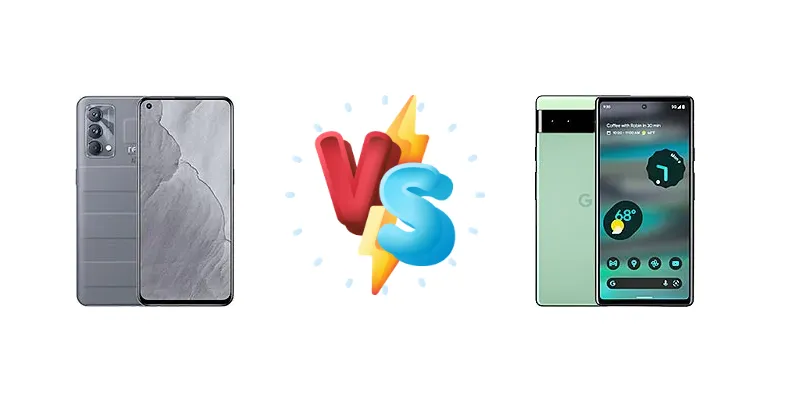
|
🏆 Quick Verdict
For most users, the Google Pixel 6a emerges as the stronger choice. While the Realme GT Master boasts significantly faster 65W charging, the Pixel 6a’s superior display brightness, Google Tensor chip, and refined software experience provide a more polished and future-proofed package.
| PHONES | ||
|---|---|---|
| Phone Names | Realme GT Master | Google Pixel 6a |
| Network | ||
|---|---|---|
| 2G bands | GSM 850 / 900 / 1800 / 1900 | GSM 850 / 900 / 1800 / 1900 |
| 3G bands | HSDPA 850 / 900 / 1700(AWS) / 1900 / 2100 | HSDPA 800 / 850 / 900 / 1700(AWS) / 1900 / 2100 |
| 4G bands | 1, 2, 3, 4, 5, 7, 8, 12, 17, 18, 19, 20, 26, 28, 38, 39, 40, 41, 66 - International | 1, 2, 3, 4, 5, 7, 8, 12, 13, 14, 17, 18, 19, 20, 25, 26, 28, 29, 30, 38, 39, 40, 41, 42, 48, 66, 71 - GX7AS, GB62Z (USA/Canada) |
| 5G bands | 1, 3, 5, 7, 8, 20, 28, 38, 40, 41, 66, 77, 78 SA/NSA - International | 1, 2, 3, 5, 7, 8, 12, 20, 25, 28, 30, 38, 40, 41, 48, 66, 71, 77, 78 SA/NSA/Sub6 - GX7AS (USA/Canada) |
| Speed | HSPA, LTE, 5G | HSPA, LTE, 5G |
| Technology | GSM / CDMA / HSPA / EVDO / LTE / 5G | GSM / HSPA / LTE / 5G |
| 1, 3, 5, 8, 28, 41, 77, 78 SA/NSA - China | 1, 2, 3, 5, 7, 8, 12, 20, 25, 28, 30, 40, 48, 66, 71, 77, 78 SA/NSA/Sub6 - G1AZG (International) | |
| Launch | ||
|---|---|---|
| Announced | 2021, July 21 | 2022, May 11 |
| Status | Available. Released 2021, July 30 | Available. Released 2022, July 21 |
| Body | ||
|---|---|---|
| Build | Glass front, plastic frame, plastic back | Glass front (Gorilla Glass 3), aluminum frame, plastic back |
| Dimensions | 159.2 mm x 73.5 mm x 8.0/8.7 mm (depending on color) | 152.2 x 71.8 x 8.9 mm (5.99 x 2.83 x 0.35 in) |
| SIM | Nano-SIM + Nano-SIM | Nano-SIM + eSIM |
| Weight | 174/180 g (depending on color) (6.14 oz) | 178 g (6.28 oz) |
| - | IP67 dust/water resistant (up to 1m for 30 min) | |
| Display | ||
|---|---|---|
| Protection | - | Corning Gorilla Glass 3 |
| Resolution | 1080 x 2400 pixels, 20:9 ratio (~409 ppi density) | 1080 x 2400 pixels, 20:9 ratio (~429 ppi density) |
| Size | 6.43 inches, 99.8 cm2 (~85.3% screen-to-body ratio) | 6.1 inches, 90.7 cm2 (~83.0% screen-to-body ratio) |
| Type | Super AMOLED, 120Hz, 1000 nits (peak) | OLED, HDR |
| - | Always-on display | |
| Platform | ||
|---|---|---|
| CPU | Octa-core (1x2.4 GHz Cortex-A78 & 3x2.2 GHz Cortex-A78 & 4x1.9 GHz Cortex-A55) | Octa-core (2x2.80 GHz Cortex-X1 & 2x2.25 GHz Cortex-A76 & 4x1.80 GHz Cortex-A55) |
| Chipset | Qualcomm SM7325 Snapdragon 778G 5G (6 nm) | Google Tensor (5 nm) |
| GPU | Adreno 642L | Mali-G78 MP20 |
| OS | Android 11, upgradable to Android 13, Realme UI 4.0 | Android 12, upgradable to Android 15, up to 5 major Android upgrades |
| Memory | ||
|---|---|---|
| Card slot | No | No |
| Internal | 128GB 6GB RAM, 128GB 8GB RAM, 256GB 8GB RAM | 128GB 6GB RAM |
| UFS | UFS 3.1 | |
| Main Camera | ||
|---|---|---|
| Dual | - | 12.2 MP, f/1.7, 27mm, (wide), 1/2.55", 1.4µm, dual pixel PDAF, OIS 12 MP, f/2.2, 17mm, 114˚ (ultrawide), 1.25µm |
| Features | LED flash, HDR, panorama | Dual-LED flash, Pixel Shift, Auto-HDR, panorama |
| Single | 32 MP, f/2.5, 26mm (wide), 1/2.74", 0.8µm | 8 MP, f/2.0, 24mm (wide), 1.12µm |
| Triple | 64 MP, f/1.8, 25mm (wide), 1/2.0", 0.7µm, PDAF 8 MP, f/2.2, 16mm, 119˚ (ultrawide), 1/4.0", 1.12µm 2 MP (macro) | - |
| Video | 4K@30fps, 1080p@30/60fps, gyro-EIS | 4K@30/60fps, 1080p@30/60/120/240fps; gyro-EIS, OIS |
| Selfie camera | ||
|---|---|---|
| Features | HDR, panorama | HDR, panorama |
| Single | 32 MP, f/2.5, 26mm (wide), 1/2.74", 0.8µm | 8 MP, f/2.0, 24mm (wide), 1.12µm |
| Video | 1080p@30fps | 1080p@30fps |
| Sound | ||
|---|---|---|
| 3.5mm jack | Yes | No |
| 35mm jack | Yes | No |
| Loudspeaker | Yes | Yes, with stereo speakers |
| 24-bit/192kHz audio | - | |
| Comms | ||
|---|---|---|
| Bluetooth | 5.2, A2DP, LE | 5.2, A2DP, LE |
| NFC | Yes | Yes |
| Positioning | GPS, GLONASS, GALILEO, BDS, QZSS | GPS, GLONASS, GALILEO, QZSS |
| Radio | No | No |
| USB | USB Type-C 2.0, OTG | USB Type-C 3.1 |
| WLAN | Wi-Fi 802.11 a/b/g/n/ac/6, dual-band, Wi-Fi Direct | Wi-Fi 802.11 a/b/g/n/ac/6e, dual-band, Wi-Fi Direct |
| Features | ||
|---|---|---|
| Sensors | Fingerprint (under display, optical), accelerometer, gyro, proximity, compass | Fingerprint (under display, optical), accelerometer, gyro, proximity, compass, barometer |
| Battery | ||
|---|---|---|
| Charging | 65W wired, 100% in 33 min | 18W wired, PD3.0 |
| Type | 4300 mAh | Li-Po 4410 mAh |
| Misc | ||
|---|---|---|
| Colors | Black, Gray, White, Aurora | Chalk, Charcoal, Sage |
| Models | RMX3363, RMX3360, RMX3361 | GX7AS, GB62Z, G1AZG, GB17L |
| Price | $ 142.99 / € 128.55 | $ 138.99 / C$ 228.74 / ₹ 23,999 |
| Tests | ||
|---|---|---|
| Battery life | Endurance rating 114h | Endurance rating 94h |
| Camera | Photo / Video | - |
| Display | Contrast ratio: Infinite (nominal) | Contrast ratio: Infinite (nominal) |
| Loudspeaker | -29.2 LUFS (Average) | - |
| Performance | AnTuTu: 529263 (v9) GeekBench: 2917 (v5.1) GFXBench: 27fps (ES 3.1 onscreen) | - |
Realme GT Master
- Incredibly fast 65W charging
- Unique and stylish design
- Slightly longer battery endurance rating
- Less bright display
- Realme UI may not appeal to all users
Google Pixel 6a
- Brighter and more vibrant display
- Google Tensor chip for smooth performance
- Excellent camera with Google’s computational photography
- Guaranteed software updates
- Slower 18W charging
- Lower battery endurance rating
Display Comparison
The Pixel 6a’s display is a clear winner in terms of brightness, achieving a measured 876 nits compared to the Realme GT Master’s 634 nits. This translates to significantly better visibility outdoors under direct sunlight. Both displays share an infinite (nominal) contrast ratio, but the Pixel 6a’s higher peak brightness makes a tangible difference in everyday use. While both are OLED panels, the Realme GT Master’s display technology isn’t specified, suggesting it lacks features like LTPO for variable refresh rates found in some competitors, potentially impacting power efficiency. The Pixel 6a’s superior brightness is a significant advantage for media consumption and general usability.
Camera Comparison
Both phones offer capable camera systems, but approach image processing differently. The Pixel 6a leverages Google’s computational photography expertise, known for its excellent dynamic range and accurate color reproduction. While specific sensor details are missing for both, the Pixel 6a’s image processing is a key differentiator. The Realme GT Master’s camera focuses on versatility, but lacks the software optimization of the Pixel. The Pixel 6a’s strength lies in its ability to consistently deliver high-quality images in various lighting conditions, making it the better choice for casual photographers. We're ignoring the likely 2MP macro sensors on both devices as they offer minimal practical benefit.
Performance
The core difference lies in the chipsets. The Google Pixel 6a utilizes Google’s in-house Tensor chip, fabricated on a 5nm process, while the Realme GT Master features the Qualcomm Snapdragon 778G 5G (6nm). While the Snapdragon 778G is a capable performer, the Tensor chip’s Cortex-X1 prime core (2.80 GHz) offers a performance advantage over the GT Master’s Cortex-A78 (2.4 GHz). The Pixel 6a’s CPU configuration (2x2.80 GHz Cortex-X1 & 2x2.25 GHz Cortex-A76 & 4x1.80 GHz Cortex-A55) is geared towards more demanding tasks. The 5nm process of the Tensor chip also contributes to better thermal efficiency, potentially reducing throttling during sustained workloads. While the GT Master is no slouch, the Pixel 6a offers a more responsive and future-proofed experience.
Battery Life
The Realme GT Master boasts an endurance rating of 114 hours, while the Pixel 6a manages 94 hours. However, this doesn’t tell the whole story. The GT Master’s 65W wired charging is a game-changer, achieving a full charge in just 33 minutes. The Pixel 6a’s 18W charging, while supporting PD3.0, is significantly slower. This means the GT Master can quickly recover from battery drain, even with its slightly lower endurance rating. The faster charging speed effectively mitigates the smaller battery capacity difference, making the GT Master more convenient for users who need a quick power boost.
Buying Guide
Buy the Realme GT Master if you prioritize incredibly fast charging and a unique, eye-catching design, and are comfortable with Realme UI. It’s ideal for users who frequently top up their phones and value aesthetics. Buy the Google Pixel 6a if you prioritize a brighter, more vibrant display, a cleaner software experience with guaranteed updates, and Google’s renowned computational photography capabilities. This phone is best for users who value simplicity, camera quality, and long-term software support.