
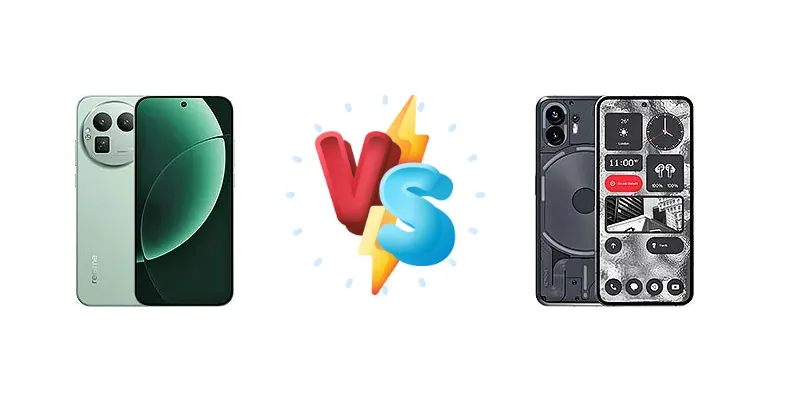
Realme GT 8 Pro vs Nothing Phone (2): A Head-to-Head Flagship Showdown
| Phones Images | |||||
|---|---|---|---|---|---|
|
🏆 Quick Verdict
For users prioritizing ultimate performance and blazing-fast charging, the Realme GT 8 Pro is the clear winner. Its Snapdragon 8 Elite Gen 5 chipset and 120W charging significantly outperform the Nothing Phone (2). However, the Nothing Phone (2) appeals to those seeking a distinctive aesthetic and a more polished software experience.
| PHONES | ||
|---|---|---|
| Phone Names | Realme GT 8 Pro | Nothing Phone (2) |
| Network | ||
|---|---|---|
| 2G bands | GSM 850 / 900 / 1800 / 1900 | GSM 850 / 900 / 1800 / 1900 |
| 3G bands | HSDPA 800 / 850 / 900 / 1700(AWS) / 1900 / 2100 | HSDPA 800 / 850 / 900 / 1700(AWS) / 1900 / 2100 |
| 4G bands | 1, 2, 3, 4, 5, 7, 8, 12, 13, 17, 18, 19, 20, 26, 28, 38, 39, 40, 41, 42, 48, 66, 71 - International | 1, 2, 3, 4, 5, 7, 8, 12, 17, 18, 19, 20, 25, 26, 28, 30, 32, 34, 38, 39, 40, 41, 42, 48, 66, 71 |
| 5G bands | 1, 2, 3, 5, 7, 8, 20, 28, 38, 40, 41, 48, 66, 71, 77, 78, 79 SA/NSA - International | 1, 2, 3, 5, 7, 8, 12, 20, 25, 28, 30, 38, 40, 41, 66, 71, 75, 77, 78 SA/NSA |
| Speed | HSPA, LTE, 5G | HSPA, LTE, 5G |
| Technology | GSM / HSPA / LTE / 5G | GSM / HSPA / LTE / 5G |
| Launch | ||
|---|---|---|
| Announced | 2025, October 21 | 2023, July 11 |
| Status | Available. Released 2025, October 21 | Available. Released 2023, July 17 |
| Body | ||
|---|---|---|
| Build | Glass front (Gorilla Glass 7i), aluminum alloy frame, fiber-reinforced plastic back or silicone polymer (eco leather) back | Glass front (Gorilla Glass 5), glass back (Gorilla Glass 5), aluminum frame |
| Dimensions | 161.8 x 76.9 x 8.2 mm (6.37 x 3.03 x 0.32 in) | 162.1 x 76.4 x 8.6 mm (6.38 x 3.01 x 0.34 in) |
| SIM | · Nano-SIM + Nano-SIM + eSIM (max 2 at a time) - International· Nano-SIM + Nano-SIM - China | Nano-SIM + Nano-SIM |
| Weight | 214 g or 218 g (7.69 oz) | 201.2 g (7.09 oz) |
| Display | ||
|---|---|---|
| Protection | Corning Gorilla Glass 7i, Mohs level 4 | Corning Gorilla Glass 5 |
| Resolution | 1440 x 3136 pixels, 19.5:9 ratio (~508 ppi density) | 1080 x 2412 pixels, 20:9 ratio (~394 ppi density) |
| Size | 6.79 inches, 112.8 cm2 (~90.7% screen-to-body ratio) | 6.7 inches, 108.0 cm2 (~87.2% screen-to-body ratio) |
| Type | AMOLED, 1B colors, 144Hz, HDR10+, HDR Vivid, Dolby Vision, 1000 nits (typ), 2000 nits (HBM), 7000 nits (peak) | LTPO OLED, 1B colors, 120Hz, 1920Hz PWM, HDR10+, 1600 nits (HBM), 1600 nits (peak) |
| Platform | ||
|---|---|---|
| CPU | Octa-core (2x4.6 GHz Oryon V3 Phoenix L + 6x3.62 GHz Oryon V3 Phoenix M) | Octa-core (1x3.0 GHz Cortex-X2 & 3x2.5 GHz Cortex-A710 & 4x1.80 GHz Cortex-A510) |
| Chipset | Qualcomm SM8850-AC Snapdragon 8 Elite Gen 5 (3 nm) | Qualcomm SM8475 Snapdragon 8+ Gen 1 (4 nm) |
| GPU | Adreno 840 | Adreno 730 |
| OS | Android 16, up to 4 major Android upgrades, Realme UI 7.0 | Android 13, upgradable to Android 15, up to 3 major Android upgrades, Nothing OS 3.0 |
| Memory | ||
|---|---|---|
| Card slot | No | No |
| Internal | 256GB 12GB RAM, 256GB 16GB RAM, 512GB 12GB RAM, 512GB 16GB RAM, 1TB 16GB RAM | 128GB 8GB RAM, 256GB 12GB RAM, 512GB 12GB RAM |
| Main Camera | ||
|---|---|---|
| Dual | - | 50 MP, f/1.9, 24mm (wide), 1/1.56", 1.0µm, PDAF, OIS 50 MP, f/2.2, 114˚ (ultrawide), 1/2.76", 0.64µm, AF |
| Features | Ricoh lens, Color spectrum sensor, LED flash, HDR, panorama, switchable camera bump | LED flash, panorama, HDR |
| Triple | 50 MP, f/1.8, 22mm (wide), 1/1.56", 1.0µm, multi-directional PDAF, OIS 200 MP, f/2.6, 65mm, (periscope telephoto), 1/1.56", 0.5µm, multi-directional PDAF, OIS, 3x optical zoom 50 MP, f/2.0, 16mm, 116˚ (ultrawide), 1/2.88", 0.64µm | - |
| Video | 8K@30fps, 4K@30/60/120fps, 1080p@30/60/120/240fps, gyro-EIS, HDR, Dolby Vision, 10-bit LOG | 4K@30/60fps, 1080p@30/60fps, gyro-EIS, live HDR, OIS |
| Selfie camera | ||
|---|---|---|
| Features | Panorama | HDR |
| Single | 32 MP, f/2.4, 24mm (wide), 1/3.1", 0.7µm | 32 MP, f/2.5, (wide), 1/2.74", 0.8µm |
| Video | 4K@30/60fps, 1080p@30/60fps; gyro-EIS, HDR, Dolby Vision | 1080p@30fps |
| Sound | ||
|---|---|---|
| 35mm jack | No | No |
| Loudspeaker | Yes, with stereo speakers | Yes, with stereo speakers |
| Comms | ||
|---|---|---|
| Bluetooth | 6.0, A2DP, LE, aptX HD, LHDC 5 | 5.3, A2DP, LE, aptX HD, aptX Adaptive |
| Infrared port | Yes | - |
| NFC | Yes, 360˚ | Yes |
| Positioning | GPS (L1+L5), BDS (B1I+B1c+B2a), GALILEO (E1+E5a), QZSS (L1+L5), GLONASS, NavIC (L5) | GPS (L1+L5), GLONASS (L1), BDS (B1I+B1c), GALILEO (E1), QZSS (L1), NavIC |
| Radio | No | No |
| USB | USB Type-C 2.0, OTG | USB Type-C 2.0, OTG |
| WLAN | Wi-Fi 802.11 a/b/g/n/ac/6/7, dual-band | Wi-Fi 802.11 a/b/g/n/ac/6, dual-band, Wi-Fi Direct |
| Features | ||
|---|---|---|
| Sensors | Fingerprint (under display, ultrasonic), accelerometer, gyro, proximity, compass | Fingerprint (under display, optical), accelerometer, proximity, gyro, compass |
| Battery | ||
|---|---|---|
| Charging | 120W wired, 120W UFCS, 14.4W PD, 55W PPS, 14.4W QC, 15 min to 50%, 43 min to 100% 50W wireless, 79 min to 100% 10W wireless reverse 5W reverse wired | 45W wired, PD3.0, PPS, QC4, 100% in 55 min 15W wireless, 100% in 130 min 5W reverse wireless |
| Type | Si/C Li-Ion 7000 mAh | Li-Ion 4700 mAh |
| Misc | ||
|---|---|---|
| Colors | Diary White, Urban Blue, Green, Aston Martin Green | White, Dark Gray |
| Models | RMX5210 | A065 |
| Price | € 899.99 | $ 379.99 / £ 370.00 |
| SAR | 0.99 W/kg (head) 1.27 W/kg (body) | - |
| EU LABEL | ||
|---|---|---|
| Battery | 60:32h endurance, 1100 cycles | - |
| Energy | Class B | - |
| Free fall | Class D (60 falls) | - |
| Repairability | Class C | - |
Realme GT 8 Pro
- Unmatched processing power with Snapdragon 8 Elite Gen 5
- Blazing-fast 120W wired and 50W wireless charging
- Extremely high peak display brightness
- Software experience may be less refined than Nothing OS
- Design may be less distinctive than the Nothing Phone (2)
Nothing Phone (2)
- Unique and eye-catching transparent design
- Clean and intuitive Nothing OS software experience
- Balanced feature set and refined camera processing
- Significantly less powerful processor than the GT 8 Pro
- Slower charging speeds compared to the GT 8 Pro
Display Comparison
The Realme GT 8 Pro boasts a significantly brighter display, reaching a measured peak of 2262 nits, compared to the Nothing Phone (2)'s 998 nits. This translates to superior visibility in direct sunlight. While both likely utilize OLED panels, the GT 8 Pro’s higher brightness and potentially higher PWM dimming rate (data unavailable) make it the better choice for outdoor use and users sensitive to flicker. The Nothing Phone (2) may offer more color accuracy out of the box, but the GT 8 Pro’s brightness advantage is substantial.
Camera Comparison
Context data is limited regarding camera specifics. However, given the market positioning, the Nothing Phone (2) likely prioritizes a more refined and balanced camera experience, focusing on software processing and image quality. The Realme GT 8 Pro, while potentially having a larger sensor, may lean towards a more saturated and contrast-rich image profile. Without detailed sensor size and aperture information, it’s difficult to definitively declare a winner, but the Nothing Phone (2)'s emphasis on computational photography suggests a more versatile camera system.
Performance
The Realme GT 8 Pro’s Qualcomm SM8850-AC Snapdragon 8 Elite Gen 5 (3nm) represents a generational leap over the Nothing Phone (2)’s Snapdragon 8+ Gen 1 (4nm). The 3nm process node of the Snapdragon 8 Elite Gen 5 offers improved power efficiency and thermal performance, allowing for sustained peak performance. The GT 8 Pro’s CPU, with its Oryon V3 Phoenix cores (2x4.6 GHz + 6x3.62 GHz), will demonstrably outperform the Nothing Phone (2)’s Octa-core configuration (1x3.0 GHz Cortex-X2 + 3x2.5 GHz Cortex-A710 + 4x1.80 GHz Cortex-A510) in CPU-intensive tasks and gaming. The GT 8 Pro is the clear winner for demanding users.
Battery Life
The Realme GT 8 Pro achieves a remarkable 60:32h endurance rating and an active use score of 20:24h, despite a potentially smaller battery capacity (data unavailable). This is largely due to the efficiency of the Snapdragon 8 Elite Gen 5 and optimized software. The Nothing Phone (2) offers a respectable 14:21h active use score and an older endurance rating of 103h. However, the GT 8 Pro’s charging speed is a game-changer: 120W wired charging can take the phone from 0-50% in just 15 minutes and to 100% in 43 minutes, while the Nothing Phone (2)'s 45W charging takes 55 minutes for a full charge. The GT 8 Pro also offers 50W wireless charging, significantly faster than the Nothing Phone (2)'s 15W wireless charging.
Buying Guide
Buy the Realme GT 8 Pro if you need uncompromising processing power for demanding games or applications, and if minimizing charging downtime is critical. Its 120W charging and impressive endurance score cater to power users. Buy the Nothing Phone (2) if you prefer a unique, transparent design, a clean software experience with the Glyph Interface, and a more balanced approach to features, even if it means sacrificing some raw performance.