
Realme GT 8 Pro vs. Google Pixel 8a: A Deep Dive into Performance, Battery, and Camera
| Phones Images | |||||
|---|---|---|---|---|---|
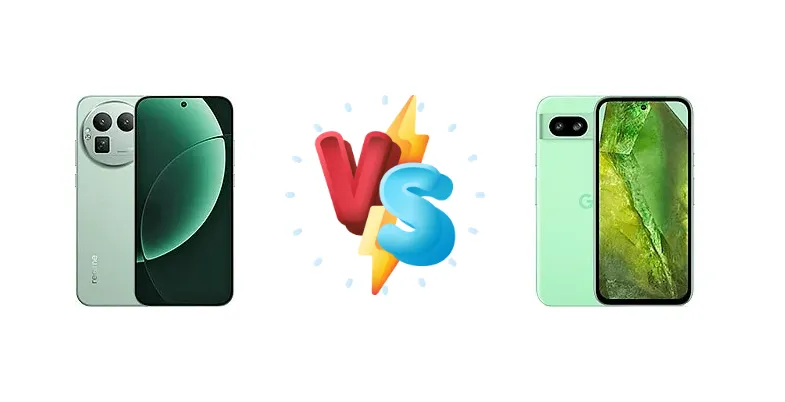
|
🏆 Quick Verdict
For users prioritizing raw power and blazing-fast charging, the Realme GT 8 Pro is the clear winner. Its Snapdragon 8 Elite Gen 5 and 120W charging are unmatched in this price bracket. However, the Pixel 8a offers a more balanced experience with excellent software, a capable camera, and respectable battery life, making it ideal for everyday users.
| PHONES | ||
|---|---|---|
| Phone Names | Realme GT 8 Pro | Google Pixel 8a |
| Network | ||
|---|---|---|
| 2G bands | GSM 850 / 900 / 1800 / 1900 | GSM 850 / 900 / 1800 / 1900 |
| 3G bands | HSDPA 800 / 850 / 900 / 1700(AWS) / 1900 / 2100 | HSDPA 800 / 850 / 900 / 1700(AWS) / 1900 / 2100 |
| 4G bands | 1, 2, 3, 4, 5, 7, 8, 12, 13, 17, 18, 19, 20, 26, 28, 38, 39, 40, 41, 42, 48, 66, 71 - International | 1, 2, 3, 4, 5, 7, 8, 12, 17, 18, 19, 20, 26, 28, 32, 38, 40, 41, 42, 66 - G6GPR (International) |
| 5G bands | 1, 2, 3, 5, 7, 8, 20, 28, 38, 40, 41, 48, 66, 71, 77, 78, 79 SA/NSA - International | 1, 2, 3, 5, 7, 8, 12, 20, 26, 28, 38, 40, 41, 66, 75, 76, 77, 78 SA/NSA/Sub6 - G6GPR (International) |
| Speed | HSPA, LTE, 5G | HSPA, LTE, 5G |
| Technology | GSM / HSPA / LTE / 5G | GSM / HSPA / LTE / 5G |
| Launch | ||
|---|---|---|
| Announced | 2025, October 21 | 2024, May 07 |
| Status | Available. Released 2025, October 21 | Available. Released 2024, May 14 |
| Body | ||
|---|---|---|
| Build | Glass front (Gorilla Glass 7i), aluminum alloy frame, fiber-reinforced plastic back or silicone polymer (eco leather) back | Glass front (Gorilla Glass 3), aluminum frame, plastic back |
| Dimensions | 161.8 x 76.9 x 8.2 mm (6.37 x 3.03 x 0.32 in) | 152.1 x 72.7 x 8.9 mm (5.99 x 2.86 x 0.35 in) |
| SIM | · Nano-SIM + Nano-SIM + eSIM (max 2 at a time) - International· Nano-SIM + Nano-SIM - China | Nano-SIM + eSIM |
| Weight | 214 g or 218 g (7.69 oz) | 188 g (6.63 oz) |
| Display | ||
|---|---|---|
| Protection | Corning Gorilla Glass 7i, Mohs level 4 | Corning Gorilla Glass 3, Mohs level 5 |
| Resolution | 1440 x 3136 pixels, 19.5:9 ratio (~508 ppi density) | 1080 x 2400 pixels, 20:9 ratio (~430 ppi density) |
| Size | 6.79 inches, 112.8 cm2 (~90.7% screen-to-body ratio) | 6.1 inches, 90.3 cm2 (~81.6% screen-to-body ratio) |
| Type | AMOLED, 1B colors, 144Hz, HDR10+, HDR Vivid, Dolby Vision, 1000 nits (typ), 2000 nits (HBM), 7000 nits (peak) | OLED, HDR, 120Hz, 2000 nits (peak) |
| Platform | ||
|---|---|---|
| CPU | Octa-core (2x4.6 GHz Oryon V3 Phoenix L + 6x3.62 GHz Oryon V3 Phoenix M) | Nona-core (1x3.0 GHz Cortex-X3 & 4x2.45 GHz Cortex-A715 & 4x2.15 GHz Cortex-A510) |
| Chipset | Qualcomm SM8850-AC Snapdragon 8 Elite Gen 5 (3 nm) | Google Tensor G3 (4 nm) |
| GPU | Adreno 840 | Immortalis-G715s MC10 |
| OS | Android 16, up to 4 major Android upgrades, Realme UI 7.0 | Android 14, upgradable to Android 16, up to 7 major Android upgrades |
| Memory | ||
|---|---|---|
| Card slot | No | No |
| Internal | 256GB 12GB RAM, 256GB 16GB RAM, 512GB 12GB RAM, 512GB 16GB RAM, 1TB 16GB RAM | 128GB 8GB RAM, 256GB 8GB RAM |
| Main Camera | ||
|---|---|---|
| Dual | - | 64 MP (16 MP eff.), f/1.9, 26mm (wide), 1/1.73", 0.8µm, dual pixel PDAF, OIS 13 MP, f/2.2, 120˚ (ultrawide), 1.12µm |
| Features | Ricoh lens, Color spectrum sensor, LED flash, HDR, panorama, switchable camera bump | Dual-LED flash, Pixel Shift, Ultra HDR, panorama, Best Take |
| Triple | 50 MP, f/1.8, 22mm (wide), 1/1.56", 1.0µm, multi-directional PDAF, OIS 200 MP, f/2.6, 65mm, (periscope telephoto), 1/1.56", 0.5µm, multi-directional PDAF, OIS, 3x optical zoom 50 MP, f/2.0, 16mm, 116˚ (ultrawide), 1/2.88", 0.64µm | - |
| Video | 8K@30fps, 4K@30/60/120fps, 1080p@30/60/120/240fps, gyro-EIS, HDR, Dolby Vision, 10-bit LOG | 4K@30/60fps, 1080p@30/60/120/240fps, OIS |
| Selfie camera | ||
|---|---|---|
| Features | Panorama | HDR, panorama |
| Single | 32 MP, f/2.4, 24mm (wide), 1/3.1", 0.7µm | 13 MP, f/2.2, 20mm (ultrawide), 1.12µm |
| Video | 4K@30/60fps, 1080p@30/60fps; gyro-EIS, HDR, Dolby Vision | 4K@30fps, 1080p@30/60fps |
| Sound | ||
|---|---|---|
| 35mm jack | No | No |
| Loudspeaker | Yes, with stereo speakers | Yes, with stereo speakers |
| Comms | ||
|---|---|---|
| Bluetooth | 6.0, A2DP, LE, aptX HD, LHDC 5 | 5.3, A2DP, LE |
| Infrared port | Yes | - |
| NFC | Yes, 360˚ | Yes |
| Positioning | GPS (L1+L5), BDS (B1I+B1c+B2a), GALILEO (E1+E5a), QZSS (L1+L5), GLONASS, NavIC (L5) | GPS, GLONASS, GALILEO, BDS, QZSS, NavIC |
| Radio | No | No |
| USB | USB Type-C 2.0, OTG | USB Type-C 3.2 |
| WLAN | Wi-Fi 802.11 a/b/g/n/ac/6/7, dual-band | Wi-Fi 802.11 a/b/g/n/ac/6e, dual/tri-band (market/region dependent) |
| Features | ||
|---|---|---|
| Sensors | Fingerprint (under display, ultrasonic), accelerometer, gyro, proximity, compass | Fingerprint (under display, optical), accelerometer, gyro, proximity, compass, barometer |
| Battery | ||
|---|---|---|
| Charging | 120W wired, 120W UFCS, 14.4W PD, 55W PPS, 14.4W QC, 15 min to 50%, 43 min to 100% 50W wireless, 79 min to 100% 10W wireless reverse 5W reverse wired | 18W wired, PD3.0 7.5W wireless Bypass charging |
| Type | Si/C Li-Ion 7000 mAh | Li-Po 4492 mAh |
| Misc | ||
|---|---|---|
| Colors | Diary White, Urban Blue, Green, Aston Martin Green | Obsidian, Porcelain, Bay, Aloe |
| Models | RMX5210 | GKV4X, G6GPR, G8HHN, G576D |
| Price | € 899.99 | $ 229.98 / C$ 417.99 / £ 279.00 / € 299.99 / ₹ 33,300 |
| SAR | 0.99 W/kg (head) 1.27 W/kg (body) | - |
| EU LABEL | ||
|---|---|---|
| Battery | 60:32h endurance, 1100 cycles | 40:06h endurance, 1000 cycles |
| Energy | Class B | Class B |
| Free fall | Class D (60 falls) | Class A (270 falls) |
| Repairability | Class C | Class B |
Realme GT 8 Pro
- Unmatched charging speed (120W)
- Superior processing power with Snapdragon 8 Elite Gen 5
- Brighter display for outdoor visibility
- Potentially less refined software experience
- Active use battery life is lower than endurance rating suggests
Google Pixel 8a
- Excellent camera with Google’s computational photography
- Streamlined and user-friendly software experience
- Longer battery endurance rating
- Significantly slower charging speed (18W)
- Less powerful chipset for demanding tasks
Display Comparison
The Realme GT 8 Pro boasts a significantly brighter display, reaching a measured 2262 nits, compared to the Pixel 8a’s 1508 nits. This translates to superior visibility under direct sunlight. While both likely utilize OLED panels, the GT 8 Pro’s higher peak brightness and potentially higher PWM dimming rate (data unavailable) could make it more comfortable for extended viewing, especially for users sensitive to flicker. The Pixel 8a’s display, while dimmer, benefits from Google’s color calibration expertise, likely offering accurate and pleasing colors.
Camera Comparison
While detailed camera specs are missing, the Pixel 8a’s strength lies in Google’s computational photography. The Tensor G3’s dedicated image processing unit (TPU) enables features like Magic Eraser and Photo Unblur. The GT 8 Pro will likely rely more on hardware capabilities, potentially featuring a larger main sensor (spec missing) to capture more light. However, without knowing sensor sizes and lens apertures, it’s difficult to definitively declare a winner. The Pixel 8a’s consistent image quality and user-friendly camera app are significant advantages, while the GT 8 Pro may offer more flexibility for advanced users.
Performance
The core difference lies in the chipsets. The Realme GT 8 Pro’s Qualcomm Snapdragon 8 Elite Gen 5 (3nm) is a powerhouse, featuring an octa-core configuration with Oryon V3 Phoenix cores clocked up to 4.6 GHz. This architecture is designed for sustained performance and efficiency. In contrast, the Google Pixel 8a utilizes the Google Tensor G3 (4nm), a nona-core chip focused on AI and machine learning tasks. While the Tensor G3 excels in areas like image processing and voice recognition, the Snapdragon 8 Elite Gen 5 will demonstrably outperform it in CPU and GPU-intensive tasks like gaming and video editing. The GT 8 Pro’s likely use of LPDDR5x RAM further enhances its memory bandwidth, contributing to smoother multitasking.
Battery Life
The Pixel 8a exhibits a longer battery endurance rating of 40:06h compared to the Realme GT 8 Pro’s 60:32h, a surprising result. However, the active use score tells a different story: 20:24h for the GT 8 Pro versus 11:25h for the Pixel 8a. This suggests the GT 8 Pro’s larger battery capacity and more efficient chipset allow for longer sustained use despite the lower endurance rating. The GT 8 Pro’s charging capabilities are in a different league, with 120W wired charging reaching 50% in just 15 minutes and 100% in 43 minutes, alongside 50W wireless charging. The Pixel 8a’s 18W wired charging is comparatively slow, taking significantly longer to fully charge.
Buying Guide
Buy the Realme GT 8 Pro if you need uncompromising performance for gaming, demanding applications, or frequent content creation, and if minimizing charging downtime is critical. Buy the Google Pixel 8a if you prefer a streamlined software experience, exceptional camera capabilities powered by Google’s AI, and a more efficient battery that prioritizes longevity over sheer speed.