
Realme GT 7T vs iQOO 12 Pro: A Deep Dive into Performance and Value
| Phones Images | |||||
|---|---|---|---|---|---|
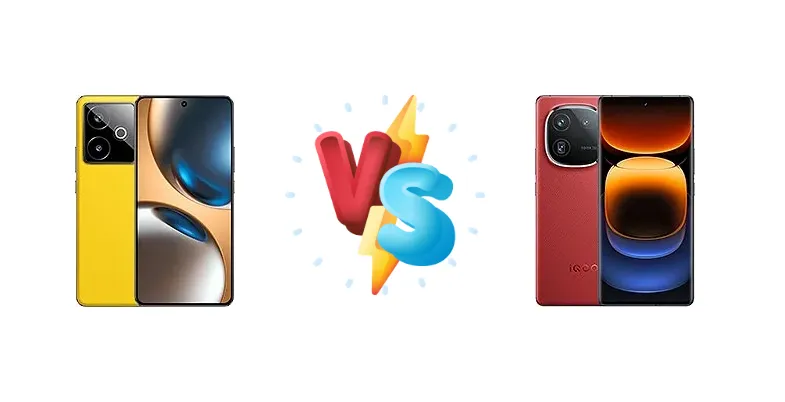
|
🏆 Quick Verdict
For the average user prioritizing sustained performance and future-proofing, the iQOO 12 Pro emerges as the winner. Its Snapdragon 8 Gen 3 chipset offers a clear advantage in demanding tasks and gaming, complemented by 50W wireless charging. However, the GT 7T provides excellent value with its 120W wired charging and strong CPU performance.
| PHONES | ||
|---|---|---|
| Phone Names | Realme GT 7T | vivo iQOO 12 Pro |
| Network | ||
|---|---|---|
| 2G bands | GSM 850 / 900 / 1800 / 1900 | GSM 850 / 900 / 1800 / 1900 |
| 3G bands | HSDPA 800 / 850 / 900 / 1700(AWS) / 1900 / 2100 | HSDPA 800 / 850 / 900 / 1700(AWS) / 1900 / 2100 |
| 4G bands | 1, 2, 3, 4, 5, 7, 8, 12, 13, 17, 18, 19, 20, 26, 28, 38, 39, 40, 41, 66 | 1, 2, 3, 4, 5, 7, 8, 12, 17, 18, 19, 20, 25, 26, 28, 34, 38, 39, 40, 41, 42, 66 |
| 5G bands | 1, 2, 3, 5, 7, 8, 20, 26, 28, 38, 40, 41, 66, 77, 78 SA/NSA | 1, 2, 3, 5, 7, 8, 12, 20, 25, 26, 28, 66, 38, 40, 41, 77, 78 SA/NSA |
| Speed | HSPA, LTE, 5G | HSPA, LTE, 5G |
| Technology | GSM / HSPA / LTE / 5G | GSM / CDMA / HSPA / CDMA2000 / LTE / 5G |
| Launch | ||
|---|---|---|
| Announced | 2025, May 27 | 2023, November 07 |
| Status | Available. Released 2025, May 27 | Available. Released 2023, November 14 |
| Body | ||
|---|---|---|
| Dimensions | 162.4 x 76 x 8.3 mm (6.39 x 2.99 x 0.33 in) | 164.6 x 75.4 x 8.6 mm or 8.8 mm |
| SIM | Nano-SIM + Nano-SIM | Nano-SIM + Nano-SIM |
| Weight | 202 g (7.13 oz) | 205 g or 210 g (7.23 oz) |
| Display | ||
|---|---|---|
| Protection | ArmorShell glass, Mohs level 6 | - |
| Resolution | 1280 x 2800 pixels, 19.5:9 ratio (~453 ppi density) | 1440 x 3200 pixels, 20:9 ratio (~518 ppi density) |
| Size | 6.8 inches, 112.8 cm2 (~91.4% screen-to-body ratio) | 6.78 inches, 111.0 cm2 (~89.4% screen-to-body ratio) |
| Type | AMOLED, 1B colors, 120Hz, 2160Hz PWM, HDR10+, Dolby Vision, 1000 nits (typ), 1800 nits (HBM), 6000 nits (peak) | LTPO AMOLED, 1B colors, 144Hz, HDR10+, 1600 nits (HBM), 3000 nits (peak) |
| Platform | ||
|---|---|---|
| CPU | Octa-core (1x3.25 GHz Cortex-A725 & 3x3.0 GHz Cortex-A725 & 4x2.1 GHz Cortex-A725) | Octa-core (1x3.3 GHz Cortex-X4 & 3x3.2 GHz Cortex-A720 & 2x3.0 GHz Cortex-A720 & 2x2.3 GHz Cortex-A520) |
| Chipset | Mediatek Dimensity 8400 Max (4 nm) | Qualcomm SM8650-AB Snapdragon 8 Gen 3 (4 nm) |
| GPU | Mali-G720 MC7 | Adreno 750 |
| OS | Android 15, up to 6 major Android upgrades, Realme UI 6.0 | Android 14, up to 2 major Android upgrades, Funtouch 14 (International), OriginOS 4 (China) |
| Memory | ||
|---|---|---|
| Card slot | No | No |
| Internal | 128GB 8GB RAM, 256GB 8GB RAM, 256GB 12GB RAM, 512GB 12GB RAM | 256GB 16GB RAM, 512GB 16GB RAM, 1TB 16GB RAM |
| Main Camera | ||
|---|---|---|
| Dual | 50 MP, f/1.8, 24mm (wide), 1/1.56", 1.0µm, multi-directional PDAF, OIS 8 MP, f/2.2, 16mm, 112˚ (ultrawide), 1/4.0", 1.12µm | - |
| Features | Color spectrum sensor, LED flash, HDR, panorama | Color spectrum sensor, Dual-LED flash, HDR, panorama |
| Triple | - | 50 MP, f/1.7, 23mm (wide), 1/1.3", 1.2µm, ulti-directional PDAF, OIS 64 MP, f/2.6, 70mm (periscope telephoto), 1/2.0", PDAF, OIS, 3x optical zoom 50 MP, f/2.0, 15mm, 119˚ (ultrawide), AF |
| Video | 4K@30/60fps, 1080p@30/60/120fps, gyro-EIS, OIS | 8K@30fps, 4K@24/30/60fps, 1080p@30/60/120/240fps, gyro-EIS |
| Selfie camera | ||
|---|---|---|
| Features | Panorama | HDR |
| Single | 32 MP, f/2.5, 21mm (wide), 1/2.74", 0.8µm | 16 MP, f/2.5, (wide) |
| Video | 4K@30/60fps, 1080p@30/60fps | 1080p@30fps, gyro-EIS |
| Sound | ||
|---|---|---|
| 35mm jack | No | No |
| Loudspeaker | Yes, with stereo speakers | Yes, with stereo speakers |
| Comms | ||
|---|---|---|
| Bluetooth | 6.0, A2DP, LE | 5.4, A2DP, LE, aptX HD, aptX Adaptive, aptX Lossless |
| Infrared port | Yes | Yes |
| NFC | Yes, 360˚ | Yes |
| Positioning | GPS (L1+L5), BDS (B1I+B1C+B2a), GALILEO (E1+E5a), QZSS (L1+L5), NavIC (L5), GLONASS | GPS (L1+L5), GLONASS (G1), BDS (B1I+B1c+B2a), GALILEO (E1+E5a), QZSS (L1+L5) |
| Radio | No | No |
| USB | USB Type-C | USB Type-C 2.0, OTG |
| WLAN | Wi-Fi 802.11 a/b/g/n/ac/6, dual-band | Wi-Fi 802.11 a/b/g/n/ac/6/7, tri-band, Wi-Fi Direct |
| Features | ||
|---|---|---|
| Sensors | Fingerprint (under display, optical), accelerometer, gyro, proximity, compass | Fingerprint (under display, ultrasonic), accelerometer, gyro, proximity, compass |
| Battery | ||
|---|---|---|
| Charging | 120W wired, 50% in 15 min, 100% in 42 min Bypass charging | 120W wired 50W wireless 10W reverse wireless |
| Type | Si/C Li-Ion 7000 mAh | 5100 mAh |
| Misc | ||
|---|---|---|
| Colors | IceSense Black, IceSense Blue, Racing Yellow | Black, Red, White (BMW M branding) |
| Models | RMX5085 | V2329A |
| Price | $ 549.00 / £ 349.99 / € 339.00 / ₹ 30,999 | About 650 EUR |
| SAR | 1.18 W/kg (head) 0.66 W/kg (body) | - |
| EU LABEL | ||
|---|---|---|
| Battery | 79:21h endurance, 800 cycles | - |
| Energy | Class A | - |
| Free fall | Class A (270 falls) | - |
| Repairability | Class B | - |
Realme GT 7T
- Ultra-fast 120W wired charging
- Strong CPU performance with Dimensity 8400 Max
- Potentially more affordable price point
- Snapdragon 8 Gen 3 is more powerful
- Lacks wireless charging
vivo iQOO 12 Pro
- Top-tier performance with Snapdragon 8 Gen 3
- 50W wireless charging and 10W reverse wireless
- Superior thermal management for sustained performance
- Likely higher price tag
- May not offer significantly better battery life despite efficiency gains
Display Comparison
While both devices are expected to feature high-refresh-rate displays (specs not provided), the core difference lies beneath the surface. The iQOO 12 Pro, being a flagship, likely incorporates LTPO technology for adaptive refresh rates, dynamically adjusting between 1Hz and 120Hz to conserve battery. The GT 7T, while fast, may lack this dynamic adjustment. This impacts battery life during static content viewing. Bezels and color accuracy are assumed to be comparable given the price bracket, but the iQOO 12 Pro’s panel is likely to achieve higher peak brightness.
Camera Comparison
Without specific camera specs, we can infer differences based on brand strategy. iQOO typically focuses on delivering a well-rounded camera experience, likely featuring a larger main sensor with OIS. The GT 7T, while capable, may prioritize value, potentially using a slightly smaller sensor. The Snapdragon 8 Gen 3’s ISP (Image Signal Processor) is also more advanced, offering superior image processing capabilities, particularly in low-light conditions. The inclusion of 50W wireless charging on the iQOO 12 Pro suggests a more premium overall camera system.
Performance
The iQOO 12 Pro’s Snapdragon 8 Gen 3 (4nm) is the clear performance leader. Its Cortex-X4 prime core, clocked at 3.3 GHz, surpasses the GT 7T’s Cortex-A725 cores (max 3.25 GHz). The Snapdragon’s architecture also benefits from improved AI processing capabilities. While the Dimensity 8400 Max is a potent chip, the Snapdragon 8 Gen 3’s superior GPU and thermal management will result in higher sustained frame rates in graphically intensive games. The iQOO 12 Pro’s use of LPDDR5x RAM further enhances memory bandwidth, contributing to smoother multitasking.
Battery Life
The Realme GT 7T boasts impressive charging speeds with its 120W wired charging, achieving 100% in just 42 minutes. The iQOO 12 Pro matches this wired speed but adds the convenience of 50W wireless charging and 10W reverse wireless charging. The GT 7T’s reported 79:21h endurance suggests a well-optimized battery experience, but the Snapdragon 8 Gen 3’s improved efficiency in the iQOO 12 Pro could offset any potential capacity differences (specs not provided). The GT 7T’s 800 charge cycles indicate a focus on long-term battery health.
Buying Guide
Buy the Realme GT 7T if you need blazing-fast 120W wired charging and a capable processor for everyday tasks and moderate gaming, all at a potentially lower price point. Buy the vivo iQOO 12 Pro if you prioritize top-tier performance for demanding games, content creation, and benefit from the added convenience of 50W wireless charging and the Snapdragon 8 Gen 3’s superior efficiency.