
Realme GT 7T vs Nothing Phone (2): A Deep Dive into Performance, Battery, and Value
| Phones Images | |||||
|---|---|---|---|---|---|
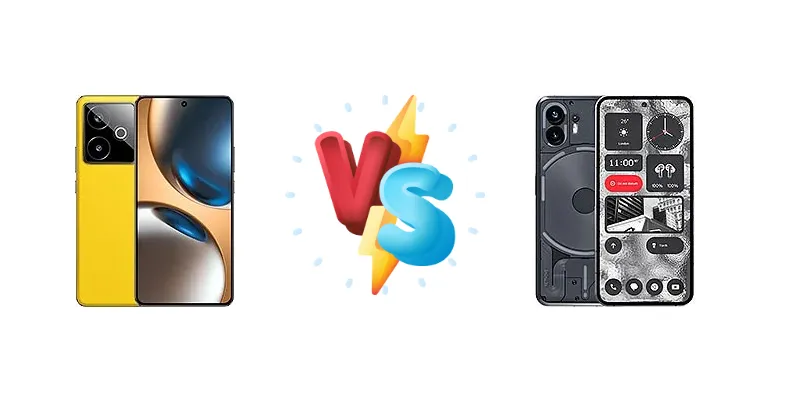
|
🏆 Quick Verdict
For users prioritizing raw performance and incredibly fast charging, the Realme GT 7T is the clear winner. Its Dimensity 8400 Max and 120W charging significantly outperform the Nothing Phone (2)'s Snapdragon 8+ Gen 1 and 45W charging. However, the Nothing Phone (2) offers a more holistic package with wireless charging and a potentially more refined user experience.
| PHONES | ||
|---|---|---|
| Phone Names | Realme GT 7T | Nothing Phone (2) |
| Network | ||
|---|---|---|
| 2G bands | GSM 850 / 900 / 1800 / 1900 | GSM 850 / 900 / 1800 / 1900 |
| 3G bands | HSDPA 800 / 850 / 900 / 1700(AWS) / 1900 / 2100 | HSDPA 800 / 850 / 900 / 1700(AWS) / 1900 / 2100 |
| 4G bands | 1, 2, 3, 4, 5, 7, 8, 12, 13, 17, 18, 19, 20, 26, 28, 38, 39, 40, 41, 66 | 1, 2, 3, 4, 5, 7, 8, 12, 17, 18, 19, 20, 25, 26, 28, 30, 32, 34, 38, 39, 40, 41, 42, 48, 66, 71 |
| 5G bands | 1, 2, 3, 5, 7, 8, 20, 26, 28, 38, 40, 41, 66, 77, 78 SA/NSA | 1, 2, 3, 5, 7, 8, 12, 20, 25, 28, 30, 38, 40, 41, 66, 71, 75, 77, 78 SA/NSA |
| Speed | HSPA, LTE, 5G | HSPA, LTE, 5G |
| Technology | GSM / HSPA / LTE / 5G | GSM / HSPA / LTE / 5G |
| Launch | ||
|---|---|---|
| Announced | 2025, May 27 | 2023, July 11 |
| Status | Available. Released 2025, May 27 | Available. Released 2023, July 17 |
| Body | ||
|---|---|---|
| Build | - | Glass front (Gorilla Glass 5), glass back (Gorilla Glass 5), aluminum frame |
| Dimensions | 162.4 x 76 x 8.3 mm (6.39 x 2.99 x 0.33 in) | 162.1 x 76.4 x 8.6 mm (6.38 x 3.01 x 0.34 in) |
| SIM | Nano-SIM + Nano-SIM | Nano-SIM + Nano-SIM |
| Weight | 202 g (7.13 oz) | 201.2 g (7.09 oz) |
| Display | ||
|---|---|---|
| Protection | ArmorShell glass, Mohs level 6 | Corning Gorilla Glass 5 |
| Resolution | 1280 x 2800 pixels, 19.5:9 ratio (~453 ppi density) | 1080 x 2412 pixels, 20:9 ratio (~394 ppi density) |
| Size | 6.8 inches, 112.8 cm2 (~91.4% screen-to-body ratio) | 6.7 inches, 108.0 cm2 (~87.2% screen-to-body ratio) |
| Type | AMOLED, 1B colors, 120Hz, 2160Hz PWM, HDR10+, Dolby Vision, 1000 nits (typ), 1800 nits (HBM), 6000 nits (peak) | LTPO OLED, 1B colors, 120Hz, 1920Hz PWM, HDR10+, 1600 nits (HBM), 1600 nits (peak) |
| Platform | ||
|---|---|---|
| CPU | Octa-core (1x3.25 GHz Cortex-A725 & 3x3.0 GHz Cortex-A725 & 4x2.1 GHz Cortex-A725) | Octa-core (1x3.0 GHz Cortex-X2 & 3x2.5 GHz Cortex-A710 & 4x1.80 GHz Cortex-A510) |
| Chipset | Mediatek Dimensity 8400 Max (4 nm) | Qualcomm SM8475 Snapdragon 8+ Gen 1 (4 nm) |
| GPU | Mali-G720 MC7 | Adreno 730 |
| OS | Android 15, up to 6 major Android upgrades, Realme UI 6.0 | Android 13, upgradable to Android 15, up to 3 major Android upgrades, Nothing OS 3.0 |
| Memory | ||
|---|---|---|
| Card slot | No | No |
| Internal | 128GB 8GB RAM, 256GB 8GB RAM, 256GB 12GB RAM, 512GB 12GB RAM | 128GB 8GB RAM, 256GB 12GB RAM, 512GB 12GB RAM |
| Main Camera | ||
|---|---|---|
| Dual | 50 MP, f/1.8, 24mm (wide), 1/1.56", 1.0µm, multi-directional PDAF, OIS 8 MP, f/2.2, 16mm, 112˚ (ultrawide), 1/4.0", 1.12µm | 50 MP, f/1.9, 24mm (wide), 1/1.56", 1.0µm, PDAF, OIS 50 MP, f/2.2, 114˚ (ultrawide), 1/2.76", 0.64µm, AF |
| Features | Color spectrum sensor, LED flash, HDR, panorama | LED flash, panorama, HDR |
| Video | 4K@30/60fps, 1080p@30/60/120fps, gyro-EIS, OIS | 4K@30/60fps, 1080p@30/60fps, gyro-EIS, live HDR, OIS |
| Selfie camera | ||
|---|---|---|
| Features | Panorama | HDR |
| Single | 32 MP, f/2.5, 21mm (wide), 1/2.74", 0.8µm | 32 MP, f/2.5, (wide), 1/2.74", 0.8µm |
| Video | 4K@30/60fps, 1080p@30/60fps | 1080p@30fps |
| Sound | ||
|---|---|---|
| 35mm jack | No | No |
| Loudspeaker | Yes, with stereo speakers | Yes, with stereo speakers |
| Comms | ||
|---|---|---|
| Bluetooth | 6.0, A2DP, LE | 5.3, A2DP, LE, aptX HD, aptX Adaptive |
| Infrared port | Yes | - |
| NFC | Yes, 360˚ | Yes |
| Positioning | GPS (L1+L5), BDS (B1I+B1C+B2a), GALILEO (E1+E5a), QZSS (L1+L5), NavIC (L5), GLONASS | GPS (L1+L5), GLONASS (L1), BDS (B1I+B1c), GALILEO (E1), QZSS (L1), NavIC |
| Radio | No | No |
| USB | USB Type-C | USB Type-C 2.0, OTG |
| WLAN | Wi-Fi 802.11 a/b/g/n/ac/6, dual-band | Wi-Fi 802.11 a/b/g/n/ac/6, dual-band, Wi-Fi Direct |
| Features | ||
|---|---|---|
| Sensors | Fingerprint (under display, optical), accelerometer, gyro, proximity, compass | Fingerprint (under display, optical), accelerometer, proximity, gyro, compass |
| Battery | ||
|---|---|---|
| Charging | 120W wired, 50% in 15 min, 100% in 42 min Bypass charging | 45W wired, PD3.0, PPS, QC4, 100% in 55 min 15W wireless, 100% in 130 min 5W reverse wireless |
| Type | Si/C Li-Ion 7000 mAh | Li-Ion 4700 mAh |
| Misc | ||
|---|---|---|
| Colors | IceSense Black, IceSense Blue, Racing Yellow | White, Dark Gray |
| Models | RMX5085 | A065 |
| Price | $ 549.00 / £ 349.99 / € 339.00 / ₹ 30,999 | $ 379.99 / £ 370.00 |
| SAR | 1.18 W/kg (head) 0.66 W/kg (body) | - |
| EU LABEL | ||
|---|---|---|
| Battery | 79:21h endurance, 800 cycles | - |
| Energy | Class A | - |
| Free fall | Class A (270 falls) | - |
| Repairability | Class B | - |
Realme GT 7T
- Incredibly fast 120W charging
- Potentially superior CPU performance with Dimensity 8400 Max
- Long-lasting battery with 800 charge cycles
- Camera specifications currently unknown
- Software experience may be less refined than Nothing OS
Nothing Phone (2)
- Brighter display for outdoor visibility
- Wireless and reverse wireless charging
- Unique and stylish design with Glyph Interface
- Slower charging speeds compared to Realme GT 7T
- Snapdragon 8+ Gen 1 is an older generation chipset
Display Comparison
The Nothing Phone (2) boasts a brighter display, reaching a measured peak of 998 nits, which will provide superior visibility in direct sunlight compared to the Realme GT 7T (brightness data unavailable). While both utilize 4nm chipsets, the Nothing Phone (2)'s display technology is a key differentiator. The GT 7T's display specs are currently unknown, but the Phone (2)'s brightness advantage is a significant consideration for outdoor users. We expect the Phone (2) to have better color accuracy and viewing angles, given Nothing's focus on design and user experience.
Camera Comparison
Camera details for the Realme GT 7T are currently unavailable, making a direct comparison difficult. The Nothing Phone (2) focuses on both photo and video capabilities, but without specific sensor size or aperture information for either device, it's hard to assess image quality. The Phone (2)'s image processing is known for its natural look, while Realme often leans towards more vibrant, saturated colors. The absence of details on the GT 7T's camera system makes it difficult to determine its strengths and weaknesses.
Performance
The Realme GT 7T's Mediatek Dimensity 8400 Max, with its octa-core configuration (1x3.25 GHz Cortex-A725, 3x3.0 GHz Cortex-A725, and 4x2.1 GHz Cortex-A725), is a newer architecture designed to challenge the Snapdragon 8+ Gen 1 in the Nothing Phone (2). The Snapdragon 8+ Gen 1 (1x3.0 GHz Cortex-X2, 3x2.5 GHz Cortex-A710, and 4x1.80 GHz Cortex-A510) is a proven performer, but the Dimensity 8400 Max's newer process node (4nm vs 4nm) and core design may offer improved efficiency and sustained performance. The GT 7T is likely to excel in CPU-intensive tasks, while the Snapdragon 8+ Gen 1 in the Phone (2) has a strong GPU for gaming. Thermal management will be crucial; the Dimensity 8400 Max's efficiency could translate to less throttling under sustained load.
Battery Life
The Realme GT 7T boasts impressive battery endurance, achieving 79:21h in testing and supporting 800 charge cycles, suggesting long-term battery health. In contrast, the Nothing Phone (2) has an active use score of 14:21h and an older endurance rating of 103h. While the endurance rating suggests comparable longevity, the active use score indicates the GT 7T will likely last significantly longer under typical usage. The GT 7T's 120W wired charging (50% in 15 minutes, 100% in 42 minutes with bypass charging) is a game-changer, dwarfing the Phone (2)'s 45W wired (100% in 55 minutes), 15W wireless (100% in 130 minutes), and 5W reverse wireless charging capabilities.
Buying Guide
Buy the Realme GT 7T if you need uncompromising performance for gaming or demanding tasks and value the fastest possible charging speeds. You're willing to trade some software polish and wireless charging convenience for this power. Buy the Nothing Phone (2) if you prefer a unique design, a balanced feature set including wireless charging, and a more curated software experience, even if it means sacrificing some peak performance and charging speed.