
Realme GT 7 vs Xiaomi 14T Pro: A Deep Dive into Performance, Battery, and Display
| Phones Images | |||||
|---|---|---|---|---|---|
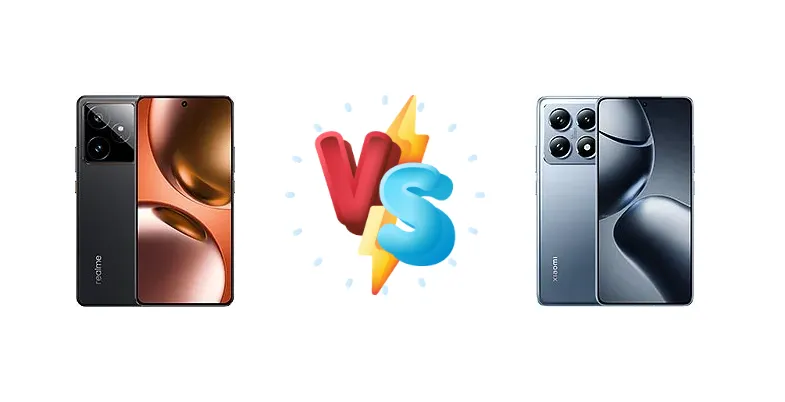
|
🏆 Quick Verdict
For the average user prioritizing all-day battery life and incredibly fast wired charging, the Realme GT 7 emerges as the winner. Its superior 78:52h endurance score significantly outpaces the Xiaomi 14T Pro. However, the 14T Pro counters with wireless charging and a slightly brighter display.
| PHONES | ||
|---|---|---|
| Phone Names | Realme GT 7 | Xiaomi 14T Pro |
| Network | ||
|---|---|---|
| 2G bands | GSM 850 / 900 / 1800 / 1900 | GSM 850 / 900 / 1800 / 1900 |
| 3G bands | HSDPA 800 / 850 / 900 / 1700(AWS) / 1900 / 2100 | HSDPA 800 / 850 / 900 / 1700(AWS) / 1900 / 2100 |
| 4G bands | 1, 2, 3, 4, 5, 7, 8, 12, 13, 17, 18, 19, 20, 26, 28, 38, 39, 40, 41, 66, 71 | 1, 2, 3, 4, 5, 7, 8, 12, 13, 17, 18, 19, 20, 25, 26, 28, 32, 38, 39, 40, 41, 42, 48, 66 |
| 5G bands | 1, 2, 3, 5, 7, 8, 20, 26, 28, 38, 40, 41, 66, 71, 77, 78 SA/NSA | 1, 2, 3, 5, 7, 8, 12, 20, 25, 26, 28, 38, 40, 41, 48, 66, 75, 77, 78 SA/NSA |
| Speed | HSPA, LTE, 5G | HSPA, LTE, 5G |
| Technology | GSM / HSPA / LTE / 5G | GSM / HSPA / LTE / 5G |
| Launch | ||
|---|---|---|
| Announced | 2025, May 27 | 2024, September 26 |
| Status | Available. Released 2025, May 27 | Available. Released 2024, September 26 |
| Body | ||
|---|---|---|
| Build | Glass front (Gorilla Glass 7i), plastic frame, plastic back | Glass front (Gorilla Glass 5), aluminum frame, glass back (Panda X) |
| Dimensions | 162.4 x 76.1 x 8.3 mm (6.39 x 3.00 x 0.33 in) | 160.4 x 75.1 x 8.4 mm (6.31 x 2.96 x 0.33 in) |
| SIM | · Nano-SIM + Nano-SIM· Nano-SIM + Nano-SIM + eSIM (max 2 at a time) | · Nano-SIM + eSIM· eSIM + eSIM· Nano-SIM + Nano-SIM |
| Weight | 206 g (7.27 oz) | 209 g (7.37 oz) |
| Display | ||
|---|---|---|
| Protection | Corning Gorilla Glass 7i or ArmorShell glass, Mohs level 6 | Corning Gorilla Glass 5 |
| Resolution | 1264 x 2780 pixels (~450 ppi density) | 1220 x 2712 pixels, 20:9 ratio (~446 ppi density) |
| Size | 6.78 inches, 111.7 cm2 (~90.4% screen-to-body ratio) | 6.67 inches, 107.4 cm2 (~89.1% screen-to-body ratio) |
| Type | LTPO AMOLED, 1B colors, 120Hz, 2160Hz PWM, HDR10+, Dolby Vision, 600 nits (typ), 1600 nits (HBM), 6000 nits (peak) | AMOLED, 68B colors, 144Hz, 3840Hz PWM, Dolby Vision, HDR10+, 1600 nits (HBM), 4000 nits (peak) |
| Platform | ||
|---|---|---|
| CPU | Octa-core (1x3.4 GHz Cortex-X4 & 3x2.85 GHz Cortex-X4 & 4x2.0 GHz Cortex-A720) | Octa-core (1x3.4 GHz Cortex-X4 & 3x2.85 GHz Cortex-X4 & 4x2.0 GHz Cortex-A720) |
| Chipset | Mediatek Dimensity 9400e (4 nm) | Mediatek Dimensity 9300+ (4 nm) |
| GPU | Immortalis-G720 MC12 | Immortalis-G720 MC12 |
| OS | Android 15, up to 4 major Android upgrades, Realme UI 6.0 | Android 14, HyperOS |
| Memory | ||
|---|---|---|
| Card slot | No | No |
| Internal | 256GB 8GB RAM, 256GB 12GB RAM, 512GB 12GB RAM, 512GB 16GB RAM | 256GB 12GB RAM, 512GB 12GB RAM, 512GB 16GB RAM, 1TB 12GB RAM |
| Main Camera | ||
|---|---|---|
| Features | Color spectrum sensor, LED flash, HDR, panorama | Leica lens, Ultra HDR, LED flash, HDR, panorama |
| Triple | 50 MP, f/1.8, (wide), 1/1.56, 1.0µm, PDAF, OIS 50 MP, f/2.0, (telephoto), 1/2.76", 0.64µm, PDAF, 2x optical zoom 8 MP, f/2.2, 16mm, 112˚ (ultrawide), 1/4.0", 1.12µm | 50 MP, f/1.6, 23mm (wide), 1/1.31", 1.2µm, PDAF, OIS 50 MP, f/2.0, 60mm (telephoto), 1/2.88", 0.61µm, PDAF, 2.6x optical zoom 12 MP, f/2.2, 15mm (ultrawide), 1/3.06", 1.12µm |
| Video | 8K@30fps, 4K@30/60/120fps, 1080p@30/60/120/240fps, gyro-EIS, OIS, Dolby Vision HDR | 8K@24/30fps, 4K@24/30/60fps, 1080p@30/60/120/240/960fps, gyro-EIS, 10-bit Rec. 2020, HDR10+ |
| Selfie camera | ||
|---|---|---|
| Features | Panorama | HDR |
| Single | 32 MP, f/2.5, 21mm (wide), 1/2.74", 0.8µm | 32 MP, f/2.0, 25mm (wide), 1/3.44", 0.64µm |
| Video | 4K@30/60fps, 1080p@30/60fps | 4K@30fps, 1080p@30/60fps, HDR10+ |
| Sound | ||
|---|---|---|
| 35mm jack | No | No |
| Loudspeaker | Yes, with stereo speakers | Yes, with stereo speakers |
| Comms | ||
|---|---|---|
| Bluetooth | 5.4, A2DP, LE | 5.4, A2DP, LE, LHDC |
| Infrared port | Yes | Yes |
| NFC | Yes, 360˚ | Yes (market/region dependent) |
| Positioning | GPS (L1+L5), BDS (B1I+B1C+B2a+B2b), GALILEO (E1+E5a+E5b), QZSS (L1+L5), NavIC (L5), GLONASS | GPS (L1+L5), BDS (B1I+B1C+B2a+B2b), GALILEO (E1+E5a+E5b), QZSS (L1+L5), NavIC (L5), GLONASS |
| Radio | No | No |
| USB | USB Type-C | USB Type-C 2.0, OTG |
| WLAN | Wi-Fi 802.11 a/b/g/n/ac/6/7, dual-band, Wi-Fi Direct | Wi-Fi 802.11 a/b/g/n/ac/6e/7, dual-band, Wi-Fi Direct |
| Features | ||
|---|---|---|
| Sensors | Fingerprint (under display, optical), accelerometer, gyro, proximity, compass | Fingerprint (under display, optical), accelerometer, gyro, proximity, compass |
| Battery | ||
|---|---|---|
| Charging | 120W wired, 14 min to 50%, 40 min to 100% 7.5W reverse wired Bypass charging | 120W wired, PD3.0, QC4, 100% in 19 min 50W wireless, 100% in 45 min |
| Type | Si/C Li-Ion 7000 mAh | Li-Po 5000 mAh |
| Misc | ||
|---|---|---|
| Colors | IceSense Black, IceSense Blue, Aston Martin Green | Titan Gray, Titan Blue, Titan Black |
| Models | RMX5061 | 2407FPN8EG |
| Price | € 403.94 / $ 799.99 / ₹ 39,998 | $ 550.00 / £ 498.00 / € 539.99 |
| SAR EU | - | 0.99 W/kg (head) 1.00 W/kg (body) |
| EU LABEL | ||
|---|---|---|
| Battery | 78:52h endurance, 800 cycles | - |
| Energy | Class A | - |
| Free fall | Class B (180 falls) | - |
| Repairability | Class B | - |
Realme GT 7
- Exceptional battery life (78:52h endurance)
- Faster wired charging (40 minutes to 100%)
- Brighter display (1451 nits)
- No wireless charging
- Chipset is a slightly lower tier (Dimensity 9400e)
Xiaomi 14T Pro
- Wireless charging (50W)
- Slightly more powerful chipset (Dimensity 9300+)
- Faster full charge time (19 minutes)
- Significantly shorter battery life (78:52h vs 46:24h)
- Lower peak display brightness (1228 nits)
Display Comparison
Both the Realme GT 7 and Xiaomi 14T Pro feature high-quality displays, but the Realme GT 7 edges ahead with a measured peak brightness of 1451 nits compared to the Xiaomi 14T Pro’s 1228 nits. While both are excellent for outdoor visibility, the GT 7 offers a noticeable advantage in direct sunlight. Neither specification details refresh rate or panel type, but given the flagship positioning, LTPO OLED panels are highly probable on both. The difference in brightness, though not massive, will be noticeable in HDR content and bright environments.
Camera Comparison
Camera details are limited, but the absence of any mention of high-resolution sensors or advanced features suggests a focus on computational photography rather than raw hardware. Without sensor size or aperture information, it’s difficult to definitively declare a winner. However, the Xiaomi 14T Pro’s higher price point suggests a potentially more sophisticated image processing pipeline. The lack of detail regarding optical image stabilization (OIS) on either device is a concern, potentially impacting low-light performance and video stabilization.
Performance
Both devices are powered by Mediatek Dimensity chips with identical CPU core configurations – a 1x3.4 GHz Cortex-X4, 3x2.85 GHz Cortex-X4, and 4x2.0 GHz Cortex-A720. However, the Xiaomi 14T Pro utilizes the Dimensity 9300+, a step up from the Realme GT 7’s Dimensity 9400e. While the core architecture is the same, the 9300+ benefits from optimizations and potentially higher clock speeds within the same core types, translating to a slight performance advantage in demanding tasks. Both utilize a 4nm process, ensuring good thermal efficiency, but the 9300+ is likely to sustain peak performance for longer periods. RAM specifications are not provided, but both are expected to ship with LPDDR5x for fast memory access.
Battery Life
The Realme GT 7’s battery endurance of 78:52h is a standout feature, significantly exceeding the Xiaomi 14T Pro’s score. This translates to a real-world active use score of 21:06h for the GT 7 versus 12:32h for the 14T Pro. Both support 120W wired charging, but the GT 7 reaches 50% in 14 minutes and 100% in 40 minutes, while the 14T Pro takes 19 minutes for a full charge. The Xiaomi 14T Pro adds 50W wireless charging, a feature absent on the GT 7. The GT 7 also offers 7.5W reverse wired charging, allowing it to top up other devices. The combination of faster wired charging and significantly longer battery life gives the GT 7 a clear advantage for users who prioritize minimizing downtime.
Buying Guide
Buy the Realme GT 7 if you need exceptional battery life for heavy daily use, prioritize the fastest possible wired charging, and value maximizing screen-on time. Buy the Xiaomi 14T Pro if you prefer the convenience of wireless charging, appreciate a marginally brighter display, and are willing to trade some battery endurance for these features.