
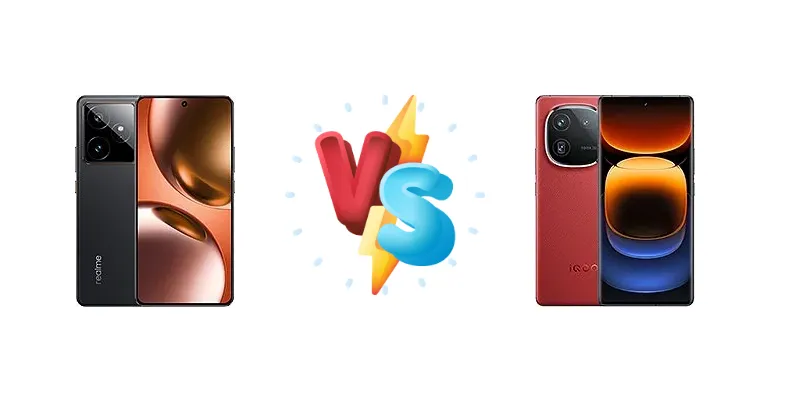
Realme GT 7 vs iQOO 12 Pro: A Head-to-Head Flagship Showdown
| Phones Images | |||||
|---|---|---|---|---|---|
|
🏆 Quick Verdict
For the average user prioritizing sustained performance and wireless charging, the iQOO 12 Pro emerges as the winner. Its Snapdragon 8 Gen 3 chipset offers a more consistent experience under load, and the addition of 50W wireless charging provides added convenience. However, the Realme GT 7’s impressive 78:52h endurance and faster wired charging make it a strong contender for power users.
| PHONES | ||
|---|---|---|
| Phone Names | Realme GT 7 | vivo iQOO 12 Pro |
| Network | ||
|---|---|---|
| 2G bands | GSM 850 / 900 / 1800 / 1900 | GSM 850 / 900 / 1800 / 1900 |
| 3G bands | HSDPA 800 / 850 / 900 / 1700(AWS) / 1900 / 2100 | HSDPA 800 / 850 / 900 / 1700(AWS) / 1900 / 2100 |
| 4G bands | 1, 2, 3, 4, 5, 7, 8, 12, 13, 17, 18, 19, 20, 26, 28, 38, 39, 40, 41, 66, 71 | 1, 2, 3, 4, 5, 7, 8, 12, 17, 18, 19, 20, 25, 26, 28, 34, 38, 39, 40, 41, 42, 66 |
| 5G bands | 1, 2, 3, 5, 7, 8, 20, 26, 28, 38, 40, 41, 66, 71, 77, 78 SA/NSA | 1, 2, 3, 5, 7, 8, 12, 20, 25, 26, 28, 66, 38, 40, 41, 77, 78 SA/NSA |
| Speed | HSPA, LTE, 5G | HSPA, LTE, 5G |
| Technology | GSM / HSPA / LTE / 5G | GSM / CDMA / HSPA / CDMA2000 / LTE / 5G |
| Launch | ||
|---|---|---|
| Announced | 2025, May 27 | 2023, November 07 |
| Status | Available. Released 2025, May 27 | Available. Released 2023, November 14 |
| Body | ||
|---|---|---|
| Build | Glass front (Gorilla Glass 7i), plastic frame, plastic back | - |
| Dimensions | 162.4 x 76.1 x 8.3 mm (6.39 x 3.00 x 0.33 in) | 164.6 x 75.4 x 8.6 mm or 8.8 mm |
| SIM | · Nano-SIM + Nano-SIM· Nano-SIM + Nano-SIM + eSIM (max 2 at a time) | Nano-SIM + Nano-SIM |
| Weight | 206 g (7.27 oz) | 205 g or 210 g (7.23 oz) |
| Display | ||
|---|---|---|
| Protection | Corning Gorilla Glass 7i or ArmorShell glass, Mohs level 6 | - |
| Resolution | 1264 x 2780 pixels (~450 ppi density) | 1440 x 3200 pixels, 20:9 ratio (~518 ppi density) |
| Size | 6.78 inches, 111.7 cm2 (~90.4% screen-to-body ratio) | 6.78 inches, 111.0 cm2 (~89.4% screen-to-body ratio) |
| Type | LTPO AMOLED, 1B colors, 120Hz, 2160Hz PWM, HDR10+, Dolby Vision, 600 nits (typ), 1600 nits (HBM), 6000 nits (peak) | LTPO AMOLED, 1B colors, 144Hz, HDR10+, 1600 nits (HBM), 3000 nits (peak) |
| Platform | ||
|---|---|---|
| CPU | Octa-core (1x3.4 GHz Cortex-X4 & 3x2.85 GHz Cortex-X4 & 4x2.0 GHz Cortex-A720) | Octa-core (1x3.3 GHz Cortex-X4 & 3x3.2 GHz Cortex-A720 & 2x3.0 GHz Cortex-A720 & 2x2.3 GHz Cortex-A520) |
| Chipset | Mediatek Dimensity 9400e (4 nm) | Qualcomm SM8650-AB Snapdragon 8 Gen 3 (4 nm) |
| GPU | Immortalis-G720 MC12 | Adreno 750 |
| OS | Android 15, up to 4 major Android upgrades, Realme UI 6.0 | Android 14, up to 2 major Android upgrades, Funtouch 14 (International), OriginOS 4 (China) |
| Memory | ||
|---|---|---|
| Card slot | No | No |
| Internal | 256GB 8GB RAM, 256GB 12GB RAM, 512GB 12GB RAM, 512GB 16GB RAM | 256GB 16GB RAM, 512GB 16GB RAM, 1TB 16GB RAM |
| Main Camera | ||
|---|---|---|
| Features | Color spectrum sensor, LED flash, HDR, panorama | Color spectrum sensor, Dual-LED flash, HDR, panorama |
| Triple | 50 MP, f/1.8, (wide), 1/1.56, 1.0µm, PDAF, OIS 50 MP, f/2.0, (telephoto), 1/2.76", 0.64µm, PDAF, 2x optical zoom 8 MP, f/2.2, 16mm, 112˚ (ultrawide), 1/4.0", 1.12µm | 50 MP, f/1.7, 23mm (wide), 1/1.3", 1.2µm, ulti-directional PDAF, OIS 64 MP, f/2.6, 70mm (periscope telephoto), 1/2.0", PDAF, OIS, 3x optical zoom 50 MP, f/2.0, 15mm, 119˚ (ultrawide), AF |
| Video | 8K@30fps, 4K@30/60/120fps, 1080p@30/60/120/240fps, gyro-EIS, OIS, Dolby Vision HDR | 8K@30fps, 4K@24/30/60fps, 1080p@30/60/120/240fps, gyro-EIS |
| Selfie camera | ||
|---|---|---|
| Features | Panorama | HDR |
| Single | 32 MP, f/2.5, 21mm (wide), 1/2.74", 0.8µm | 16 MP, f/2.5, (wide) |
| Video | 4K@30/60fps, 1080p@30/60fps | 1080p@30fps, gyro-EIS |
| Sound | ||
|---|---|---|
| 35mm jack | No | No |
| Loudspeaker | Yes, with stereo speakers | Yes, with stereo speakers |
| Comms | ||
|---|---|---|
| Bluetooth | 5.4, A2DP, LE | 5.4, A2DP, LE, aptX HD, aptX Adaptive, aptX Lossless |
| Infrared port | Yes | Yes |
| NFC | Yes, 360˚ | Yes |
| Positioning | GPS (L1+L5), BDS (B1I+B1C+B2a+B2b), GALILEO (E1+E5a+E5b), QZSS (L1+L5), NavIC (L5), GLONASS | GPS (L1+L5), GLONASS (G1), BDS (B1I+B1c+B2a), GALILEO (E1+E5a), QZSS (L1+L5) |
| Radio | No | No |
| USB | USB Type-C | USB Type-C 2.0, OTG |
| WLAN | Wi-Fi 802.11 a/b/g/n/ac/6/7, dual-band, Wi-Fi Direct | Wi-Fi 802.11 a/b/g/n/ac/6/7, tri-band, Wi-Fi Direct |
| Features | ||
|---|---|---|
| Sensors | Fingerprint (under display, optical), accelerometer, gyro, proximity, compass | Fingerprint (under display, ultrasonic), accelerometer, gyro, proximity, compass |
| Battery | ||
|---|---|---|
| Charging | 120W wired, 14 min to 50%, 40 min to 100% 7.5W reverse wired Bypass charging | 120W wired 50W wireless 10W reverse wireless |
| Type | Si/C Li-Ion 7000 mAh | 5100 mAh |
| Misc | ||
|---|---|---|
| Colors | IceSense Black, IceSense Blue, Aston Martin Green | Black, Red, White (BMW M branding) |
| Models | RMX5061 | V2329A |
| Price | € 403.94 / $ 799.99 / ₹ 39,998 | About 650 EUR |
| EU LABEL | ||
|---|---|---|
| Battery | 78:52h endurance, 800 cycles | - |
| Energy | Class A | - |
| Free fall | Class B (180 falls) | - |
| Repairability | Class B | - |
Realme GT 7
- Exceptional battery life (78:52h endurance)
- Ultra-fast 120W wired charging
- Bright display (1451 nits)
- Dimensity 9400e may exhibit more thermal throttling
- Lacks wireless charging
vivo iQOO 12 Pro
- Superior sustained performance with Snapdragon 8 Gen 3
- 50W wireless charging and 10W reverse wireless charging
- Likely more advanced camera system
- Potentially lower battery endurance compared to GT 7
- May run hotter under sustained load
Display Comparison
The Realme GT 7 boasts a peak brightness of 1451 nits, ensuring excellent visibility even in direct sunlight. While both phones likely utilize high refresh rate panels, the GT 7’s brightness advantage is a measurable benefit. The iQOO 12 Pro, while likely offering excellent color accuracy, doesn’t have a published peak brightness figure, suggesting it may fall slightly behind in outdoor scenarios. The absence of LTPO information for both devices means we can't assess their dynamic refresh rate efficiency, but both are expected to offer adaptive refresh rates to conserve battery.
Camera Comparison
Without detailed camera specifications, a direct comparison is difficult. However, the iQOO 12 Pro, being a flagship from a brand known for camera innovation, likely features a more sophisticated camera system with larger sensors and advanced image processing algorithms. The Realme GT 7, while capable, likely focuses on delivering good value rather than pushing the boundaries of mobile photography. The absence of information on OIS and aperture sizes prevents a deeper analysis, but the iQOO 12 Pro’s brand positioning suggests a stronger emphasis on camera quality.
Performance
The core difference lies in the chipsets: the Realme GT 7 features the Mediatek Dimensity 9400e, while the iQOO 12 Pro utilizes the Qualcomm Snapdragon 8 Gen 3. The Snapdragon 8 Gen 3, with its Cortex-X4 prime core clocked at 3.3 GHz, generally offers superior sustained performance and efficiency compared to the Dimensity 9400e’s 3.4 GHz Cortex-X4. The iQOO 12 Pro’s CPU configuration (1x3.3 GHz + 3x3.2 GHz + 2x3.0 GHz + 2x2.3 GHz) is optimized for a balance of peak and sustained performance, while the GT 7’s (1x3.4 GHz + 3x2.85 GHz + 4x2.0 GHz) may prioritize burst speeds. Both utilize a 4nm process, but Qualcomm’s architecture and thermal management are typically more refined.
Battery Life
The Realme GT 7 shines in battery endurance, achieving a remarkable 78:52h rating and 21:06h of active use. This is likely due to a combination of efficient chipset tuning and optimized software. While the iQOO 12 Pro’s battery capacity is not specified, its Snapdragon 8 Gen 3 chipset, while powerful, is known to consume more power. The GT 7’s 120W wired charging (50% in 14 minutes, 100% in 40 minutes) is matched by the iQOO 12 Pro, but the iQOO 12 Pro adds the convenience of 50W wireless charging and 10W reverse wireless charging, offering greater versatility.
Buying Guide
Buy the Realme GT 7 if you need exceptional battery life and incredibly fast wired charging, and are comfortable with a potentially less consistent peak performance profile. This phone is ideal for users who prioritize longevity and quick top-ups. Buy the vivo iQOO 12 Pro if you prefer a more refined and consistently powerful experience, value wireless charging, and are willing to trade a bit of battery endurance for top-tier processing capabilities. This is the phone for demanding gamers and power users.