
Realme GT 7 vs Samsung Galaxy S24 FE: A Deep Dive into Speed, Battery, and Value
| Phones Images | |||||
|---|---|---|---|---|---|
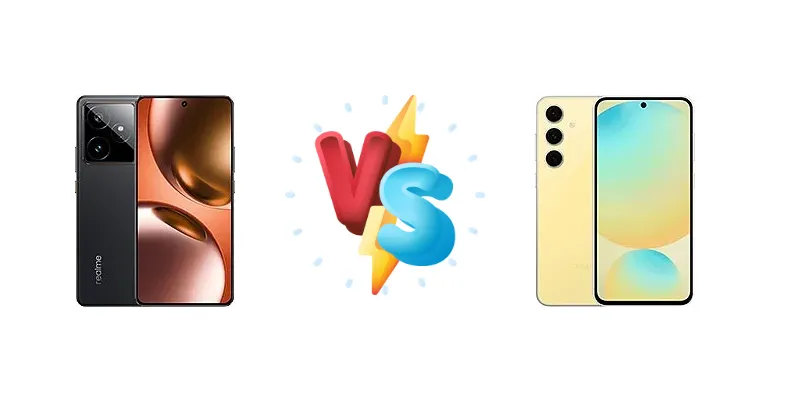
|
🏆 Quick Verdict
For users prioritizing raw speed and incredibly fast charging, the Realme GT 7 is the clear winner. However, the Samsung Galaxy S24 FE offers superior battery cycle longevity and a more refined software experience, making it the better choice for those valuing long-term reliability and ecosystem integration.
| PHONES | ||
|---|---|---|
| Phone Names | Realme GT 7 | Samsung Galaxy S24 FE |
| Network | ||
|---|---|---|
| 2G bands | GSM 850 / 900 / 1800 / 1900 | GSM 850 / 900 / 1800 / 1900 |
| 3G bands | HSDPA 800 / 850 / 900 / 1700(AWS) / 1900 / 2100 | HSDPA 850 / 900 / 1700(AWS) / 1900 / 2100 |
| 4G bands | 1, 2, 3, 4, 5, 7, 8, 12, 13, 17, 18, 19, 20, 26, 28, 38, 39, 40, 41, 66, 71 | 1, 2, 3, 4, 5, 7, 8, 12, 17, 18, 19, 20, 25, 26, 28, 32, 38, 40, 41, 66 - International |
| 5G bands | 1, 2, 3, 5, 7, 8, 20, 26, 28, 38, 40, 41, 66, 71, 77, 78 SA/NSA | 1, 2, 3, 5, 7, 8, 12, 20, 25, 26, 28, 38, 40, 41, 66, 75, 77, 78 SA/NSA/Sub6 - International |
| Speed | HSPA, LTE, 5G | HSPA, LTE, 5G |
| Technology | GSM / HSPA / LTE / 5G | GSM / HSPA / LTE / 5G |
| Launch | ||
|---|---|---|
| Announced | 2025, May 27 | 2024, September 26 |
| Status | Available. Released 2025, May 27 | Available. Released 2024, October 03 |
| Body | ||
|---|---|---|
| Build | Glass front (Gorilla Glass 7i), plastic frame, plastic back | Glass front (Gorilla Glass Victus+), glass back (Gorilla Glass Victus+), aluminum frame |
| Dimensions | 162.4 x 76.1 x 8.3 mm (6.39 x 3.00 x 0.33 in) | 162 x 77.3 x 8 mm (6.38 x 3.04 x 0.31 in) |
| SIM | · Nano-SIM + Nano-SIM· Nano-SIM + Nano-SIM + eSIM (max 2 at a time) | · Nano-SIM· Nano-SIM + Nano-SIM· Nano-SIM + eSIM· eSIM + eSIM |
| Weight | 206 g (7.27 oz) | 213 g (7.51 oz) |
| Display | ||
|---|---|---|
| Protection | Corning Gorilla Glass 7i or ArmorShell glass, Mohs level 6 | Corning Gorilla Glass Victus+, Mohs level 5 |
| Resolution | 1264 x 2780 pixels (~450 ppi density) | 1080 x 2340 pixels, 19.5:9 ratio (~385 ppi density) |
| Size | 6.78 inches, 111.7 cm2 (~90.4% screen-to-body ratio) | 6.7 inches, 110.2 cm2 (~88.0% screen-to-body ratio) |
| Type | LTPO AMOLED, 1B colors, 120Hz, 2160Hz PWM, HDR10+, Dolby Vision, 600 nits (typ), 1600 nits (HBM), 6000 nits (peak) | Dynamic AMOLED 2X, 120Hz, HDR10+, 1900 nits (peak) |
| Platform | ||
|---|---|---|
| CPU | Octa-core (1x3.4 GHz Cortex-X4 & 3x2.85 GHz Cortex-X4 & 4x2.0 GHz Cortex-A720) | 10-core (1x3.1 GHz + 2x2.9 GHz + 3x2.6 GHz + 4x1.95 GHz) |
| Chipset | Mediatek Dimensity 9400e (4 nm) | Exynos 2400e (4 nm) |
| GPU | Immortalis-G720 MC12 | Xclipse 940 |
| OS | Android 15, up to 4 major Android upgrades, Realme UI 6.0 | Android 14, up to 7 major Android upgrades, One UI 8.0 |
| Memory | ||
|---|---|---|
| Card slot | No | No |
| Internal | 256GB 8GB RAM, 256GB 12GB RAM, 512GB 12GB RAM, 512GB 16GB RAM | 128GB 8GB RAM, 256GB 8GB RAM, 512GB 8GB RAM |
| Main Camera | ||
|---|---|---|
| Features | Color spectrum sensor, LED flash, HDR, panorama | LED flash, HDR, panorama |
| Triple | 50 MP, f/1.8, (wide), 1/1.56, 1.0µm, PDAF, OIS 50 MP, f/2.0, (telephoto), 1/2.76", 0.64µm, PDAF, 2x optical zoom 8 MP, f/2.2, 16mm, 112˚ (ultrawide), 1/4.0", 1.12µm | 50 MP, f/1.8, 24mm (wide), 1/1.57", 1.0µm, dual pixel PDAF, OIS 8 MP, f/2.4, 75mm (telephoto), 1/4.4", 1.0µm, PDAF, OIS, 3x optical zoom 12 MP, f/2.2, 13mm, 123˚ (ultrawide), 1/3.0", 1.12µm |
| Video | 8K@30fps, 4K@30/60/120fps, 1080p@30/60/120/240fps, gyro-EIS, OIS, Dolby Vision HDR | 8K@30fps, 4K@30/60/120fps, 1080p@30/60/120/240fps |
| Selfie camera | ||
|---|---|---|
| Features | Panorama | - |
| Single | 32 MP, f/2.5, 21mm (wide), 1/2.74", 0.8µm | 10 MP, f/2.4, 26mm (wide), 1/3.0", 1.22µm |
| Video | 4K@30/60fps, 1080p@30/60fps | 4K@30/60fps, 1080p@30/60fps; gyro-EIS |
| Sound | ||
|---|---|---|
| 35mm jack | No | No |
| Loudspeaker | Yes, with stereo speakers | Yes, with stereo speakers |
| Comms | ||
|---|---|---|
| Bluetooth | 5.4, A2DP, LE | 5.3, A2DP, LE |
| Infrared port | Yes | - |
| NFC | Yes, 360˚ | Yes |
| Positioning | GPS (L1+L5), BDS (B1I+B1C+B2a+B2b), GALILEO (E1+E5a+E5b), QZSS (L1+L5), NavIC (L5), GLONASS | GPS, GLONASS, GALILEO, BDS |
| Radio | No | Unspecified |
| USB | USB Type-C | USB Type-C 3.2, OTG |
| WLAN | Wi-Fi 802.11 a/b/g/n/ac/6/7, dual-band, Wi-Fi Direct | Wi-Fi 802.11 a/b/g/n/ac/6e, dual-band or tri-band (market/region dependent), Wi-Fi Direct |
| Features | ||
|---|---|---|
| Sensors | Fingerprint (under display, optical), accelerometer, gyro, proximity, compass | Fingerprint (under display, optical), accelerometer, gyro, compass |
| Battery | ||
|---|---|---|
| Charging | 120W wired, 14 min to 50%, 40 min to 100% 7.5W reverse wired Bypass charging | 25W wired, PD, QC2, 50% in 30 min 15W wireless Reverse wireless |
| Type | Si/C Li-Ion 7000 mAh | 4700 mAh |
| Misc | ||
|---|---|---|
| Colors | IceSense Black, IceSense Blue, Aston Martin Green | Blue, Graphite, Gray, Mint, Yellow |
| Models | RMX5061 | SM-S721B, SM-S721B/DS, SM-S721U1, SM-S721U, SM-S721W, SM-S7210, SM-S721N |
| Price | € 403.94 / $ 799.99 / ₹ 39,998 | $ 249.74 / C$ 498.99 / £ 335.00 / € 387.00 / ₹ 34,180 |
| SAR | - | 0.94 W/kg (head) 0.71 W/kg (body) |
| SAR EU | - | 0.86 W/kg (head) 1.29 W/kg (body) |
| EU LABEL | ||
|---|---|---|
| Battery | 78:52h endurance, 800 cycles | 42:00h endurance, 2000 cycles |
| Energy | Class A | Class B |
| Free fall | Class B (180 falls) | Class A (270 falls) |
| Repairability | Class B | Class C |
Realme GT 7
- Significantly faster charging (120W)
- Superior battery endurance and active use scores
- Potentially higher peak performance with Dimensity 9400e
- Lower battery cycle lifespan (800 cycles)
- Software experience may not be as refined as Samsung’s
Samsung Galaxy S24 FE
- Longer battery cycle lifespan (2000 cycles)
- More polished software experience with Samsung One UI
- Wireless charging and reverse wireless charging support
- Slower charging speed (25W)
- Lower battery endurance and active use scores
Display Comparison
Both devices feature 4nm chipsets and boast displays capable of reaching high brightness levels, with the Realme GT 7 edging out the S24 FE at 1451 nits versus 1372 nits. While the difference isn’t massive, the GT 7’s higher peak brightness will be noticeable in direct sunlight. Neither specification details refresh rate or panel type, but both are likely to offer smooth visuals. The lack of LTPO on either device suggests potential for less efficient power consumption at lower refresh rates compared to flagship models.
Camera Comparison
Without detailed camera specifications, a direct comparison is limited. However, the market positioning suggests the S24 FE will likely prioritize image processing and software features, leveraging Samsung’s established camera expertise. The GT 7 may focus on delivering competitive hardware at a lower price point. The absence of information regarding sensor size and OIS makes it difficult to assess image quality potential. We can assume both phones will offer a versatile camera system, but the S24 FE’s software optimization could give it an edge in challenging lighting conditions.
Performance
The Realme GT 7’s Mediatek Dimensity 9400e, with its unique octa-core configuration (1x3.4 GHz Cortex-X4, 3x2.85 GHz Cortex-X4, and 4x2.0 GHz Cortex-A720), is designed for peak performance. The Samsung Galaxy S24 FE’s Exynos 2400e utilizes a 10-core setup. While core count isn’t everything, the Dimensity 9400e’s emphasis on high-clocked Cortex-X4 cores suggests a potential advantage in single-core tasks and burst performance. However, the Exynos 2400e’s architecture may offer better sustained performance due to its more balanced core distribution. Thermal management will be crucial for both, as sustained performance is heavily reliant on preventing throttling.
Battery Life
The Realme GT 7’s 78:52h endurance score and 21:06h active use score significantly outperform the Samsung Galaxy S24 FE’s 42:00h endurance and 11:48h active use. This is despite the S24 FE having a larger battery cycle count (2000 vs 800). The GT 7’s advantage stems from its more efficient chipset and aggressive power management. However, the S24 FE’s 2000 charge cycles suggest a longer lifespan before significant battery degradation. The GT 7’s 120W charging (50% in 14 minutes, 100% in 40 minutes) is dramatically faster than the S24 FE’s 25W charging (50% in 30 minutes), offering a substantial convenience factor.
Buying Guide
Buy the Realme GT 7 if you need uncompromising performance for gaming and demanding tasks, and if minimizing charging time is a top priority. Its 120W charging is a game-changer. Buy the Samsung Galaxy S24 FE if you prefer a more polished software experience, value long-term battery health (with 2000 charge cycles), and appreciate Samsung’s ecosystem of features and services.