
Realme GT 7 vs Google Pixel 8a: A Deep Dive into Performance and Value
| Phones Images | |||||
|---|---|---|---|---|---|
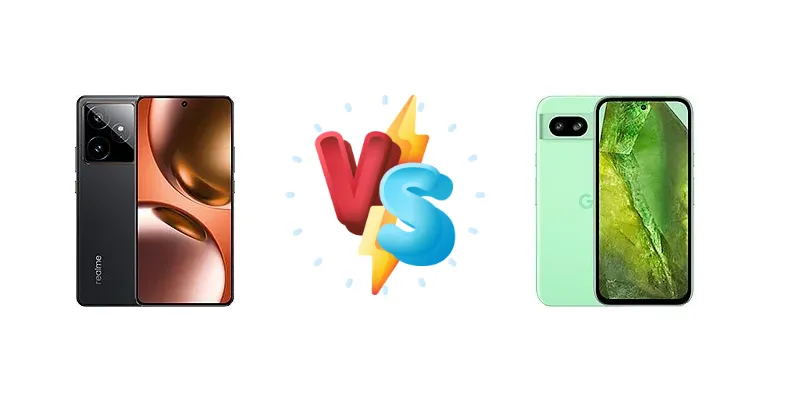
|
🏆 Quick Verdict
For users prioritizing raw performance and rapid charging, the Realme GT 7 is the clear winner. Its Dimensity 9400e and 120W charging significantly outperform the Pixel 8a. However, the Pixel 8a’s superior battery cycle count and Google’s image processing make it the better choice for photography enthusiasts and those valuing long-term software support.
| PHONES | ||
|---|---|---|
| Phone Names | Realme GT 7 | Google Pixel 8a |
| Network | ||
|---|---|---|
| 2G bands | GSM 850 / 900 / 1800 / 1900 | GSM 850 / 900 / 1800 / 1900 |
| 3G bands | HSDPA 800 / 850 / 900 / 1700(AWS) / 1900 / 2100 | HSDPA 800 / 850 / 900 / 1700(AWS) / 1900 / 2100 |
| 4G bands | 1, 2, 3, 4, 5, 7, 8, 12, 13, 17, 18, 19, 20, 26, 28, 38, 39, 40, 41, 66, 71 | 1, 2, 3, 4, 5, 7, 8, 12, 17, 18, 19, 20, 26, 28, 32, 38, 40, 41, 42, 66 - G6GPR (International) |
| 5G bands | 1, 2, 3, 5, 7, 8, 20, 26, 28, 38, 40, 41, 66, 71, 77, 78 SA/NSA | 1, 2, 3, 5, 7, 8, 12, 20, 26, 28, 38, 40, 41, 66, 75, 76, 77, 78 SA/NSA/Sub6 - G6GPR (International) |
| Speed | HSPA, LTE, 5G | HSPA, LTE, 5G |
| Technology | GSM / HSPA / LTE / 5G | GSM / HSPA / LTE / 5G |
| Launch | ||
|---|---|---|
| Announced | 2025, May 27 | 2024, May 07 |
| Status | Available. Released 2025, May 27 | Available. Released 2024, May 14 |
| Body | ||
|---|---|---|
| Build | Glass front (Gorilla Glass 7i), plastic frame, plastic back | Glass front (Gorilla Glass 3), aluminum frame, plastic back |
| Dimensions | 162.4 x 76.1 x 8.3 mm (6.39 x 3.00 x 0.33 in) | 152.1 x 72.7 x 8.9 mm (5.99 x 2.86 x 0.35 in) |
| SIM | · Nano-SIM + Nano-SIM· Nano-SIM + Nano-SIM + eSIM (max 2 at a time) | Nano-SIM + eSIM |
| Weight | 206 g (7.27 oz) | 188 g (6.63 oz) |
| Display | ||
|---|---|---|
| Protection | Corning Gorilla Glass 7i or ArmorShell glass, Mohs level 6 | Corning Gorilla Glass 3, Mohs level 5 |
| Resolution | 1264 x 2780 pixels (~450 ppi density) | 1080 x 2400 pixels, 20:9 ratio (~430 ppi density) |
| Size | 6.78 inches, 111.7 cm2 (~90.4% screen-to-body ratio) | 6.1 inches, 90.3 cm2 (~81.6% screen-to-body ratio) |
| Type | LTPO AMOLED, 1B colors, 120Hz, 2160Hz PWM, HDR10+, Dolby Vision, 600 nits (typ), 1600 nits (HBM), 6000 nits (peak) | OLED, HDR, 120Hz, 2000 nits (peak) |
| Platform | ||
|---|---|---|
| CPU | Octa-core (1x3.4 GHz Cortex-X4 & 3x2.85 GHz Cortex-X4 & 4x2.0 GHz Cortex-A720) | Nona-core (1x3.0 GHz Cortex-X3 & 4x2.45 GHz Cortex-A715 & 4x2.15 GHz Cortex-A510) |
| Chipset | Mediatek Dimensity 9400e (4 nm) | Google Tensor G3 (4 nm) |
| GPU | Immortalis-G720 MC12 | Immortalis-G715s MC10 |
| OS | Android 15, up to 4 major Android upgrades, Realme UI 6.0 | Android 14, upgradable to Android 16, up to 7 major Android upgrades |
| Memory | ||
|---|---|---|
| Card slot | No | No |
| Internal | 256GB 8GB RAM, 256GB 12GB RAM, 512GB 12GB RAM, 512GB 16GB RAM | 128GB 8GB RAM, 256GB 8GB RAM |
| Main Camera | ||
|---|---|---|
| Dual | - | 64 MP (16 MP eff.), f/1.9, 26mm (wide), 1/1.73", 0.8µm, dual pixel PDAF, OIS 13 MP, f/2.2, 120˚ (ultrawide), 1.12µm |
| Features | Color spectrum sensor, LED flash, HDR, panorama | Dual-LED flash, Pixel Shift, Ultra HDR, panorama, Best Take |
| Triple | 50 MP, f/1.8, (wide), 1/1.56, 1.0µm, PDAF, OIS 50 MP, f/2.0, (telephoto), 1/2.76", 0.64µm, PDAF, 2x optical zoom 8 MP, f/2.2, 16mm, 112˚ (ultrawide), 1/4.0", 1.12µm | - |
| Video | 8K@30fps, 4K@30/60/120fps, 1080p@30/60/120/240fps, gyro-EIS, OIS, Dolby Vision HDR | 4K@30/60fps, 1080p@30/60/120/240fps, OIS |
| Selfie camera | ||
|---|---|---|
| Features | Panorama | HDR, panorama |
| Single | 32 MP, f/2.5, 21mm (wide), 1/2.74", 0.8µm | 13 MP, f/2.2, 20mm (ultrawide), 1.12µm |
| Video | 4K@30/60fps, 1080p@30/60fps | 4K@30fps, 1080p@30/60fps |
| Sound | ||
|---|---|---|
| 35mm jack | No | No |
| Loudspeaker | Yes, with stereo speakers | Yes, with stereo speakers |
| Comms | ||
|---|---|---|
| Bluetooth | 5.4, A2DP, LE | 5.3, A2DP, LE |
| Infrared port | Yes | - |
| NFC | Yes, 360˚ | Yes |
| Positioning | GPS (L1+L5), BDS (B1I+B1C+B2a+B2b), GALILEO (E1+E5a+E5b), QZSS (L1+L5), NavIC (L5), GLONASS | GPS, GLONASS, GALILEO, BDS, QZSS, NavIC |
| Radio | No | No |
| USB | USB Type-C | USB Type-C 3.2 |
| WLAN | Wi-Fi 802.11 a/b/g/n/ac/6/7, dual-band, Wi-Fi Direct | Wi-Fi 802.11 a/b/g/n/ac/6e, dual/tri-band (market/region dependent) |
| Features | ||
|---|---|---|
| Sensors | Fingerprint (under display, optical), accelerometer, gyro, proximity, compass | Fingerprint (under display, optical), accelerometer, gyro, proximity, compass, barometer |
| Battery | ||
|---|---|---|
| Charging | 120W wired, 14 min to 50%, 40 min to 100% 7.5W reverse wired Bypass charging | 18W wired, PD3.0 7.5W wireless Bypass charging |
| Type | Si/C Li-Ion 7000 mAh | Li-Po 4492 mAh |
| Misc | ||
|---|---|---|
| Colors | IceSense Black, IceSense Blue, Aston Martin Green | Obsidian, Porcelain, Bay, Aloe |
| Models | RMX5061 | GKV4X, G6GPR, G8HHN, G576D |
| Price | € 403.94 / $ 799.99 / ₹ 39,998 | $ 229.98 / C$ 417.99 / £ 279.00 / € 299.99 / ₹ 33,300 |
| EU LABEL | ||
|---|---|---|
| Battery | 78:52h endurance, 800 cycles | 40:06h endurance, 1000 cycles |
| Energy | Class A | Class B |
| Free fall | Class B (180 falls) | Class A (270 falls) |
| Repairability | Class B | Class B |
Realme GT 7
- Blazing-fast 120W charging
- Potentially higher CPU performance with Dimensity 9400e
- Long active use score (21:06h)
- Lower battery cycle count (800)
- Camera specifications are unknown
- Display details are limited
Google Pixel 8a
- Exceptional camera quality and image processing
- Higher battery cycle count (1000)
- Brighter display (1508 nits)
- Slower 18W charging
- Lower active use score (11:25h)
- Less powerful chipset for demanding tasks
Display Comparison
Both devices feature 4nm chipsets, but their displays differ significantly. The Pixel 8a boasts a slightly brighter panel at 1508 nits compared to the Realme GT 7’s 1451 nits, offering marginally better visibility in direct sunlight. While both are excellent, the Realme GT 7’s display technology isn’t specified, leaving questions about refresh rate and panel type unanswered. The Pixel 8a’s OLED panel is known for its vibrant colors and excellent contrast. The difference in peak brightness is minimal in real-world use, but the Pixel 8a’s established OLED quality gives it a slight edge.
Camera Comparison
The Pixel 8a’s strength lies in its computational photography, leveraging Google’s image processing algorithms. While sensor sizes aren’t provided, the Pixel’s reputation for excellent dynamic range and low-light performance is well-established. The Realme GT 7’s camera specifications are missing, making a direct comparison difficult. However, Realme often focuses on high megapixel counts, which doesn’t always translate to better image quality. The Pixel 8a’s consistent image quality and software features give it a significant advantage for most users.
Performance
The Realme GT 7’s Mediatek Dimensity 9400e, with its Cortex-X4 prime cores, is architecturally designed for peak performance, potentially exceeding the Google Tensor G3 in raw CPU power. The Tensor G3 utilizes a nona-core configuration with Cortex-X3 and A715/A510 cores, prioritizing AI and machine learning tasks. While the Tensor G3 excels in on-device AI processing, the Dimensity 9400e’s core configuration suggests a stronger focus on sustained CPU and GPU performance, making the GT 7 more appealing for gamers. The GT 7’s unspecified RAM type and speed are a question mark, but the Dimensity 9400e’s efficiency should mitigate some potential memory bandwidth limitations.
Battery Life
The Realme GT 7 offers a remarkable 78:52h endurance rating and 21:06h of active use, coupled with incredibly fast 120W charging (50% in 14 minutes, 100% in 40 minutes). The Pixel 8a, however, provides a more conservative 40:06h endurance and 11:25h of active use, with a much slower 18W charging speed. Despite the lower endurance, the Pixel 8a boasts a higher battery cycle count of 1000, suggesting greater long-term battery health. The GT 7’s charging speed is a game-changer for users who frequently need to top up their battery, while the Pixel 8a prioritizes longevity.
Buying Guide
Buy the Realme GT 7 if you need uncompromising performance for gaming and demanding applications, and if minimizing charging time is a priority. You’ll benefit from its faster processor and incredibly quick 120W charging. Buy the Google Pixel 8a if you prefer a streamlined software experience, exceptional camera quality powered by Google’s algorithms, and a phone designed to last with a higher battery cycle count, even if it means sacrificing some raw speed.