
Realme C85 vs. vivo V30 SE: Which Budget Champion Reigns Supreme?
| Phones Images | |||||
|---|---|---|---|---|---|
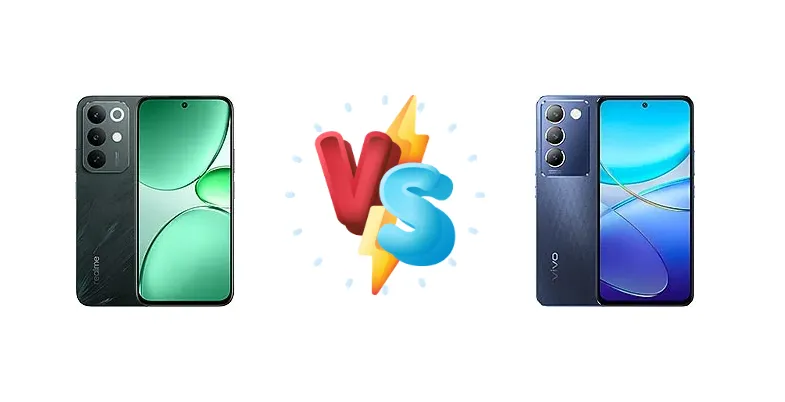
|
🏆 Quick Verdict
For the average user prioritizing sustained performance and future-proofing, the vivo V30 SE emerges as the better choice. Its Snapdragon 4 Gen 2, built on a 4nm process, offers superior efficiency and thermal management compared to the Realme C85’s Dimensity 6300, translating to a smoother long-term experience despite a slightly lower peak CPU clock speed.
| PHONES | ||
|---|---|---|
| Phone Names | Realme C85 | vivo V30 SE |
| Network | ||
|---|---|---|
| 2G bands | GSM 850 / 900 / 1800 / 1900 | GSM 850 / 900 / 1800 / 1900 |
| 3G bands | HSDPA 800 / 850 / 900 / 1700(AWS) / 1900 / 2100 | HSDPA 850 / 900 / 1700(AWS) / 1900 / 2100 |
| 4G bands | 1, 2, 3, 4, 5, 7, 8, 12, 13, 17, 18, 19, 20, 28, 38, 40, 41, 66 | 1, 2, 3, 4, 5, 7, 8, 12, 13, 17, 18, 19, 20, 26, 28, 32, 38, 40, 41, 66 |
| 5G bands | 1, 2, 3, 5, 7, 8, 20, 26, 28, 38, 40, 41, 66, 77, 78 SA/NSA | 1, 2, 3, 5, 7, 8, 20, 26, 28, 38, 40, 41, 66, 75, 77, 78 SA/NSA |
| Speed | HSPA, LTE, 5G | HSPA, LTE, 5G |
| Technology | GSM / HSPA / LTE / 5G | GSM / HSPA / LTE / 5G |
| Launch | ||
|---|---|---|
| Announced | 2025, November 02 | 2024, May 01 |
| Status | Available. Released 2025, November 13 | Available. Released 2024, May 01 |
| Body | ||
|---|---|---|
| Build | - | Glass front, plastic or silicone polymer (eco leather) back |
| Dimensions | 166.1 x 77.9 x 8.4 mm (6.54 x 3.07 x 0.33 in) | 163.2 x 75.8 x 7.8 mm (6.43 x 2.98 x 0.31 in) |
| SIM | Nano-SIM + Nano-SIM | Nano-SIM + Nano-SIM |
| Weight | 215 g (7.58 oz) | 185.5 g or 191 g (6.56 oz) |
| Display | ||
|---|---|---|
| Resolution | 720 x 1570 pixels, 19.5:9 ratio (~254 ppi density) | 1080 x 2400 pixels, 20:9 ratio (~395 ppi density) |
| Size | 6.8 inches, 113.0 cm2 (~87.4% screen-to-body ratio) | 6.67 inches, 107.4 cm2 (~86.8% screen-to-body ratio) |
| Type | IPS LCD, 144Hz, 1200 nits (HBM) | AMOLED, 120Hz, 1200 nits (HBM), 1800 nits (peak) |
| Platform | ||
|---|---|---|
| CPU | Octa-core (2x2.4 GHz Cortex-A76 & 6x2.0 GHz Cortex-A55) | Octa-core (2x2.2 GHz Cortex-A78 & 6x1.95 GHz Cortex-A55) |
| Chipset | Mediatek Dimensity 6300 (6 nm) | Qualcomm SM4450 Snapdragon 4 Gen 2 (4 nm) |
| GPU | Mali-G57 MC2 | Adreno 613 |
| OS | Android 15, Realme UI 6.0 | Android 14, Funtouch 14 |
| Memory | ||
|---|---|---|
| Card slot | microSDXC (uses shared SIM slot) | microSDXC (uses shared SIM slot) |
| Internal | Up to 256GB | 256GB 8GB RAM |
| Main Camera | ||
|---|---|---|
| Features | LED flash, HDR, panorama | LED flash, panorama, HDR |
| Single | 50 MP, f/1.8, 28mm (wide), 1/2.96", PDAF | - |
| Triple | - | 50 MP, f/1.8, 26mm (wide), PDAF 8 MP, f/2.2, (ultrawide) 2 MP (macro) |
| Video | 1080p@30/120fps | 1080p@30fps |
| Selfie camera | ||
|---|---|---|
| Features | Panorama | - |
| Single | 8 MP, f/2.0, 26mm (wide), 1/4.0", 1.12µm | 16 MP, f/2.0, (wide) |
| Video | 1080p@30fps | 1080p@30fps |
| Sound | ||
|---|---|---|
| 35mm jack | No | No |
| Loudspeaker | Yes | Yes, with stereo speakers |
| Comms | ||
|---|---|---|
| Bluetooth | 5.3, A2DP, LE | 5.0, A2DP, LE |
| NFC | Yes (market/region dependent) | No |
| Positioning | GPS, GALILEO, GLONASS, QZSS, BDS | GPS, GLONASS, GALILEO, BDS, QZSS |
| Radio | No | No |
| USB | USB Type-C 2.0, OTG | USB Type-C 2.0, OTG |
| WLAN | Wi-Fi 802.11 a/b/g/n/ac, dual-band | Wi-Fi 802.11 a/b/g/n/ac, dual-band |
| Features | ||
|---|---|---|
| Sensors | Fingerprint (side-mounted), accelerometer, gyro, proximity, compass | Fingerprint (under display, optical), accelerometer, gyro, proximity, compass |
| Battery | ||
|---|---|---|
| Charging | 45W wired Reverse wired Bypass charging | 44W wired, 50% in 25 min |
| Type | Si/C Li-Ion 7000 mAh | Li-Ion 5000 mAh |
| Misc | ||
|---|---|---|
| Colors | Green, Purple | Crystal Black, Leather Purple |
| Models | RMX5253 | - |
| Price | - | About 250 EUR |
Realme C85
- Faster 45W wired charging
- Reverse wired charging capability
- Higher peak CPU clock speed (potentially faster short bursts)
- Less efficient 6nm chipset
- Potential for more thermal throttling
- Older CPU core architecture (Cortex-A76)
vivo V30 SE
- More efficient 4nm Snapdragon 4 Gen 2 chipset
- Better thermal management
- Architecturally superior Cortex-A78 cores
- Potentially longer battery life
- Slightly slower 44W charging
- Lacks reverse wired charging
Display Comparison
Neither device boasts a standout display. While specific panel details (like peak brightness or color gamut coverage) are absent, the focus here is on processing power, not visual fidelity. Both likely utilize LCD panels common in this price bracket. The absence of high refresh rates or advanced features like LTPO suggests a similar viewing experience, making display quality a non-differentiating factor.
Camera Comparison
Without detailed camera specs, a direct comparison is difficult. However, both phones likely feature a primary camera sensor paired with auxiliary lenses of limited utility. The image processing capabilities of Qualcomm’s Snapdragon SoCs are generally considered more refined than those of Mediatek’s equivalent offerings, potentially giving the vivo V30 SE an edge in image quality, particularly in challenging lighting conditions. Expect both to perform adequately in well-lit environments but struggle in low light.
Performance
The core battleground lies in the chipsets. The Realme C85’s Dimensity 6300 (6nm) features a dual-core configuration with 2x2.4 GHz Cortex-A76 cores paired with 6x2.0 GHz Cortex-A55 cores. The vivo V30 SE counters with the Snapdragon 4 Gen 2 (4nm), utilizing 2x2.2 GHz Cortex-A78 cores and 6x1.95 GHz Cortex-A55 cores. While the Realme has a slightly higher peak clock speed on its prime cores, the Snapdragon 4 Gen 2’s 4nm fabrication process is a significant advantage. This smaller node translates to improved power efficiency and reduced heat generation, mitigating throttling during prolonged use. The Cortex-A78 cores in the Snapdragon are also architecturally superior to the A76, offering better instructions per clock (IPC).
Battery Life
The Realme C85’s 45W wired charging is a clear advantage, offering faster top-ups compared to the vivo V30 SE’s 44W charging (50% in 25 minutes). While the difference isn’t massive, it’s noticeable. The Realme also boasts reverse wired charging, a feature absent on the vivo. However, the Snapdragon 4 Gen 2’s superior efficiency means the vivo V30 SE will likely deliver longer battery life on a single charge, offsetting the slightly slower charging speed. The actual battery capacity of both devices is not provided, but the efficiency of the Snapdragon will likely result in a longer usable time.
Buying Guide
Buy the Realme C85 if you frequently engage in short bursts of demanding tasks and prioritize the fastest possible charging speeds. Its 45W charging and higher-clocked Cortex-A76 cores offer a temporary performance edge. Buy the vivo V30 SE if you value consistent performance, better battery life, and a more efficient chipset that will likely hold up better over time, especially for gaming or multitasking.