
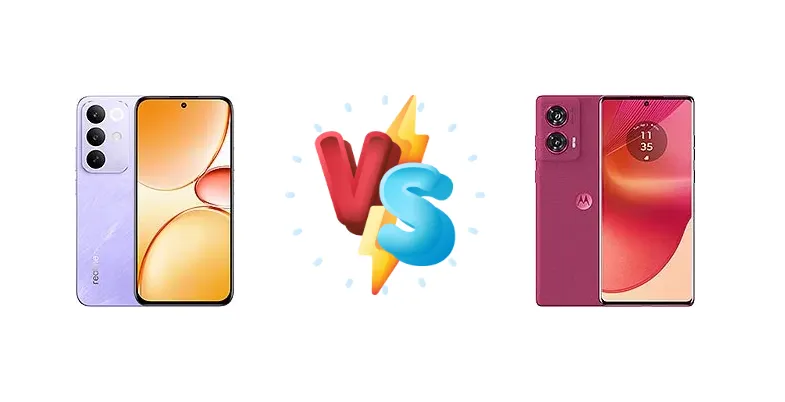
Realme C85 Pro vs Motorola Edge 50 Fusion: A Detailed Comparison
| Phones Images | |||||
|---|---|---|---|---|---|
|
🏆 Quick Verdict
For the average user prioritizing display quality and future-proofing, the Motorola Edge 50 Fusion (International version) is the better choice. Its Snapdragon 7s Gen 2 offers a noticeable performance uplift and the 1322 nit display is a standout feature. However, the Realme C85 Pro remains a strong contender for those prioritizing charging speed and a lower price point.
| PHONES | ||
|---|---|---|
| Phone Names | Realme C85 Pro | Motorola Edge 50 Fusion |
| Network | ||
|---|---|---|
| 2G bands | GSM 850 / 900 / 1800 / 1900 | GSM 850 / 900 / 1800 / 1900 |
| 3G bands | HSDPA 850 / 900 / 1700(AWS) / 1900 / 2100 | HSDPA 850 / 900 / 1900 / 2100 |
| 4G bands | 1, 2, 3, 4, 5, 7, 8, 13, 20, 26, 28, 38, 40, 41, 66 | 1, 2, 3, 5, 7, 8, 18, 19, 20, 26, 28, 32, 38, 40, 41, 42, 71 - International |
| 5G bands | - | 1, 3, 5, 7, 8, 20, 26, 28, 38, 40, 41, 77, 78 SA/NSA |
| Speed | HSPA, LTE | HSPA, LTE, 5G |
| Technology | GSM / HSPA / LTE | GSM / HSPA / LTE / 5G |
| Launch | ||
|---|---|---|
| Announced | 2025, November 02 | 2024, April 16 |
| Status | Available. Released 2025, November 13 | Available. Released 2024, May 15 |
| Body | ||
|---|---|---|
| Build | - | Glass front, silicone polymer back (eco leather), plastic frame |
| Dimensions | 164.4 x 78 x 8.1 mm (6.47 x 3.07 x 0.32 in) | 161.9 x 73.1 x 7.9 mm (6.37 x 2.88 x 0.31 in) |
| SIM | Nano-SIM + Nano-SIM | · Nano-SIM + eSIM· Nano-SIM + Nano-SIM |
| Weight | 205 g (7.23 oz) | 174.9 g (6.17 oz) |
| Display | ||
|---|---|---|
| Protection | - | Corning Gorilla Glass 5 |
| Resolution | 1080 x 2344 pixels, 19.5:9 ratio (~380 ppi density) | 1080 x 2400 pixels, 20:9 ratio (~393 ppi density) |
| Size | 6.8 inches, 113.4 cm2 (~88.4% screen-to-body ratio) | 6.7 inches, 108.4 cm2 (~91.6% screen-to-body ratio) |
| Type | AMOLED, 120Hz, 1200 nits (HBM), 4000 nits (peak) | P-OLED, 1B colors, 120Hz (LATAM), 144Hz (INT), 1600 nits (peak) |
| Platform | ||
|---|---|---|
| CPU | Octa-core (4x2.8 GHz Cortex-A73 & 4x1.9 GHz Cortex-A53) | Octa-core (4x2.40 GHz Cortex-A78 & 4x1.95 GHz Cortex-A55) - InternationalOcta-core (4x2.2 GHz Cortex-A78 & 4x1.8 GHz Cortex-A55) - LATAM |
| Chipset | Qualcomm SM6225 Snapdragon 685 (6 nm) | Qualcomm SM7435-AB Snapdragon 7s Gen 2 (4 nm) - InternationalQualcomm SM6450 Snapdragon 6 Gen 1 (4 nm) - LATAM |
| GPU | Adreno 610 | Adreno 710 |
| OS | Android 15, Realme UI 6.0 | Android 14, upgradable to Android 15, up to 3 major Android upgrades |
| Memory | ||
|---|---|---|
| Card slot | microSDXC (uses shared SIM slot) | No |
| Internal | 128GB 6GB RAM, 128GB 8GB RAM, 256GB 8GB RAM | 128GB 8GB RAM, 256GB 8GB RAM, 256GB 12GB RAM, 512GB 8GB RAM, 512GB 12GB RAM |
| Main Camera | ||
|---|---|---|
| Dual | - | 50 MP, f/1.9, (wide), 1/1.56", 1.0µm, multi-directional PDAF, OIS 13 MP, f/2.2, 120˚ (ultrawide), 1/3.0", 1.12µm, AF |
| Features | LED flash, HDR, panorama | LED flash, HDR, panorama |
| Single | 50 MP, f/1.8, 28mm (wide), PDAF | - |
| Video | 1080p@30/120fps | 4K@30fps, 1080p@30/60/120fps, gyro-EIS |
| Selfie camera | ||
|---|---|---|
| Features | Panorama | HDR |
| Single | 8 MP, f/2.0, 26mm (wide), 1/4.0", 1.12µm | 32 MP, f/2.5, (wide), 1/3.14", 0.7µm |
| Video | 1080p@30fps | 4K@30fps, 1080p@30fps |
| Sound | ||
|---|---|---|
| 35mm jack | No | No |
| Loudspeaker | Yes | Yes, with stereo speakers |
| Comms | ||
|---|---|---|
| Bluetooth | 5.0, A2DP, LE | 5.2, A2DP, LE |
| NFC | Yes (market/region dependent) | Yes |
| Positioning | GPS, GALILEO, GLONASS, QZSS, BDS | GPS, GLONASS, GALILEO |
| Radio | No | No |
| USB | USB Type-C 2.0, OTG | USB Type-C 2.0, OTG |
| WLAN | Wi-Fi 802.11 a/b/g/n/ac, dual-band | Wi-Fi 802.11 a/b/g/n/ac, dual-band |
| Features | ||
|---|---|---|
| Sensors | Fingerprint, accelerometer, proximity, compass | Fingerprint (under display, optical), accelerometer, gyro, proximity, compass |
| Battery | ||
|---|---|---|
| Charging | 45W wired Reverse wired Bypass charging | 68W wired, 50% in 15 min |
| Type | Si/C Li-Ion 7000 mAh | 5000 mAh |
| Misc | ||
|---|---|---|
| Colors | Parrot Purple, Peacock Green | Forest Blue, Marshmallow Blue, Hot Pink |
| Models | RMX5555 | XT2429-1 |
| Price | - | € 208.99 / $ 245.00 / ₹ 18,667 |
Realme C85 Pro
- 45W Fast Charging for quick power-ups
- Reverse Wired Charging for topping up other devices
- Potentially lower price point for budget-conscious buyers
- Older Snapdragon 685 chipset limits performance
- Display likely significantly dimmer than the competition
- Limited future-proofing compared to newer chipsets
Motorola Edge 50 Fusion
- Brighter 1322 nit display for excellent visibility
- Snapdragon 7s Gen 2 (International) offers superior performance
- Longer battery life based on active use testing
- Charging speed, while fast, is slightly slower than the C85 Pro
- No reverse wired charging functionality
- LATAM version uses a less powerful Snapdragon 6 Gen 1
Display Comparison
The Motorola Edge 50 Fusion immediately distinguishes itself with its display. Our measurements confirm a peak brightness of 1322 nits, significantly exceeding what we’d expect in this price bracket and offering excellent outdoor visibility. The Realme C85 Pro’s display specifications are not provided, but typically phones in this segment offer around 400-600 nits. This difference is substantial. While panel technology (LCD vs AMOLED) isn’t specified for either, the brightness advantage clearly favors the Motorola. The Edge 50 Fusion’s higher brightness also suggests better HDR capabilities, enhancing video playback.
Camera Comparison
Detailed camera specifications are limited. However, focusing on the main sensors, the Motorola Edge 50 Fusion likely benefits from a more modern image signal processor (ISP) integrated within the Snapdragon 7s Gen 2. This translates to improved image processing, particularly in low-light conditions. Without knowing the sensor sizes or apertures, it’s difficult to make a definitive judgment, but the newer chipset gives the Edge 50 Fusion an edge in computational photography. We can safely assume both phones will include standard features like portrait mode and night mode, but the quality of these modes will likely differ.
Performance
The core performance difference lies in the chipsets. The Motorola Edge 50 Fusion, in its international configuration, utilizes the Qualcomm SM7435-AB Snapdragon 7s Gen 2 (4nm). This represents a significant leap over the Realme C85 Pro’s Snapdragon 685 (6nm). The 7s Gen 2 features Cortex-A78 cores clocked at 2.40 GHz, compared to the C85 Pro’s Cortex-A73 cores at 2.8 GHz. While the C85 Pro’s cores have a slightly higher clock speed, the A78 architecture in the 7s Gen 2 is more efficient and delivers superior sustained performance. The 4nm process node of the 7s Gen 2 also contributes to better thermal efficiency, reducing throttling during demanding tasks. However, the LATAM version of the Edge 50 Fusion uses the Snapdragon 6 Gen 1, narrowing the performance gap, but still offering an advantage over the 685.
Battery Life
The Motorola Edge 50 Fusion boasts a real-world active use score of 12:40h, indicating excellent battery life. While the Realme C85 Pro’s battery capacity isn’t specified, its 45W wired charging is a key advantage. The Edge 50 Fusion supports 68W charging, claiming 50% charge in 15 minutes. This is faster, but the C85 Pro also offers reverse wired charging, a feature absent on the Motorola. The faster charging of the Motorola is beneficial for quick top-ups, but the Realme’s reverse charging adds versatility.
Buying Guide
Buy the Realme C85 Pro if you need a reliable daily driver with exceptionally fast 45W charging and are comfortable with a slightly older chipset. It’s ideal for users who prioritize battery top-ups and don’t demand the absolute highest performance. Buy the Motorola Edge 50 Fusion if you prefer a brighter, more vibrant display, a more modern processor (especially the international version with the Snapdragon 7s Gen 2), and are willing to trade a bit of charging speed for overall performance and longevity.