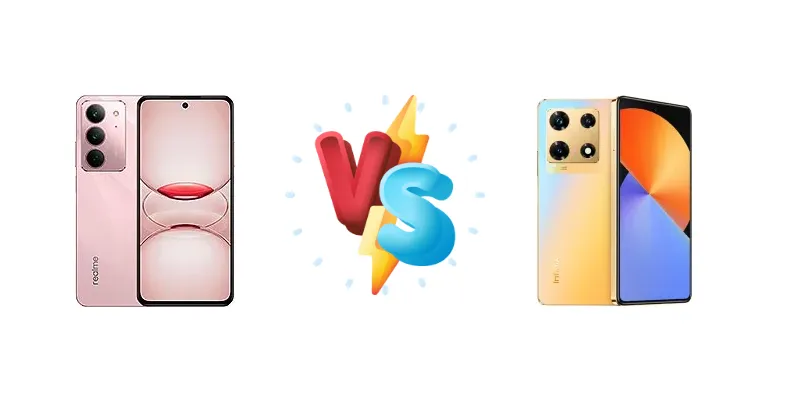
The Realme C75x and Infinix Note 30 Pro represent compelling options in the increasingly competitive budget smartphone market. Both aim to deliver a solid experience without breaking the bank, but they take different approaches to achieving this. The C75x focuses on a streamlined experience with a focus on efficiency, while the Note 30 Pro pushes the boundaries with faster charging and a more powerful chipset. This comparison will dissect their key differences to help you choose the right device.
🏆 Quick Verdict
For the average user prioritizing performance and future-proofing, the Infinix Note 30 Pro emerges as the stronger contender. Its Helio G99 chipset, built on a more efficient 6nm process, offers a noticeable performance uplift over the C75x’s Helio G81 Ultra. The significantly faster 68W charging with wireless capabilities further solidifies its advantage.
| Network |
|---|
| 2G bands | GSM 850 / 900 / 1800 / 1900 | GSM 850 / 900 / 1800 / 1900 |
| 3G bands | HSDPA 850 / 900 / 2100 | HSDPA 850 / 900 / 1700(AWS) / 1900 / 2100 |
| 4G bands | 1, 3, 5, 7, 8, 20, 28, 38, 40, 41 | 1, 2, 3, 4, 5, 7, 8, 12, 17, 20, 28, 38, 40, 41, 66 |
| Speed | HSPA, LTE | HSPA, LTE |
| Technology | GSM / HSPA / LTE | GSM / HSPA / LTE |
| Launch |
|---|
| Announced | 2025, March 07 | 2023, May 22 |
| Status | Available. Released 2025, March 08 | Available. Released 2023, May 22 |
| Body |
|---|
| Build | - | Glass front, plastic frame, glass back |
| Dimensions | 165.7 x 76.2 x 8 mm (6.52 x 3.00 x 0.31 in) | 162.7 x 76 x 8.2 mm (6.41 x 2.99 x 0.32 in) |
| SIM | Nano-SIM + Nano-SIM | Nano-SIM + Nano-SIM |
| Weight | 196 g (6.91 oz) | 203 g (7.16 oz) |
| | - | IP53 |
| Display |
|---|
| Protection | ArmorShell glass | - |
| Resolution | 720 x 1604 pixels, 20:9 ratio (~264 ppi density) | 1080 x 2400 pixels, 20:9 ratio (~395 ppi density) |
| Size | 6.67 inches, 107.2 cm2 (~84.9% screen-to-body ratio) | 6.67 inches, 107.4 cm2 (~86.9% screen-to-body ratio) |
| Type | IPS LCD, 120Hz, 500 nits (typ), 625 nits (HBM) | AMOLED, 1B colors, 120Hz, 900 nits (peak) |
| | - | * the display diagonal size and resolution is unconfirmed |
| Platform |
|---|
| CPU | Octa-core (2x2.0 GHz Cortex-A75 & 6x1.8 GHz Cortex-A55) | Octa-core (2x2.2 GHz Cortex-A76 & 6x2.0 GHz Cortex-A55) |
| Chipset | Mediatek Helio G81 Ultra (12 nm) | Mediatek Helio G99 (6 nm) |
| GPU | Mali-G52 MC2 | Mali-G57 MC2 |
| OS | Android 15, Realme UI 6.0 | Android 13, XOS 13 |
| Memory |
|---|
| Card slot | microSDXC (dedicated slot) | microSDXC (dedicated slot) |
| Internal | 128GB 6GB RAM, 128GB 8GB RAM, 256GB 8GB RAM | 256GB 8GB RAM |
| Main Camera |
|---|
| Features | LED flash, panorama | Quad-LED flash, HDR, panorama |
| Single | 50 MP, f/1.8, (wide), 1/2.88", PDAF | - |
| Triple | - | 108 MP, (wide), 1/1.67", PDAF
2 MP (macro)
Auxiliary lens |
| Video | 1080p@30fps | 1440p@30fps, 1080p@30fps |
| Selfie camera |
|---|
| Features | Panorama | LED flash, HDR |
| Single | 5 MP, f/2.2, (wide), 1/5" | 32 MP, f/2.0, (wide), 1/2.8" |
| Video | 1080p@30fps | 1080p@30fps |
| Sound |
|---|
| 3.5mm jack | - | Yes |
| 35mm jack | No | Yes |
| Loudspeaker | Yes | Yes, with dual speakers |
| | - | Sound by JBL
24-bit/192kHz audio |
| Comms |
|---|
| Bluetooth | 5.0, A2DP, LE | Yes |
| NFC | No | Yes (market/region dependent) |
| Positioning | GPS, GALILEO, GLONASS, QZSS, BDS | GPS |
| Radio | Unspecified | FM radio |
| USB | USB Type-C 2.0 | USB Type-C 2.0, OTG |
| WLAN | Wi-Fi 802.11 a/b/g/n/ac, dual-band | Wi-Fi 802.11 a/b/g/n/ac, dual-band, Wi-Fi Direct |
| Features |
|---|
| Sensors | Fingerprint (side-mounted), accelerometer, proximity, compass | Fingerprint (side-mounted), accelerometer, gyro, proximity, compass |
| Battery |
|---|
| Charging | 45W wired, 100% in 90 min | 68W wired, PD3.0, 80% in 30 min
15W wireless
Reverse wireless |
| Type | 5600 mAh | 5000 mAh |
| Misc |
|---|
| Colors | Coral Pink, Oceanic Blue | Magic Black, Variable Gold |
| Models | - | X678B |
| Price | About 320 EUR | - |
Realme C75x
- Potentially lower price point
- Efficient processor for basic tasks
- Simple and streamlined user experience
- Slower charging speed
- Less powerful chipset for gaming
- No wireless charging
Infinix Note 30 Pro
- Faster 68W wired charging
- Wireless and reverse wireless charging
- More powerful and efficient Helio G99 chipset
- Likely a higher price tag
- Potentially more heat generation under sustained load (though mitigated by 6nm process)
- Software bloatware (common with Infinix)
Display Comparison
Neither device boasts a standout display, but the specifics matter. While both likely utilize IPS LCD panels (based on market segment), the absence of detailed display specs necessitates focusing on the chipset's impact on rendering. The more powerful GPU in the Note 30 Pro will translate to smoother visuals in games, even if the panel resolution and refresh rate are similar. Bezels are likely comparable, given the price points, and color accuracy will be standard for this segment.
Camera Comparison
Without detailed camera specs, a direct comparison is difficult. However, the market positioning suggests the Infinix Note 30 Pro likely features a more capable main sensor. The focus should be on the primary lens aperture and sensor size, as these directly impact low-light performance. The presence of OIS (Optical Image Stabilization) on the Note 30 Pro, while unconfirmed, would be a significant advantage. The 2MP macro cameras found on both devices are largely marketing features and offer limited practical benefit.
Performance
The core difference lies in the chipsets. The Infinix Note 30 Pro’s Mediatek Helio G99 (6nm) is a clear upgrade over the Realme C75x’s Helio G81 Ultra (12nm). The 6nm process inherently offers better power efficiency, leading to less heat generation and sustained performance during demanding tasks. The G99’s CPU, with 2x2.2 GHz Cortex-A76 cores, also outperforms the C75x’s 2x2.0 GHz Cortex-A75 cores. This translates to faster app loading times, smoother multitasking, and a more enjoyable gaming experience. While RAM configurations aren't specified, the G99's architecture will better utilize available memory.
Battery Life
The Infinix Note 30 Pro’s 68W charging is a game-changer. Achieving 80% charge in just 30 minutes is significantly faster than the Realme C75x’s 45W charging, which takes 90 minutes for a full charge. The addition of 15W wireless charging and reverse wireless charging on the Note 30 Pro adds further convenience. While battery capacity isn't specified, the G99's superior efficiency means the Note 30 Pro will likely deliver comparable or better battery life despite potentially having a similar capacity to the C75x.
Buying Guide
Buy the Realme C75x if you prioritize a simple, efficient experience and are on a very tight budget. It’s a good choice for basic tasks, social media, and light gaming. Buy the Infinix Note 30 Pro if you value performance, faster charging, and the convenience of wireless charging. It’s better suited for gamers, power users, and those who want a phone that will remain responsive for longer.
Frequently Asked Questions
❓ Will the Helio G99 in the Infinix Note 30 Pro handle demanding games like PUBG Mobile at high settings?
Yes, the Helio G99 is capable of running PUBG Mobile at high settings with playable frame rates. The 6nm process and more powerful CPU/GPU compared to the C75x’s Helio G81 Ultra will provide a smoother and more consistent gaming experience, though you may still need to adjust settings for optimal performance.
❓ How much faster is the 68W charging on the Infinix Note 30 Pro compared to the 45W charging on the Realme C75x in real-world use?
The 68W charging on the Note 30 Pro is significantly faster. While the C75x takes 90 minutes for a full charge, the Note 30 Pro can reach 80% charge in just 30 minutes. This means you can quickly top up your phone during short breaks, making it ideal for users who are always on the go.
❓ Does the Infinix Note 30 Pro suffer from significant thermal throttling during extended gaming sessions?
While the Helio G99 can generate heat under sustained load, the 6nm process helps mitigate thermal throttling compared to the 12nm Helio G81 Ultra in the C75x. The Note 30 Pro is likely to maintain higher frame rates for longer periods, but some throttling may still occur during very demanding games.