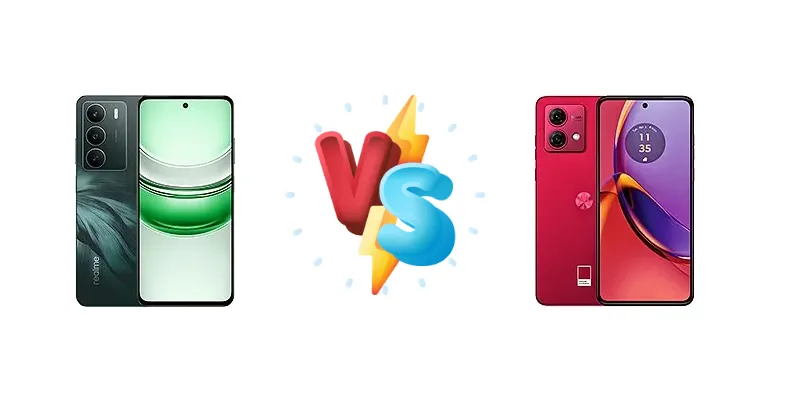
The Realme C75 and Motorola Moto G84 represent compelling options in the increasingly competitive budget 5G smartphone market. The C75 prioritizes exceptional battery life and fast charging, while the Moto G84 focuses on a brighter display and a more established brand reputation. This comparison dives deep into their specifications to determine which device delivers the best overall experience.
🏆 Quick Verdict
For the average user prioritizing longevity, the Realme C75 emerges as the winner. Its significantly longer 65:33h battery endurance and 45W charging outweigh the Moto G84’s brighter screen. However, users heavily invested in the Motorola ecosystem or desiring a slightly more refined display experience may prefer the Moto G84.
| Network |
|---|
| 2G bands | GSM 850 / 900 / 1800 / 1900 | GSM 850 / 900 / 1800 / 1900 |
| 3G bands | HSDPA 850 / 900 / 2100 | HSDPA 850 / 900 / 1700(AWS) / 1900 / 2100 - LATAM |
| 4G bands | 1, 3, 5, 8, 28, 40, 41 | 1, 2, 3, 4, 5, 7, 8, 12, 13, 17, 25, 26, 28, 38, 40, 41, 42, 66 - LATAM |
| 5G bands | 1, 3, 5, 8, 28, 40, 41, 77, 78 SA/NSA | 1, 2, 3, 5, 7, 26, 28, 40, 66, 78 SA/NSA/Sub6 - LATAM |
| Speed | HSPA, LTE, 5G | HSPA, LTE, 5G |
| Technology | GSM / HSPA / LTE / 5G | GSM / HSPA / LTE / 5G |
| Launch |
|---|
| Announced | 2025, May 02 | 2023, August 24 |
| Status | Available. Released 2025, May 08 | Available. Released 2023, September 08 |
| Body |
|---|
| Build | - | Glass front, plastic frame, plastic back or eco leather back |
| Dimensions | 165.7 x 76.2 x 7.9 mm (6.52 x 3.00 x 0.31 in) | 160 x 74.4 x 7.6 mm (6.30 x 2.93 x 0.30 in) |
| SIM | Nano-SIM + Nano-SIM | Nano-SIM + Nano-SIM |
| Weight | 190 g (6.70 oz) | 166.8 g (5.86 oz) |
| Display |
|---|
| Protection | Mohs level 5 | - |
| Resolution | 720 x 1604 pixels, 20:9 ratio (~264 ppi density) | 1080 x 2400 pixels, 20:9 ratio (~405 ppi density) |
| Size | 6.67 inches, 107.2 cm2 (~84.9% screen-to-body ratio) | 6.5 inches, 102.0 cm2 (~85.7% screen-to-body ratio) |
| Type | IPS LCD, 120Hz, 625 nits | P-OLED, 1B colors, 120Hz, 1300 nits (peak) |
| Platform |
|---|
| CPU | Octa-core (2x2.4 GHz Cortex-A76 & 6x2.0 GHz Cortex-A55) | Octa-core (2x2.2 GHz Kryo 660 Gold & 6x1.7 GHz Kryo 660 Silver) |
| Chipset | Mediatek Dimensity 6300 (6 nm) | Qualcomm SM6375 Snapdragon 695 5G (6 nm) |
| GPU | Mali-G57 MC2 | Adreno 619 |
| OS | Android 15, Realme UI 6.0 | Android 13, upgradable to Android 15 |
| Memory |
|---|
| Card slot | microSDXC (uses shared SIM slot) | microSDXC (uses shared SIM slot) |
| Internal | 64GB 4GB RAM, 128GB 4GB RAM, 128GB 6GB RAM | 256GB 8GB RAM, 256GB 12GB RAM |
| Main Camera |
|---|
| Dual | - | 50 MP, f/1.9 (wide), 1/1.5", 1.0µm, PDAF, OIS
8 MP, f/2.2, 120˚ (ultrawide), 1/4.0", 1.12µm, AF |
| Features | LED flash, panorama | LED flash, HDR, panorama |
| Single | 32 MP, f/1.8, 27mm (wide), 1/3.1", PDAF | - |
| Video | 1080p@30fps | 1080p@30/60fps |
| Selfie camera |
|---|
| Features | Panorama | - |
| Single | 8 MP, f/2.0, (wide) | 16 MP, f/2.5, (wide), 1.0µm |
| Video | 1080p@30fps | 1080p@30fps |
| Sound |
|---|
| 35mm jack | Yes | Yes |
| Loudspeaker | Yes | Yes, with stereo speakers |
| Comms |
|---|
| Bluetooth | 5.3, A2DP, LE | 5.1, A2DP, LE |
| NFC | No | Yes (market/region dependent) |
| Positioning | GPS, GALILEO, GLONASS, QZSS, BDS | GPS, GLONASS, GALILEO |
| Radio | No | FM radio (market/region dependent) |
| USB | USB Type-C 2.0, OTG | USB Type-C 2.0 |
| WLAN | Wi-Fi 802.11 a/b/g/n/ac, dual-band | Wi-Fi 802.11 a/b/g/n/ac, dual-band, Wi-Fi Direct |
| Features |
|---|
| Sensors | Fingerprint (side-mounted), accelerometer, proximity, compass | Fingerprint (under display, optical), accelerometer, gyro, proximity, compass |
| Battery |
|---|
| Charging | 45W wired
5W reverse wired | 30W wired |
| Type | Li-Po 6000 mAh | Li-Po 5000 mAh |
| Misc |
|---|
| Colors | Midnight Lily, Purple Blossom, Lily White | Marshmallow Blue, Midnight Blue, Viva Magenta |
| Models | RMX3943 | XT2347, XT2347-1, XT2347-2 |
| Price | ₹ 11,990 | $ 399.00 / £ 189.99 / € 169.00 |
| EU LABEL |
|---|
| Battery | 65:33h endurance, 1000 cycles | - |
| Energy | Class A | - |
| Free fall | Class B (180 falls) | - |
| Repairability | Class B | - |
Realme C75
- Exceptional battery life (65:33h endurance)
- Faster 45W wired charging
- 5W reverse wired charging
- Display brightness not specified, potentially lower than Moto G84
- Camera specifications are unknown
Motorola Moto G84
- Bright 996 nit display for outdoor visibility
- Efficient Snapdragon 695 5G modem
- Motorola’s clean software experience
- Significantly shorter battery life
- Slower 30W wired charging
- Lacks reverse wireless charging
Display Comparison
The Motorola Moto G84 boasts a notably brighter display, reaching a measured peak brightness of 996 nits. This is a significant advantage for outdoor visibility compared to the Realme C75, which lacks published brightness data. While the C75’s panel technology isn’t specified, the G84’s brightness suggests an LCD or potentially an OLED panel optimized for high peak output. Bezels appear comparable based on available imagery, and color accuracy is not detailed for either device, leaving this as an area where user reviews will be crucial.
Camera Comparison
Camera details are sparse for both devices. The Moto G84 is advertised with Photo/Video capabilities, implying a focus on versatile imaging. However, without sensor size or aperture information, it’s difficult to assess its low-light performance. The Realme C75’s camera specifications are entirely absent, making a direct comparison impossible. It’s reasonable to assume both phones will include a standard array of lenses, but image processing algorithms will likely be the differentiating factor. We’d caution against expecting flagship-level camera performance from either device.
Performance
Both phones utilize 6nm chipsets, but the architectures differ. The Realme C75’s Mediatek Dimensity 6300 features a 2x2.4 GHz Cortex-A76 and 6x2.0 GHz Cortex-A55 configuration, while the Moto G84’s Qualcomm Snapdragon 695 5G employs 2x2.2 GHz Kryo 660 Gold and 6x1.7 GHz Kryo 660 Silver cores. The Dimensity 6300’s higher clock speeds on its prime cores suggest a slight edge in single-core performance, beneficial for responsive app launching. However, the Snapdragon 695 is known for its efficient 5G modem, potentially offering more stable connectivity. RAM specifications are not provided, but LPDDR5x would be a significant advantage for either device.
Battery Life
Battery life is where the Realme C75 truly shines. Its claimed 65:33h endurance significantly surpasses the Moto G84’s 12:31h active use score and older 117h endurance rating. This difference is substantial, suggesting the C75 can easily last a full day of heavy use, while the G84 may require a midday top-up. The C75 also supports 45W wired charging, considerably faster than the Moto G84’s 30W charging. The C75 also offers 5W reverse wired charging, a feature absent on the Moto G84, allowing it to charge accessories.
Buying Guide
Buy the Realme C75 if you need all-day battery life and rapid recharging, making it ideal for travelers or heavy mobile users. Its Dimensity 6300 chipset provides sufficient power for everyday tasks and moderate gaming. Buy the Motorola Moto G84 if you prioritize a brighter, more visible display in outdoor conditions and appreciate Motorola’s clean software experience, even if it means sacrificing some battery endurance.
Frequently Asked Questions
❓ Does the Mediatek Dimensity 6300 in the Realme C75 throttle under sustained load, like during extended gaming sessions?
While the Dimensity 6300 is a capable chipset, throttling is always a possibility with mid-range processors. The 6nm process node helps mitigate heat, but without specific thermal testing data, it’s difficult to say definitively. User reviews will be crucial to determine real-world performance under stress.
❓ How does the 5G performance of the Snapdragon 695 in the Moto G84 compare to other 5G chipsets in this price range?
The Snapdragon 695 is known for its reliable 5G connectivity and efficient modem. It supports a wide range of 5G bands, ensuring compatibility with most carriers. While not the fastest 5G chipset available, it provides a stable and consistent connection for streaming, browsing, and online gaming.
❓ Is the 30W charging on the Motorola Moto G84 fast enough for quick top-ups throughout the day?
30W charging is adequate, but not exceptionally fast. Expect a full charge to take around 1.5 to 2 hours. It’s sufficient for overnight charging, but won’t provide a significant boost in a short amount of time compared to the Realme C75’s 45W charging.
❓ What type of display technology does the Motorola Moto G84 use, and does it support a high refresh rate?
The display type isn't explicitly stated, but the 996 nit peak brightness suggests it's either a high-quality LCD or an OLED panel. Refresh rate information is also unavailable; however, most phones in this price range typically offer a standard 60Hz refresh rate.