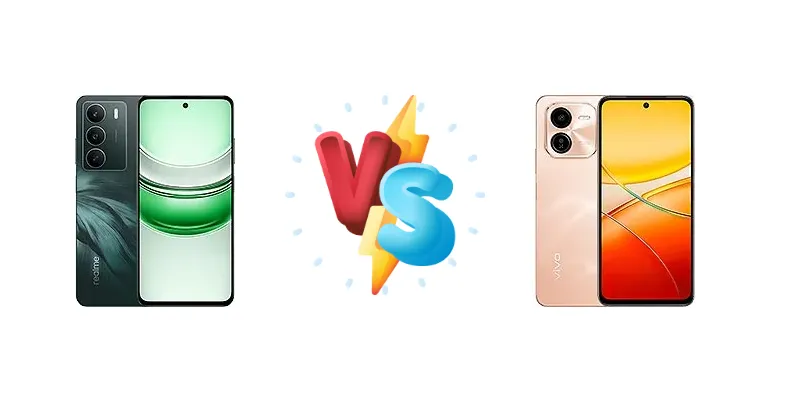
The Realme C71 and vivo Y200+ represent compelling options in the increasingly competitive sub-$200 smartphone market. While both aim to deliver essential features at an accessible price, they diverge significantly in their core hardware. The C71 leverages the Unisoc T7250, prioritizing battery endurance, while the Y200+ opts for Qualcomm’s Snapdragon 4 Gen 2, focusing on a more efficient architecture and potentially smoother performance.
🏆 Quick Verdict
For the average user prioritizing long-lasting battery life and a proven track record of software support, the Realme C71 emerges as the better choice. However, users who value a more modern chipset architecture and potentially better sustained performance, even at a slight battery life cost, will find the vivo Y200+ more appealing.
| Network |
|---|
| 2G bands | GSM 850 / 900 / 1800 / 1900 | GSM 850 / 900 / 1800 / 1900 |
| 3G bands | HSDPA 850 / 900 / 2100 - Asia | HSDPA 850 / 900 / 2100 |
| 4G bands | 1, 3, 5, 7, 8, 20, 28, 38, 40, 41 - Asia | 1, 3, 5, 8, 28, 34, 38, 39, 40, 41 |
| 5G bands | - | 1, 3, 5, 8, 28, 41, 77, 78 SA/NSA |
| Speed | HSPA, LTE | HSPA, LTE, 5G |
| Technology | GSM / HSPA / LTE | GSM / CDMA / HSPA / CDMA2000 / LTE / 5G |
| Launch |
|---|
| Announced | 2025, June 02 | 2025, January 02 |
| Status | Available. Released 2025, June 02 | Available. Released 2025, January 02 |
| Body |
|---|
| Build | - | Glass front, plastic frame, plastic back |
| Dimensions | 165.8 x 75.9 x 7.8 mm (6.53 x 2.99 x 0.31 in) | 165.7 x 76 x 8 mm (6.52 x 2.99 x 0.31 in) |
| SIM | Nano-SIM + Nano-SIM | Nano-SIM + Nano-SIM |
| Weight | 196 g (6.91 oz) | 199 g (7.02 oz) |
| Display |
|---|
| Protection | Mohs level 6 | - |
| Resolution | 720 x 1604 pixels, 20:9 ratio (~264 ppi density) | 720 x 1608 pixels, 20:9 ratio (~264 ppi density) |
| Size | 6.67 inches, 107.2 cm2 (~85.2% screen-to-body ratio) | 6.68 inches, 107.4 cm2 (~85.3% screen-to-body ratio) |
| Type | IPS LCD, 120Hz, 725 nits (peak) | IPS LCD, 120Hz, 1000 nits (HBM) |
| Platform |
|---|
| CPU | Octa-core (2x1.8 GHz Cortex-A75 & 6x1.6 GHz Cortex-A55) | Octa-core (2x2.2 GHz Cortex-A78 & 6x2.0 GHz Cortex-A55) |
| Chipset | Unisoc T7250 (12 nm) | Qualcomm SM4450 Snapdragon 4 Gen 2 (4 nm) |
| GPU | Mali-G57 MP1 | Adreno 613 |
| OS | Android 15, Realme UI 6.0 | Android 14, OriginOS 4 |
| Memory |
|---|
| Card slot | microSDXC (dedicated slot) | No |
| Internal | 64GB 4GB RAM, 128GB 4GB RAM, 128GB 6GB RAM, 128GB 8GB RAM, 256GB 8GB RAM | 256GB 8GB RAM, 256GB 12GB RAM, 512GB 12GB RAM |
| Main Camera |
|---|
| Dual | - | 50 MP, f/1.8, (wide), PDAF
Auxiliary lens |
| Features | LED flash, panorama | LED flash, panorama |
| Single | 50 MP, f/1.8, 27mm (wide), 1/2.88", PDAF | - |
| Video | 1080p@30fps | 1080p@30fps |
| Selfie camera |
|---|
| Single | 5 MP, f/2.2, 27mm (wide), 1/5.0" | 5 MP, f/2.2, (wide) |
| Video | 720p@30fps | 1080p@30fps |
| Sound |
|---|
| 35mm jack | Yes | Yes |
| Loudspeaker | Yes | Yes, with stereo speakers |
| Comms |
|---|
| Bluetooth | 5.2, A2DP, LE | 4.2, A2DP, LE, aptX Adaptive |
| NFC | Yes (market/region dependent) | No |
| Positioning | GPS, GALILEO, GLONASS, BDS | GPS, GALILEO, GLONASS, BDS, QZSS |
| Radio | No | No |
| USB | USB Type-C 2.0, OTG | USB Type-C 2.0, OTG |
| WLAN | Wi-Fi 802.11 a/b/g/n/ac, dual-band | Wi-Fi 802.11 a/b/g/n/ac, dual-band |
| Features |
|---|
| Sensors | Fingerprint (side-mounted), accelerometer, gyro, proximity, compass | Fingerprint (side-mounted), accelerometer, proximity, compass |
| Battery |
|---|
| Charging | 45W wired, 50% in 36 min (C71 model)
15W wired (P3 Lite model)
6W reverse wired | 44W wired, 50% in 36 min
Reverse wired |
| Type | Market-dependent versions:· 6000 mAh - Europe· 6300 mAh - Asia | 6000 mAh |
| Misc |
|---|
| Colors | Midnight Lily (Forest Owl), Lily White (White Swan), Green, White | Dark Gray, Green, Apricot |
| Models | RMX5303 | - |
| Price | € 84.69 / $ 113.38 / £ 118.99 / ₹ 6,874 | About 150 EUR |
| EU LABEL |
|---|
| Battery | 65:46h endurance, 1000 cycles | - |
| Energy | Class A | - |
| Free fall | Class A (270 falls) | - |
| Repairability | Class B | - |
Realme C71
- Exceptional battery life (65:46h endurance)
- 6W reverse wired charging for accessory top-ups
- 1000 charge cycles for long-term battery health
- Less efficient 12nm Unisoc T7250 chipset
- Potentially lower sustained performance compared to Snapdragon
vivo Y200+
- More efficient 4nm Snapdragon 4 Gen 2 chipset
- Faster Cortex-A78 CPU cores for improved responsiveness
- Potentially better thermal management
- Likely shorter battery life compared to Realme C71
- Lacks reverse wired charging
Display Comparison
Display specifications are not provided, so a direct comparison is limited. However, given the price bracket, both devices likely utilize LCD panels. The focus here shifts to internal processing. The Realme C71's Unisoc T7250 (12nm) will likely exhibit higher power consumption than the vivo Y200+'s Snapdragon 4 Gen 2 (4nm) during graphically intensive tasks, impacting overall display-on time.
Camera Comparison
Camera details are absent, so analysis relies on brand tendencies. vivo typically emphasizes camera capabilities, even in budget models, often employing sophisticated image processing algorithms. Realme tends to focus more on overall value. Without sensor size or aperture information, it's reasonable to assume the Y200+ might offer slightly better image quality, particularly in low-light conditions, due to vivo’s software optimizations. However, this is speculative without concrete data.
Performance
The core difference lies in the chipsets. The vivo Y200+’s Snapdragon 4 Gen 2, built on a 4nm process, offers a significant architectural advantage over the Realme C71’s 12nm Unisoc T7250. While both are octa-core CPUs, the Y200+ utilizes Cortex-A78 cores (2x2.2 GHz) which are more powerful than the C71’s Cortex-A75 cores (2x1.8 GHz). This translates to faster app loading times and a smoother experience with demanding applications. The 4nm process also contributes to better thermal efficiency, potentially reducing throttling during prolonged gaming sessions. The C71's CPU, while capable, will likely struggle with sustained loads compared to the Y200+.
Battery Life
The Realme C71 boasts a 65:46h endurance rating, indicating exceptional battery life. While the Y200+’s endurance isn’t specified, the more efficient Snapdragon 4 Gen 2 (4nm) should offer competitive performance. Both devices support 44/45W wired charging, achieving 50% charge in 36 minutes. The C71 also includes 6W reverse wired charging, a useful feature for topping up accessories, which the Y200+ lacks. The C71’s stated 1000 charge cycles suggest a focus on long-term battery health.
Buying Guide
Buy the Realme C71 if you need exceptional battery life, a reliable chipset for everyday tasks, and a phone that can withstand extensive use without frequent charging. Buy the vivo Y200+ if you prefer a more modern and efficient processor, potentially better gaming performance, and are willing to trade a small amount of battery endurance for improved responsiveness.
Frequently Asked Questions
❓ Will the Unisoc T7250 in the Realme C71 struggle with demanding games like PUBG Mobile?
While the Unisoc T7250 can run PUBG Mobile, expect to use lower graphics settings to maintain a stable frame rate. The Snapdragon 4 Gen 2 in the Y200+ will provide a smoother gaming experience, allowing for higher settings and potentially more consistent performance due to its more efficient architecture and faster CPU cores.
❓ How significant is the difference between the 12nm and 4nm process nodes in terms of real-world battery life?
The 4nm process used in the Snapdragon 4 Gen 2 is significantly more efficient than the 12nm process of the Unisoc T7250. This means the Y200+ will consume less power for the same tasks, resulting in longer battery life. While the C71 compensates with a potentially larger battery, the Y200+ will likely offer better efficiency overall.
❓ Does the Realme C71's 6W reverse charging work with all devices?
The Realme C71's 6W reverse charging is compatible with most devices that charge via USB-C, including smartphones, earbuds, and smartwatches. However, charging speeds will be slow, and it's best suited for emergency top-ups rather than full charges.