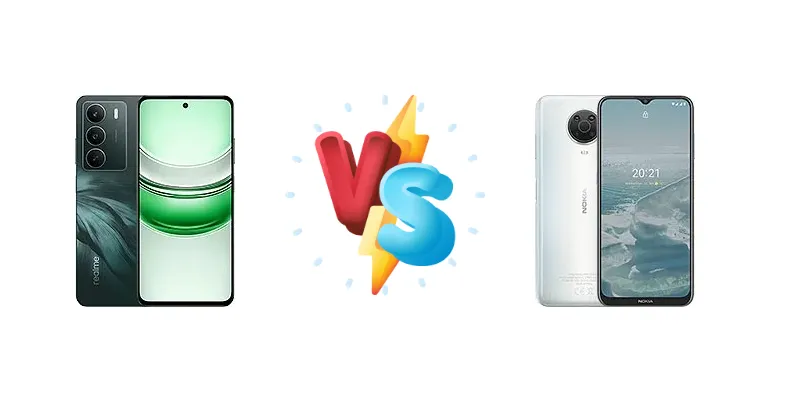
The Realme C71 and Nokia G20 represent two distinct approaches to the ultra-budget smartphone market. The C71 prioritizes charging speed and a more modern chipset, while the G20 aims for a balance of affordability and a recognizable brand. This comparison dissects their key specifications to determine which device offers the best experience for users seeking a reliable, low-cost mobile solution.
🏆 Quick Verdict
For most users, the Realme C71 emerges as the superior choice. Its Unisoc T7250 chipset offers a noticeable performance advantage over the Nokia G20’s Helio G35, and the 45W charging is a game-changer in this price bracket. While the Nokia G20 offers a familiar brand experience, it falls behind in key areas.
| Network |
|---|
| 2G bands | GSM 850 / 900 / 1800 / 1900 | GSM 850 / 900 / 1800 / 1900 |
| 3G bands | HSDPA 850 / 900 / 2100 - Asia | HSDPA 850 / 900 / 1900 / 2100 - International |
| 4G bands | 1, 3, 5, 7, 8, 20, 28, 38, 40, 41 - Asia | 1, 3, 5, 7, 8, 20, 28, 38, 40, 41 - International |
| Speed | HSPA, LTE | HSPA 42.2/5.76 Mbps, LTE Cat4 150/50 Mbps |
| Technology | GSM / HSPA / LTE | GSM / HSPA / LTE |
| | - | 1, 2, 3, 4, 5, 7, 8, 12, 17, 28, 66 - LATAM |
| Launch |
|---|
| Announced | 2025, June 02 | 2021, April 08 |
| Status | Available. Released 2025, June 02 | Available. Released 2021, May 17 |
| Body |
|---|
| Dimensions | 165.8 x 75.9 x 7.8 mm (6.53 x 2.99 x 0.31 in) | 164.9 x 76 x 9.2 mm (6.49 x 2.99 x 0.36 in) |
| SIM | Nano-SIM + Nano-SIM | · Nano-SIM· Nano-SIM + Nano-SIM |
| Weight | 196 g (6.91 oz) | 197 g (6.95 oz) |
| | - | Splash protection |
| Display |
|---|
| Protection | Mohs level 6 | - |
| Resolution | 720 x 1604 pixels, 20:9 ratio (~264 ppi density) | 720 x 1600 pixels, 20:9 ratio (~269 ppi density) |
| Size | 6.67 inches, 107.2 cm2 (~85.2% screen-to-body ratio) | 6.52 inches, 102.6 cm2 (~81.9% screen-to-body ratio) |
| Type | IPS LCD, 120Hz, 725 nits (peak) | IPS LCD |
| Platform |
|---|
| CPU | Octa-core (2x1.8 GHz Cortex-A75 & 6x1.6 GHz Cortex-A55) | Octa-core (4x2.3 GHz Cortex-A53 & 4x1.8 GHz Cortex-A53) |
| Chipset | Unisoc T7250 (12 nm) | Mediatek MT6765G Helio G35 (12 nm) |
| GPU | Mali-G57 MP1 | PowerVR GE8320 |
| OS | Android 15, Realme UI 6.0 | Android 11, upgradable to Android 13 |
| Memory |
|---|
| Card slot | microSDXC (dedicated slot) | microSDXC (dedicated slot) |
| Internal | 64GB 4GB RAM, 128GB 4GB RAM, 128GB 6GB RAM, 128GB 8GB RAM, 256GB 8GB RAM | 64GB 4GB RAM, 128GB 4GB RAM |
| Main Camera |
|---|
| Features | LED flash, panorama | LED flash, HDR, panorama |
| Quad | - | 48 MP, f/1.8, (wide), PDAF
5 MP, (ultrawide)
2 MP (macro)
Auxiliary lens |
| Single | 50 MP, f/1.8, 27mm (wide), 1/2.88", PDAF | 8 MP, (wide) |
| Video | 1080p@30fps | 1080p@30fps |
| Selfie camera |
|---|
| Single | 5 MP, f/2.2, 27mm (wide), 1/5.0" | 8 MP, (wide) |
| Video | 720p@30fps | 1080p@30fps |
| Sound |
|---|
| 3.5mm jack | - | Yes |
| 35mm jack | Yes | Yes |
| Loudspeaker | Yes | Yes |
| Comms |
|---|
| Bluetooth | 5.2, A2DP, LE | 5.0, A2DP, LE |
| NFC | Yes (market/region dependent) | Yes (market/region dependent) |
| Positioning | GPS, GALILEO, GLONASS, BDS | GPS, GLONASS, BDS |
| Radio | No | FM radio |
| USB | USB Type-C 2.0, OTG | USB Type-C 2.0, OTG |
| WLAN | Wi-Fi 802.11 a/b/g/n/ac, dual-band | Wi-Fi 802.11 b/g/n |
| Features |
|---|
| Sensors | Fingerprint (side-mounted), accelerometer, gyro, proximity, compass | Fingerprint (side-mounted), accelerometer, gyro, proximity |
| Battery |
|---|
| Charging | 45W wired, 50% in 36 min (C71 model)
15W wired (P3 Lite model)
6W reverse wired | 10W wired |
| Type | Market-dependent versions:· 6000 mAh - Europe· 6300 mAh - Asia | Li-Po 5050 mAh |
| Misc |
|---|
| Colors | Midnight Lily (Forest Owl), Lily White (White Swan), Green, White | Glacier, Night |
| Models | RMX5303 | TA-1336, TA-1343, TA-1347, TA-1372, TA-1365 |
| Price | € 84.69 / $ 113.38 / £ 118.99 / ₹ 6,874 | About 90 EUR |
| SAR | - | 1.01 W/kg (head) 1.02 W/kg (body) |
| SAR EU | - | 0.49 W/kg (head) 1.13 W/kg (body) |
| EU LABEL |
|---|
| Battery | 65:46h endurance, 1000 cycles | - |
| Energy | Class A | - |
| Free fall | Class A (270 falls) | - |
| Repairability | Class B | - |
Realme C71
- Significantly faster charging (45W)
- More powerful processor (Unisoc T7250)
- Longer battery endurance (65:46h)
- Brand recognition is lower than Nokia
- Detailed display specs are unknown
Nokia G20
- Familiar and trusted Nokia brand
- Simpler software experience (likely)
- Potentially more durable build quality
- Slower processor (Helio G35)
- Significantly slower charging (10W)
- Lower battery endurance
Display Comparison
Neither device boasts a standout display. Both are likely utilizing LCD panels, common in this segment. However, detailed display specs (resolution, brightness, color gamut) are missing. The Realme C71’s potential for a higher refresh rate (though unconfirmed) would be a significant advantage, but without concrete data, it’s difficult to assess. Bezels are likely comparable, reflecting the cost-conscious design of both phones.
Camera Comparison
Camera performance is likely to be similar, with both phones targeting basic photography needs. Detailed sensor information is absent, but given the price point, expect modest image quality. The Nokia G20’s camera setup is likely to focus on simplicity, while the Realme C71 may offer more software-based enhancements. Without specific details on sensor size, aperture, or image processing algorithms, it’s difficult to declare a clear winner. The presence of a 2MP macro lens on either device is largely inconsequential, offering limited practical benefit.
Performance
The Realme C71’s Unisoc T7250 (12nm) significantly outperforms the Nokia G20’s MediaTek Helio G35 (12nm). The T7250’s octa-core configuration, featuring two Cortex-A75 cores clocked at 1.8GHz alongside six Cortex-A55 cores, provides a substantial boost in CPU performance compared to the G20’s four Cortex-A53 cores at 2.3GHz and another four at 1.8GHz. While the G20’s cores have a higher clock speed, the A75 cores in the T7250 offer superior instruction set architecture and overall processing power. This translates to snappier app launches, smoother multitasking, and a more responsive user experience on the C71. The T7250 also benefits from a more modern process node, potentially leading to better thermal efficiency.
Battery Life
The Realme C71’s battery endurance of 65:46h is a standout feature, suggesting excellent power efficiency. While the exact battery capacity isn’t specified, the endurance rating indicates it’s well-optimized. Crucially, the 45W wired charging (on the C71 model) is a massive advantage, allowing a 50% charge in just 36 minutes. The Nokia G20’s 10W charging is significantly slower, requiring considerably more time to reach a full charge. The C71 also offers 6W reverse wired charging, a useful feature for topping up accessories. The C71’s 1000 cycle battery life claim suggests long-term durability.
Buying Guide
Buy the Realme C71 if you need a phone that can handle everyday tasks smoothly and charges incredibly quickly. It’s ideal for users who prioritize responsiveness and minimizing downtime. Buy the Nokia G20 if you prefer a simpler software experience and value the Nokia brand’s reputation for durability, but understand you’ll be making compromises in performance and charging speed.
Frequently Asked Questions
❓ Does the Realme C71’s Unisoc T7250 chipset handle demanding games like PUBG Mobile?
While the Unisoc T7250 isn’t a gaming powerhouse, it’s significantly more capable than the Helio G35 in the Nokia G20. PUBG Mobile should be playable at medium settings with reasonable frame rates. However, expect some frame drops during intense action sequences. The G20 would likely struggle to maintain a stable frame rate even at lower settings.
❓ How long does it *actually* take to fully charge the Nokia G20 with its 10W charger?
With a 10W charger, a full charge on the Nokia G20 will likely take over 3 hours, potentially closer to 4 hours depending on the battery’s initial state. This is a significant drawback compared to the Realme C71’s 45W charging, which can reach 50% in just 36 minutes.
❓ Is the 6W reverse charging on the Realme C71 useful for charging accessories like earbuds?
Yes, the 6W reverse charging is a convenient feature for topping up small accessories like wireless earbuds or a smartwatch. It won’t rapidly charge them, but it can provide a useful boost when you’re away from a power outlet.
❓ What kind of software experience can I expect on the Nokia G20? Is it heavily customized?
The Nokia G20 runs a near-stock version of Android, which is a key selling point for the brand. You can expect a clean, uncluttered interface with minimal bloatware. Nokia also promises regular security updates, which is important for long-term security.