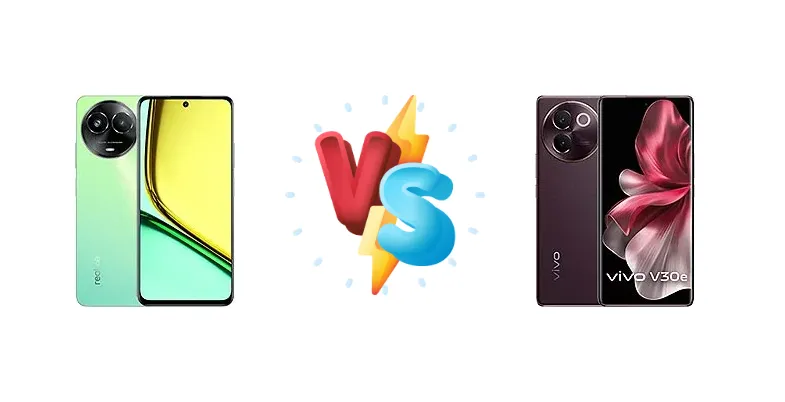
The Realme C67 and vivo V30e represent compelling options in the increasingly competitive mid-range smartphone market. While both aim to deliver a balanced experience, they take different approaches to achieving it – the Realme C67 leverages MediaTek’s Dimensity 6100+ for raw processing power, while the vivo V30e opts for Qualcomm’s Snapdragon 6 Gen 1, prioritizing efficiency and features like reverse charging. This comparison will dissect their key differences to determine which device best suits your needs.
🏆 Quick Verdict
For the average user prioritizing all-around usability and faster charging, the vivo V30e emerges as the stronger contender. Its Snapdragon 6 Gen 1 offers a more efficient architecture, and the inclusion of 44W charging with Power Delivery and reverse charging capabilities provides a tangible advantage over the Realme C67’s 33W implementation.
| Network |
|---|
| 2G bands | GSM 850 / 900 / 1800 / 1900 | GSM 850 / 900 / 1800 / 1900 |
| 3G bands | HSDPA 850 / 900 / 2100 | HSDPA 850 / 900 / 1700(AWS) / 1900 / 2100 - Malaysia |
| 4G bands | 1, 3, 5, 8, 28, 40, 41 | 1, 2, 3, 4, 5, 7, 8, 18, 19, 20, 26, 28, 38, 39, 40, 41 - Malaysia |
| 5G bands | 1, 3, 5, 8, 28, 40, 41, 77, 78 SA/NSA | 1, 3, 5, 7, 8, 20, 28, 38, 40, 41, 77, 78 SA/NSA - Malaysia |
| Speed | HSPA, LTE, 5G | HSPA, LTE, 5G |
| Technology | GSM / HSPA / LTE / 5G | GSM / HSPA / LTE / 5G |
| Launch |
|---|
| Announced | 2023, December 14 | 2024, May 02 |
| Status | Available. Released 2023, December 16 | Available. Released 2024, May 09 |
| Body |
|---|
| Build | - | Glass front, plastic frame, glass back or plastic back |
| Dimensions | 165.7 x 76 x 7.9 mm (6.52 x 2.99 x 0.31 in) | 164.4 x 74.8 x 7.7 mm (6.47 x 2.94 x 0.30 in) |
| SIM | Nano-SIM + Nano-SIM | Nano-SIM + Nano-SIM |
| Weight | 190 g (6.70 oz) | 179 g or 188 g (6.31 oz) |
| Display |
|---|
| Protection | - | Schott Xensation |
| Resolution | 1080 x 2400 pixels, 20:9 ratio (~392 ppi density) | 1080 x 2400 pixels, 20:9 ratio (~388 ppi density) |
| Size | 6.72 inches, 109.0 cm2 (~86.6% screen-to-body ratio) | 6.78 inches, 111.0 cm2 (~90.3% screen-to-body ratio) |
| Type | IPS LCD, 120Hz, 550 nits (typ), 680 nits (HBM) | AMOLED, 1B colors, 120Hz, 1300 nits (peak) |
| Platform |
|---|
| CPU | Octa-core (2x2.2 GHz Cortex-A76 & 6x2.0 GHz Cortex-A55) | Octa-core (4x2.2 GHz Cortex-A78 & 4x1.8 GHz Cortex-A55) |
| Chipset | Mediatek Dimensity 6100+ (6 nm) | Qualcomm SM6450 Snapdragon 6 Gen 1 (4 nm) |
| GPU | Mali-G57 MC2 | Adreno 710 |
| OS | Android 13, Realme UI 4.0 | Android 14, Funtouch 14 |
| Memory |
|---|
| Card slot | microSDXC (dedicated slot) | microSDXC (uses shared SIM slot) |
| Internal | 128GB 4GB RAM, 128GB 6GB RAM | 128GB 8GB RAM, 256GB 8GB RAM, 256GB 12GB RAM |
| Main Camera |
|---|
| Dual | 50 MP, f/1.8, 27mm (wide), 0.64µm, PDAF
Auxiliary lens | 50 MP, f/1.8, 26mm (wide), 1/1.95", 0.8µm, PDAF, OIS (India only)
8 MP, f/2.2, 120˚ (ultrawide), 1/4.0", 1.12µm |
| Features | LED flash, HDR, panorama | Ring-LED flash, panorama, HDR |
| Video | 1080p@30fps | 4K@30fps, 1080p@30fps |
| Selfie camera |
|---|
| Features | Panorama | - |
| Single | 8 MP, f2.1, 26mm (wide) | 50 MP, f/2.5, 25mm (wide), AF - India
32 MP, f/2.0, 24mm (wide) - Malaysia |
| Video | 1080p@30fps | 4K@30fps (India only), 1080p@30fps |
| Sound |
|---|
| 35mm jack | Yes | No |
| Loudspeaker | Yes | Yes |
| Comms |
|---|
| Bluetooth | 5.2, A2DP, LE | 5.1, A2DP, LE |
| NFC | No | Yes (market/region dependent) |
| Positioning | GPS, GALILEO, GLONASS, BDS | GPS, GLONASS, GALILEO, BDS, QZSS, NavIC |
| Radio | Unspecified | No |
| USB | USB Type-C 2.0 | USB Type-C 2.0, OTG |
| WLAN | Wi-Fi 802.11 a/b/g/n/ac, dual-band, Wi-Fi Direct | Wi-Fi 802.11 a/b/g/n/ac, dual-band |
| Features |
|---|
| Sensors | Fingerprint (side-mounted), accelerometer, proximity, compass | Fingerprint (under display, optical), accelerometer, gyro, proximity, compass |
| Battery |
|---|
| Charging | 33W wired, 50% in 29 min | 44W wired, PD
Reverse wired |
| Type | 5000 mAh | Li-Ion 5500 mAh |
| Misc |
|---|
| Colors | Sunny Oasis, Dark Purple | Velvet Red (Coco Brown), Silk Blue, Sky Mirror |
| Models | - | V2339 |
| Price | About 390 EUR | ₹ 23,999 |
Realme C67
- Potentially higher peak CPU performance due to Dimensity 6100+ core configuration.
- Competitive pricing likely makes it a more affordable option.
- Sufficient performance for everyday tasks and light gaming.
- Less efficient 6nm process may lead to more heat and throttling.
- Slower 33W charging without Power Delivery.
- Lacks reverse charging functionality.
vivo V30e
- More efficient 4nm Snapdragon 6 Gen 1 for better battery life and thermal management.
- Faster 44W charging with Power Delivery.
- Convenient reverse wired charging capability.
- Potentially slightly lower peak CPU performance compared to the Realme C67.
- May be priced slightly higher than the Realme C67.
- Software experience can be polarizing (ColorOS).
Display Comparison
Neither device boasts a standout display. While specific panel details (like peak brightness or color gamut coverage) are absent, the focus here is on the underlying processors. Display quality will likely be similar, leaning towards adequate for the price point. Bezels are expected to be comparable, typical of this segment. Color accuracy will likely be tuned for vibrant visuals, a common trend in both Realme and vivo devices.
Camera Comparison
Without detailed camera specs, a direct comparison is limited. However, both brands typically prioritize main sensor resolution. We can expect both phones to feature a primary camera capable of decent daylight photography. The Snapdragon 6 Gen 1’s ISP (Image Signal Processor) is generally regarded as more advanced, potentially leading to better image processing, especially in challenging lighting conditions. The absence of OIS (Optical Image Stabilization) on either device suggests reliance on software stabilization, which may not be as effective. The inclusion of low-resolution macro lenses on both devices is largely a marketing tactic and unlikely to deliver significant photographic value.
Performance
The core difference lies in the chipsets. The Realme C67’s MediaTek Dimensity 6100+ (6nm) features a dual-core Cortex-A76 setup clocked at 2.2 GHz, paired with six Cortex-A55 cores. The vivo V30e’s Qualcomm Snapdragon 6 Gen 1 (4nm) utilizes a quad-core Cortex-A78 configuration, also at 2.2 GHz, alongside four Cortex-A55 cores. The Snapdragon 6 Gen 1’s 4nm process offers a significant advantage in power efficiency, translating to better thermal management and potentially longer sustained performance. While both have 2.2GHz cores, the A78 cores in the Snapdragon are architecturally superior to the A76 cores in the Dimensity, offering better IPC (Instructions Per Clock). This means the Snapdragon will likely handle complex tasks more efficiently. The Realme C67 may show a slight edge in raw benchmark scores, but the vivo V30e will likely provide a smoother, more consistent experience during prolonged use.
Battery Life
The Realme C67 offers 33W wired charging, reaching 50% charge in 29 minutes. The vivo V30e steps up the game with 44W wired charging, supporting Power Delivery (PD) and, crucially, reverse wired charging. This allows the V30e to act as a power bank for other devices, a feature absent on the C67. While battery capacity isn’t specified, the Snapdragon 6 Gen 1’s superior efficiency will likely result in comparable or even better real-world battery life on the V30e, despite potentially having a similar or slightly smaller battery capacity. The faster charging and added convenience of reverse charging give the V30e a clear advantage.
Buying Guide
Buy the Realme C67 if you prioritize maximizing CPU performance for demanding multitasking or light gaming and are comfortable with slightly slower charging speeds. Its Dimensity 6100+ offers a higher clock speed on its prime cores. Buy the vivo V30e if you value battery efficiency, faster and more versatile charging (including reverse wireless), and a more refined software experience, even if it means a slight trade-off in peak CPU performance.
Frequently Asked Questions
❓ Will the Snapdragon 6 Gen 1 in the vivo V30e struggle with graphically intensive games like PUBG or Genshin Impact?
While the Snapdragon 6 Gen 1 isn't a flagship chipset, it's capable of running PUBG and Genshin Impact at medium settings with reasonable frame rates. The 4nm process and improved thermal management will help maintain consistent performance during gaming sessions, preventing excessive throttling. Expect to adjust graphics settings for optimal balance between visual fidelity and smoothness.
❓ How useful is the reverse charging feature on the vivo V30e in real-world scenarios?
The reverse charging feature on the vivo V30e is surprisingly practical. It's ideal for topping up accessories like wireless earbuds or smartwatches when you're away from a power outlet. While it won't fully charge another phone quickly, it can provide enough power to get you through a few hours in an emergency.
❓ Does the Dimensity 6100+ in the Realme C67 get noticeably hot during extended use, like video recording or gaming?
The 6nm process of the Dimensity 6100+ is less efficient than the 4nm Snapdragon 6 Gen 1. Therefore, the Realme C67 is more likely to experience thermal throttling during prolonged, demanding tasks like video recording or gaming. While it won't become dangerously hot, you may notice a slight performance dip after extended use.