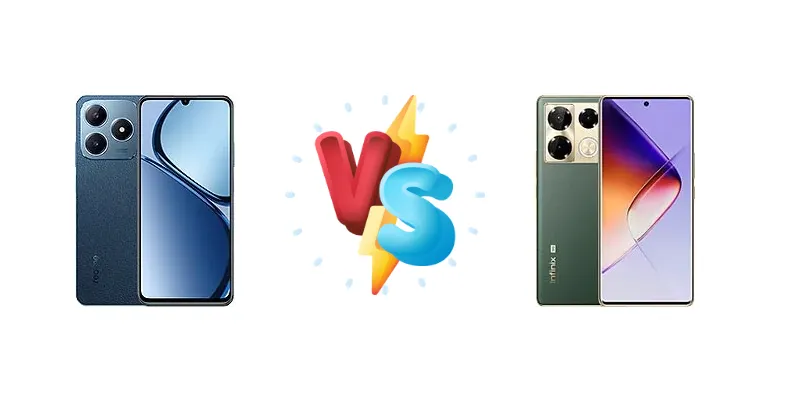
The sub-$200 smartphone market is fiercely competitive. The Realme C63 and Infinix Note 40 Pro both aim to deliver a compelling experience without breaking the bank, but they take different approaches. The C63 focuses on streamlined efficiency, while the Note 40 Pro packs in more features, including wireless charging and a more powerful chipset. This comparison dives deep into the specifics to determine which device reigns supreme.
🏆 Quick Verdict
For the average user prioritizing overall performance and future-proofing, the Infinix Note 40 Pro is the better choice. Its Mediatek Dimensity 7020 chipset offers a significant performance uplift over the Realme C63’s Unisoc Tiger T612, and the addition of 50W MagCharge wireless charging adds considerable convenience. However, the C63 remains a viable option for those on a tighter budget.
| Network |
|---|
| 2G bands | GSM 850 / 900 / 1800 / 1900 | GSM 850 / 900 / 1800 / 1900 |
| 3G bands | HSDPA 850 / 900 / 2100 | HSDPA 850 / 900 / 1700(AWS) / 1900 / 2100 |
| 4G bands | 1, 3, 5, 7, 8, 20, 28, 38, 40, 41 | 1, 2, 3, 4, 5, 7, 8, 12, 17, 20, 28, 38, 40, 41, 42, 66 |
| 5G bands | - | 1, 3, 5, 7, 8, 12, 20, 28, 38, 40, 41, 66, 77, 78 SA/NSA |
| Speed | HSPA, LTE | HSPA, LTE, 5G |
| Technology | GSM / HSPA / LTE | GSM / HSPA / LTE / 5G |
| Launch |
|---|
| Announced | 2024, May 31 | 2024, March 18 |
| Status | Available. Released 2024, June 05 | Available. Released 2024, March 19 |
| Body |
|---|
| Build | Glass front, plastic back or silicone polymer back (eco leather), plastic frame | - |
| Dimensions | 167.3 x 76.7 x 7.7 mm (6.59 x 3.02 x 0.30 in) | 164.3 x 74.5 x 8.1 mm (6.47 x 2.93 x 0.32 in) |
| SIM | Nano-SIM + Nano-SIM | Nano-SIM + Nano-SIM |
| Weight | 189 g or 191 g (6.67 oz) | 190 g or 196 g (6.70 oz) |
| Display |
|---|
| Protection | - | Corning Gorilla Glass |
| Resolution | 720 x 1600 pixels, 20:9 ratio (~260 ppi density) | 1080 x 2436 pixels (~393 ppi density) |
| Size | 6.75 inches, 110.0 cm2 (~85.7% screen-to-body ratio) | 6.78 inches, 109.9 cm2 (~89.8% screen-to-body ratio) |
| Type | IPS LCD, 90Hz, 560 nits (HBM) | AMOLED, 1B colors, 120Hz, 2160Hz PWM, 1300 nits (peak) |
| Platform |
|---|
| CPU | Octa-core (2x1.8 GHz Cortex-A75 & 6x1.8 GHz Cortex-A55) | Octa-core (2x2.2 GHz Cortex-A78 & 6x2.0 GHz Cortex-A55) |
| Chipset | Unisoc Tiger T612 (12 nm) | Mediatek Dimensity 7020 (6 nm) |
| GPU | Mali-G57 | IMG BXM-8-256 |
| OS | Android 14 | Android 14, XOS 14 |
| Memory |
|---|
| Card slot | microSDXC (dedicated slot) | Unspecified |
| Internal | 64GB 4GB RAM, 128GB 4GB RAM, 128GB 6GB RAM, 128GB 8GB RAM, 256GB 8GB RAM | 256GB 8GB RAM |
| Main Camera |
|---|
| Features | LED flash, panorama | Dual-LED flash, HDR, panorama |
| Single | 50 MP, f/1.8, (wide), 1/2.5", PDAF
Auxiliary lens | - |
| Triple | - | 108 MP, f/1.8, (wide), PDAF, OIS
2 MP, f/2.4
2 MP, f/2.4 |
| Video | 1080p@30fps | 1440p@30fps, 1080p@30/60fps |
| Selfie camera |
|---|
| Features | - | Dual-LED flash |
| Single | 8 MP, f/2.0, (wide), 1/4.0" | 32 MP, f/2.2, (wide), 1/3.1" |
| Video | 720p@30fps | 1080p@30fps |
| Sound |
|---|
| 35mm jack | Yes | No |
| Loudspeaker | Yes | Yes, with stereo speakers |
| Comms |
|---|
| Bluetooth | 5.0, A2DP, LE | Yes |
| Infrared port | - | Yes |
| NFC | Yes (market/region dependent) | Yes (market/region dependent) |
| Positioning | GPS, GALILEO, GLONASS, BDS | GPS |
| Radio | Unspecified | FM radio |
| USB | USB Type-C 2.0 | USB Type-C 2.0, OTG |
| WLAN | Wi-Fi 802.11 a/b/g/n/ac, dual-band | Wi-Fi 802.11 a/b/g/n/ac, dual-band |
| Features |
|---|
| Sensors | Fingerprint (side-mounted), accelerometer, gyro, proximity, compass | Fingerprint (under display, optical), accelerometer, gyro, proximity, compass |
| Battery |
|---|
| Charging | 45W wired | 45W wired, 50% in 26 min
20W wireless MagCharge
Reverse wired
Reverse wireless |
| Type | 5000 mAh | 5000 mAh |
| Misc |
|---|
| Colors | Leather Blue, Jade Green | Vintage Green, Titan Gold, Racing Edition |
| Models | - | X6851 |
| Price | £ 98.00 / ₹ 8,132 | About 280 EUR |
Realme C63
- More affordable price point
- Reliable for basic smartphone tasks
- 45W wired charging
- Less powerful chipset
- No wireless charging
- Potentially limited long-term performance
Infinix Note 40 Pro
- Significantly faster processor (Dimensity 7020)
- Wireless charging (MagCharge)
- Reverse wired and wireless charging
- Higher price compared to Realme C63
- May be slightly heavier due to added features
- Potential for more software bloat (typical of Infinix)
Display Comparison
Neither device boasts a standout display. While specific panel details (like peak brightness or color gamut coverage) are absent, the core difference lies in the processing power driving them. Both will likely feature LCD panels at this price point. The focus here isn't display quality, but the chipset's ability to render graphics smoothly. The Dimensity 7020 in the Infinix Note 40 Pro will provide a more responsive experience when scrolling and navigating the UI.
Camera Comparison
Without detailed camera specs beyond the main sensors, a direct comparison is difficult. However, the chipset plays a crucial role in image processing. The Dimensity 7020’s ISP (Image Signal Processor) is more advanced than the Unisoc T612’s, enabling better noise reduction, dynamic range, and overall image quality. While both phones likely include standard features like HDR and portrait modes, the Infinix Note 40 Pro will likely produce more detailed and visually appealing photos, especially in challenging lighting conditions. The presence of OIS (Optical Image Stabilization) on the Note 40 Pro, if equipped, would further enhance image quality and video stabilization.
Performance
The performance gap is the most significant differentiator. The Infinix Note 40 Pro’s Mediatek Dimensity 7020, fabricated on a 6nm process, is a substantial upgrade over the Realme C63’s 12nm Unisoc Tiger T612. The Dimensity 7020 utilizes more modern Cortex-A78 cores (2x2.2 GHz) compared to the C63’s Cortex-A75 cores (2x1.8 GHz), resulting in faster single-core and multi-core performance. This translates to quicker app loading times, smoother multitasking, and a more enjoyable gaming experience. The 6nm process also contributes to better thermal efficiency, potentially reducing throttling during sustained workloads.
Battery Life
Both phones feature 45W wired charging, but the Infinix Note 40 Pro adds the convenience of 50% charge in 26 minutes and 20W wireless MagCharge. While the Realme C63 offers fast wired charging, the Note 40 Pro’s wireless charging capability is a significant advantage for users who prefer cable-free convenience. The battery capacity is not specified for either device, but the more efficient Dimensity 7020 in the Note 40 Pro will likely result in comparable or even better battery life despite potentially having a similar capacity.
Buying Guide
Buy the Realme C63 if you need a reliable, basic smartphone for everyday tasks like calling, texting, and light social media use, and prioritize affordability above all else. Buy the Infinix Note 40 Pro if you prefer a smoother experience for multitasking, gaming, and content creation, and value the convenience of wireless charging and faster wired charging speeds. The Note 40 Pro is also the better choice for users who anticipate keeping their phone for several years.
Frequently Asked Questions
❓ Does the Mediatek Dimensity 7020 in the Infinix Note 40 Pro get hot during extended gaming sessions?
The Dimensity 7020 is fabricated on a 6nm process, which is more efficient than the 12nm Unisoc Tiger T612 in the Realme C63. This means it generates less heat under load. While some warming is inevitable during prolonged gaming, the Note 40 Pro is less likely to experience significant throttling compared to the C63.
❓ Is the 20W MagCharge wireless charging on the Infinix Note 40 Pro truly useful, or is it too slow?
20W wireless charging is a respectable speed for a budget phone. While not as fast as wired charging, it's convenient for topping up the battery overnight or during work hours. The MagCharge feature also allows for easy alignment and secure attachment to compatible accessories.
❓ How does the Unisoc Tiger T612 handle multitasking compared to the Dimensity 7020?
The Unisoc Tiger T612 is a capable processor for basic multitasking, but it will struggle with demanding applications or numerous apps running simultaneously. The Dimensity 7020, with its more powerful cores and improved architecture, offers a significantly smoother multitasking experience, allowing you to switch between apps quickly and efficiently.