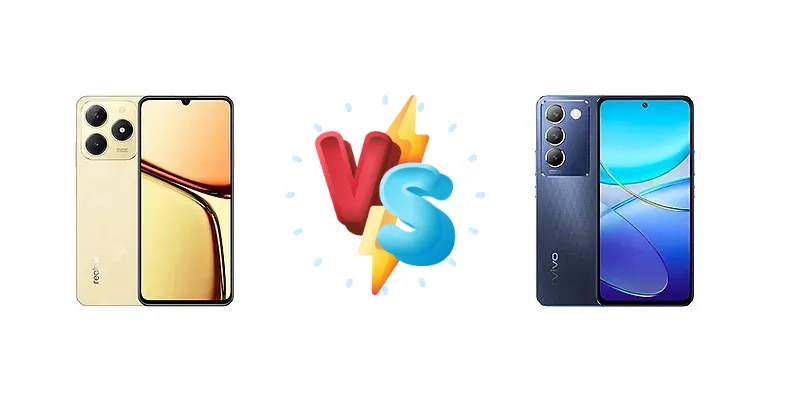
The sub-$200 smartphone market is fiercely competitive. The Realme C61, powered by a Unisoc Tiger T612, aims for affordability, while the vivo V30 SE leverages Qualcomm’s Snapdragon 4 Gen 2 for a more modern experience. This comparison breaks down the key differences to help you choose the right device for your needs.
🏆 Quick Verdict
For most users, the vivo V30 SE is the superior choice. Its Snapdragon 4 Gen 2 chipset, built on a 4nm process, delivers significantly better performance and efficiency than the Realme C61’s Unisoc T612. The 44W charging is a game-changer, offsetting the slightly higher price.
| Network |
|---|
| 2G bands | GSM 850 / 900 / 1800 / 1900 | GSM 850 / 900 / 1800 / 1900 |
| 3G bands | HSDPA 850 / 900 / 2100 | HSDPA 850 / 900 / 1700(AWS) / 1900 / 2100 |
| 4G bands | 1, 3, 5, 7, 8, 20, 28, 38, 40, 41 | 1, 2, 3, 4, 5, 7, 8, 12, 13, 17, 18, 19, 20, 26, 28, 32, 38, 40, 41, 66 |
| 5G bands | - | 1, 2, 3, 5, 7, 8, 20, 26, 28, 38, 40, 41, 66, 75, 77, 78 SA/NSA |
| Speed | HSPA, LTE | HSPA, LTE, 5G |
| Technology | GSM / HSPA / LTE | GSM / HSPA / LTE / 5G |
| Launch |
|---|
| Announced | 2024, July | 2024, May 01 |
| Status | Available. Released 2024, July 25 | Available. Released 2024, May 01 |
| Body |
|---|
| Build | Glass front, plastic frame, plastic back | Glass front, plastic or silicone polymer (eco leather) back |
| Dimensions | 167.3 x 76.7 x 7.8 mm (6.59 x 3.02 x 0.31 in) | 163.2 x 75.8 x 7.8 mm (6.43 x 2.98 x 0.31 in) |
| SIM | Nano-SIM + Nano-SIM | Nano-SIM + Nano-SIM |
| Weight | 188 g (6.63 oz) | 185.5 g or 191 g (6.56 oz) |
| Display |
|---|
| Resolution | 720 x 1600 pixels, 20:9 ratio (~260 ppi density) | 1080 x 2400 pixels, 20:9 ratio (~395 ppi density) |
| Size | 6.74 inches, 109.7 cm2 (~85.5% screen-to-body ratio) | 6.67 inches, 107.4 cm2 (~86.8% screen-to-body ratio) |
| Type | IPS LCD, 90Hz, 450 nits (typ), 560 nits (HBM) | AMOLED, 120Hz, 1200 nits (HBM), 1800 nits (peak) |
| Platform |
|---|
| CPU | Octa-core (2x1.8 GHz Cortex-A75 & 6x1.8 GHz Cortex-A55) | Octa-core (2x2.2 GHz Cortex-A78 & 6x1.95 GHz Cortex-A55) |
| Chipset | Unisoc Tiger T612 (12 nm) | Qualcomm SM4450 Snapdragon 4 Gen 2 (4 nm) |
| GPU | Mali-G57 | Adreno 613 |
| OS | Android 14, Realme UI | Android 14, Funtouch 14 |
| Memory |
|---|
| Card slot | microSDXC (dedicated slot) | microSDXC (uses shared SIM slot) |
| Internal | 64GB 4GB RAM, 128GB 4GB RAM, 128GB 6GB RAM, 128GB 8GB RAM, 256GB 6GB RAM, 256GB 8GB RAM | 256GB 8GB RAM |
| Main Camera |
|---|
| Features | LED flash, HDR, panorama | LED flash, panorama, HDR |
| Single | 50 MP, f/1.8, (wide), 1/2.5", PDAF
Auxiliary lens | - |
| Triple | - | 50 MP, f/1.8, 26mm (wide), PDAF
8 MP, f/2.2, (ultrawide)
2 MP (macro) |
| Video | 1080p@30fps | 1080p@30fps |
| Selfie camera |
|---|
| Single | 5 MP, f/2.2, 27mm (wide), 1/5.0", 1.12µm | 16 MP, f/2.0, (wide) |
| Video | 720p@30fps | 1080p@30fps |
| Sound |
|---|
| 35mm jack | Yes | No |
| Loudspeaker | Yes | Yes, with stereo speakers |
| Comms |
|---|
| Bluetooth | 5.0, A2DP, LE | 5.0, A2DP, LE |
| NFC | No | No |
| Positioning | GPS, GALILEO, GLONASS, BDS | GPS, GLONASS, GALILEO, BDS, QZSS |
| Radio | Unspecified | No |
| USB | USB Type-C | USB Type-C 2.0, OTG |
| WLAN | Wi-Fi 802.11 a/b/g/n/ac, dual-band | Wi-Fi 802.11 a/b/g/n/ac, dual-band |
| Features |
|---|
| Sensors | Fingerprint (side-mounted), accelerometer, gyro, proximity, compass | Fingerprint (under display, optical), accelerometer, gyro, proximity, compass |
| Battery |
|---|
| Charging | 15W wired | 44W wired, 50% in 25 min |
| Type | 5000 mAh | Li-Ion 5000 mAh |
| Misc |
|---|
| Colors | Sparkle Gold, Dark Green | Crystal Black, Leather Purple |
| Models | RMX3939, RMX3930 | - |
| Price | $ 109.15 / £ 79.00 / € 89.99 | About 250 EUR |
Realme C61
- Lower price point makes it very accessible.
- Functional for basic smartphone tasks.
- May offer longer standby time due to less powerful chipset (potentially).
- Unisoc T612 chipset is significantly less powerful than the Snapdragon 4 Gen 2.
- Slow 15W charging.
- Likely to struggle with demanding apps and games.
vivo V30 SE
- Snapdragon 4 Gen 2 offers superior performance and efficiency.
- 44W fast charging significantly reduces charging times.
- More future-proof chipset for software updates and app compatibility.
- Higher price compared to the Realme C61.
- May not have a dramatically better camera experience without further specs.
- Potentially slightly shorter battery life under heavy load (offset by efficiency).
Display Comparison
Neither device boasts a standout display. While specific panel details (like peak brightness or color gamut coverage) are unavailable, the focus here is on processing power, not visual fidelity. Expect typical LCD panels in this price bracket. Bezels are likely comparable, and both will prioritize cost-effectiveness over premium display features.
Camera Comparison
Without detailed camera specs, it’s difficult to make a definitive judgment. However, the chipset plays a role in image processing. The Snapdragon 4 Gen 2’s ISP (Image Signal Processor) is likely more advanced, resulting in better image quality, especially in low-light conditions. Expect both phones to feature a primary camera and potentially depth/macro sensors, but the Realme C61 will likely rely more on software processing to compensate for a potentially less capable sensor. The absence of OIS on either device suggests a reliance on software stabilization.
Performance
The core difference lies in the chipsets. The vivo V30 SE’s Qualcomm Snapdragon 4 Gen 2 (4nm) is a substantial upgrade over the Realme C61’s Unisoc Tiger T612 (12nm). The 4nm fabrication process of the Snapdragon offers significantly improved power efficiency, translating to less heat and sustained performance. The Snapdragon’s CPU configuration – 2x2.2 GHz Cortex-A78 & 6x1.95 GHz Cortex-A55 – also provides a performance edge over the Realme’s 2x1.8 GHz Cortex-A75 & 6x1.8 GHz Cortex-A55. This means faster app loading times, smoother multitasking, and a better gaming experience on the vivo.
Battery Life
While battery capacity isn’t specified, the vivo V30 SE’s 44W wired charging is a major advantage. Achieving 50% charge in just 25 minutes is a significant convenience. The Realme C61’s 15W charging is considerably slower, requiring substantially more time to fully replenish the battery. The Snapdragon 4 Gen 2’s efficiency also contributes to better battery life, potentially offsetting any capacity differences.
Buying Guide
Buy the Realme C61 if your primary need is basic smartphone functionality – calls, texts, and light social media – and you’re on an extremely tight budget. It’s a functional device for minimal usage. Buy the vivo V30 SE if you prioritize smoother performance for apps and games, faster charging, and a more future-proof chipset, even if it means spending a bit more upfront.
Frequently Asked Questions
❓ Will the Unisoc Tiger T612 in the Realme C61 struggle with popular games like PUBG Mobile?
Yes, the Unisoc Tiger T612 is a budget chipset and will likely struggle to run PUBG Mobile smoothly at high settings. You’ll likely need to lower the graphics settings significantly to achieve a playable frame rate, and even then, expect occasional stuttering. The Snapdragon 4 Gen 2 in the vivo V30 SE will provide a much more consistent gaming experience.
❓ How much faster is the 44W charging on the vivo V30 SE compared to the 15W charging on the Realme C61 in real-world use?
The difference is substantial. While exact 0-100% times aren't available, the vivo V30 SE can reach 50% charge in 25 minutes. The Realme C61’s 15W charging will likely take well over two hours to fully charge the battery. This means you can quickly top up the vivo V30 SE during short breaks, while the Realme C61 requires a much longer charging commitment.
❓ Does the Snapdragon 4 Gen 2 in the vivo V30 SE offer noticeable improvements in app loading times compared to the Realme C61?
Absolutely. The Snapdragon 4 Gen 2’s more powerful CPU and faster memory interface will result in significantly faster app loading times. Apps will launch quicker, and multitasking will feel more responsive on the vivo V30 SE. The Realme C61 will likely exhibit noticeable delays when opening and switching between apps.