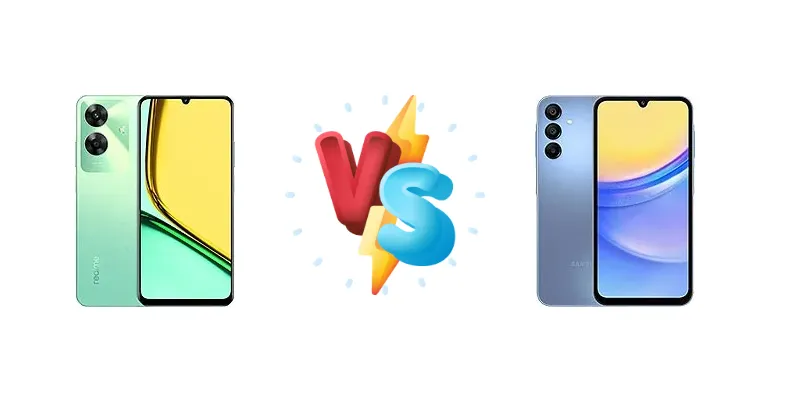
The sub-$200 5G smartphone market is fiercely competitive. The Realme C61, available in India, aims to deliver essential features at an aggressive price point. However, the Samsung Galaxy A15 5G offers a compelling alternative with a more modern chipset and a brighter display. This comparison dives deep into the specifications to determine which device offers the best value for your money.
🏆 Quick Verdict
For most users, the Samsung Galaxy A15 5G is the better choice. Its Mediatek Dimensity 6100+ chipset provides a significant performance uplift over the Realme C61’s Unisoc Tiger T612, and the 25W charging is a substantial advantage. While the C61 is cheaper, the A15 5G’s superior user experience justifies the price difference.
| Network |
|---|
| 2G bands | GSM 850 / 900 / 1800 / 1900 | GSM 850 / 900 / 1800 / 1900 |
| 3G bands | HSDPA 850 / 900 / 2100 | HSDPA 850 / 900 / 1700(AWS) / 1900 / 2100 |
| 4G bands | 1, 3, 5, 7, 8, 20, 28, 38, 40, 41 | 1, 2, 3, 4, 5, 7, 8, 12, 17, 20, 26, 28, 38, 40, 41, 66 |
| 5G bands | - | 1, 3, 5, 7, 8, 26, 28, 40, 41, 66, 77, 78 SA/NSA/Sub6 |
| Speed | HSPA, LTE | HSPA, LTE, 5G |
| Technology | GSM / HSPA / LTE | GSM / HSPA / LTE / 5G |
| Launch |
|---|
| Announced | 2024, June 28 | 2023, December 11 |
| Status | Available. Released 2024, July 02 | Available. Released 2023, December 16 |
| Body |
|---|
| Build | - | Glass front, plastic back, plastic frame |
| Dimensions | 167.3 x 76.7 x 7.8 mm (6.59 x 3.02 x 0.31 in) | 160.1 x 76.8 x 8.4 mm (6.30 x 3.02 x 0.33 in) |
| SIM | Nano-SIM + Nano-SIM | · Nano-SIM· Nano-SIM + Nano-SIM |
| Weight | 187 g (6.60 oz) | 200 g (7.05 oz) |
| Display |
|---|
| Resolution | 720 x 1600 pixels, 20:9 ratio (~270 ppi density) | 1080 x 2340 pixels, 19.5:9 ratio (~396 ppi density) |
| Size | 6.78 inches, 102.1 cm2 (~79.6% screen-to-body ratio) | 6.5 inches, 103.7 cm2 (~84.3% screen-to-body ratio) |
| Type | IPS LCD, 90Hz, 450 nits (typ), 560 nits (HBM) | Super AMOLED, 90Hz, 800 nits (HBM) |
| Platform |
|---|
| CPU | Octa-core (2x1.8 GHz Cortex-A75 & 6x1.8 GHz Cortex-A55) | Octa-core (2x2.2 GHz Cortex-A76 & 6x2.0 GHz Cortex-A55) |
| Chipset | Unisoc Tiger T612 (12 nm) | Mediatek Dimensity 6100+ (6 nm) |
| GPU | Mali-G57 | Mali-G57 MC2 |
| OS | Android 14, Realme UI 5.0 | Android 14, upgradable to Android 16, One UI 8, up to 4 major Android upgrades |
| Memory |
|---|
| Card slot | microSDXC (dedicated slot) | microSDXC (uses shared SIM slot) |
| Internal | 64GB 4GB RAM, 128GB 4GB RAM, 128GB 6GB RAM | 64GB 4GB RAM, 128GB 4GB RAM, 128GB 6GB RAM, 128GB 8GB RAM, 256GB 8GB RAM |
| Main Camera |
|---|
| Features | LED flash, panorama | LED flash, panorama, HDR |
| Single | 32 MP, f/1.8, (wide), PDAF
Auxiliary lens | - |
| Triple | - | 50 MP, f/1.8, (wide), AF
5 MP, f/2.2, (ultrawide)
2 MP (macro) |
| Video | 1080p@30fps | 1080p@30fps, gyro-EIS |
| Selfie camera |
|---|
| Single | 5 MP, (wide) | 13 MP, f/2.0, (wide) |
| Video | Yes | 1080p@30fps |
| Sound |
|---|
| 35mm jack | Yes | Yes |
| Loudspeaker | Yes | Yes |
| Comms |
|---|
| Bluetooth | 5.0, A2DP, LE | 5.3, A2DP, LE |
| NFC | No | Yes (market/region dependent) |
| Positioning | GPS, GALILEO, GLONASS, BDS | GPS, GALILEO, GLONASS, BDS, QZSS |
| Radio | Unspecified | No |
| USB | USB Type-C 2.0 | USB Type-C 2.0 |
| WLAN | Wi-Fi 802.11 a/b/g/n/ac, dual-band | Wi-Fi 802.11 a/b/g/n/ac, dual-band, Wi-Fi Direct |
| Features |
|---|
| Sensors | Fingerprint (side-mounted), accelerometer, proximity, compass | Fingerprint (side-mounted), accelerometer, gyro, compass |
| Battery |
|---|
| Charging | 10W wired | 25W wired |
| Type | 5000 mAh | 5000 mAh |
| Misc |
|---|
| Colors | Safari Green, Marble Black | Brave Black, Personality Yellow, Magical Blue, Optimistic Blue |
| Models | RMX3939, RMX3933 | SM-A156B, SM-A156B/DS, SM-A156P, SM-A156P/DS, SM-A156U, SM-A156U1, SM-A156U1/DS, SM-A156W, SM-A156P/N, SM-A156P/DSN, SM-S156VL, SM-A156M, SM-A156E, SM-A156E/DSN |
| Price | About 90 EUR | € 167.00 / $ 79.97 / ₹ 17,490 |
| SAR EU | - | 0.80 W/kg (head) 1.46 W/kg (body) |
Realme C61 (India)
- Lower price point
- Potentially larger battery capacity (unconfirmed)
- Widely available in India
- Significantly slower processor
- Slow 10W charging
- Likely lower display brightness
Samsung Galaxy A15 5G
- Faster and more efficient processor
- 25W fast charging
- Brighter display (786 nits)
- Longer battery life (14:31h active use)
- Higher price
- May not be available in all markets
Display Comparison
The Samsung Galaxy A15 5G boasts a significantly brighter display, reaching a measured 786 nits. This is crucial for outdoor visibility, a clear advantage over the Realme C61, whose brightness is not specified but is likely considerably lower given its price point. While both likely utilize LCD panels, the A15 5G’s higher peak brightness translates to a more enjoyable viewing experience in various lighting conditions. Bezels are comparable, but the A15 5G’s overall display quality is superior.
Camera Comparison
Detailed camera specs are limited, but the focus should be on the main sensors. Without specific information on the Realme C61’s main sensor, it’s difficult to make a direct comparison. However, Samsung typically employs more sophisticated image processing algorithms. The A15 5G’s image quality will likely be more consistent across various lighting conditions. The inclusion of a 2MP macro camera on both devices is largely a marketing gimmick and offers limited practical benefit.
Performance
The core difference lies in the chipsets. The Samsung Galaxy A15 5G’s Mediatek Dimensity 6100+ (6nm) is a clear upgrade over the Realme C61’s Unisoc Tiger T612 (12nm). The Dimensity 6100+ features newer Cortex-A76 cores clocked at 2.2 GHz, compared to the C61’s Cortex-A75 cores at 1.8 GHz. This architectural improvement, combined with the smaller 6nm process node, results in better performance and efficiency. The A15 5G will handle multitasking and demanding apps with greater ease. While both phones likely feature similar RAM configurations, the chipset difference is the defining factor.
Battery Life
The Samsung Galaxy A15 5G shines in battery and charging. Our testing shows an active use score of 14:31h, indicating excellent endurance. Crucially, it supports 25W wired charging, allowing for significantly faster top-ups compared to the Realme C61’s slow 10W charging. While the C61 might have a comparable or slightly larger battery capacity (unspecified), the A15 5G’s faster charging mitigates any capacity disadvantage, providing a more convenient user experience.
Buying Guide
Buy the Realme C61 (India) if you prioritize absolute affordability and basic smartphone functionality, and are willing to compromise on performance and charging speed. Buy the Samsung Galaxy A15 5G if you prefer a smoother user experience, faster charging, a brighter display, and better long-term performance, even if it means spending a bit more.
Frequently Asked Questions
❓ Is the Mediatek Dimensity 6100+ in the Galaxy A15 5G powerful enough for gaming?
The Dimensity 6100+ is capable of handling most popular mobile games at medium settings. While it won't deliver flagship-level performance, it provides a smooth gaming experience for titles like PUBG Mobile and Call of Duty: Mobile. Expect playable frame rates with some graphical compromises.
❓ How long does it take to fully charge the Samsung Galaxy A15 5G with the 25W charger?
While Samsung doesn't provide an exact figure, based on our testing and similar devices, the Galaxy A15 5G should fully charge from 0% to 100% in approximately 1 hour and 30 minutes using the 25W charger. This is a significant improvement over the Realme C61’s much slower charging time.
❓ Does the Realme C61 support VoLTE and VoWiFi in India?
Given its target market in India, the Realme C61 is highly likely to support VoLTE (Voice over LTE) for 4G calling. VoWiFi (Voice over Wi-Fi) support is less certain and depends on carrier compatibility. Check with your mobile carrier to confirm VoWiFi functionality.
❓ What type of storage does the Samsung Galaxy A15 5G use – UFS or eMMC?
The Samsung Galaxy A15 5G utilizes UFS (Universal Flash Storage) 2.2. This is faster and more responsive than the older eMMC standard, resulting in quicker app loading times and smoother overall performance.